Stage 1
BeginnerSentence Roles
Learn how particles show the topic, subject, object, destination, and place of an action.
Learn grammar with clear explanations, learning objectives, key vocabulary, worksheet previews, and printable Korean PDFs.
Beginner grammar course
Start with noun roles, build polite sentences, add time and intention, and then connect ideas. Complete each lesson before using its printable review.
Stage 1
BeginnerLearn how particles show the topic, subject, object, destination, and place of an action.
Stage 2
BeginnerBuild conversational sentences and then move the same idea into the past.
Stage 3
Upper Beginner FoundationExpress what you want to do and what you can or cannot do.
Stage 4
Upper Beginner FoundationJoin actions and descriptions so your Korean is no longer limited to one-clause sentences.
State the pattern's main meaning in one plain sentence.
Check what attaches to a noun or verb stem.
Compare the closest pattern that beginners confuse with it.
Say and write one sentence about your real life.
Correct mistakes, then try the same form again the next day.
Topic or contrast vs focused grammatical subject
Destination, time, or static location vs place of an action
Polite present vs polite past
Desire to do vs ability or possibility
Simple connection vs result or consequence
Visual formula
Place + 에서 + action verb
저는 도서관에서 공부해요.
I study at the library.
어디에서 공부해요?
Where do you study?
The action 공부해요 happens at the library, so 에서 is natural. Use 에 with a destination: 도서관에 가요.
Use more than multiple choice. A learner understands a pattern when they can recognize, choose, correct, say, and write it.
Underline the target form and explain its job.
Select between two similar particles from sentence meaning.
Find one unnatural marker or ending and repair it.
Answer a personal question with the target pattern.
Create a new sentence without copying the model.
Find the grammar inside a short dialogue or paragraph.
Your checks are saved on this device.
0% complete
Complete: 저___ 학생이에요.
는
Complete: 물___ 마셔요.
을
Complete: 집___ 공부해요.
에서
Change 먹어요 to polite past.
먹었어요
Say: I want to go.
가고 싶어요.
Say: I can read Hangul.
한글을 읽을 수 있어요.
Start with basic sentence order and the topic, subject, and object particles. Then learn the polite present ending before adding tense and longer expressions.
Particles show the role or relationship of a noun. They help listeners understand topic, subject, object, location, direction, and other meanings even when context changes the word order.
Not completely. Both can follow a noun, but they organize information differently. 은/는 frames a topic or contrast, while 이/가 identifies or focuses the subject.
Learn a short rule, compare examples, and produce your own sentence. Repeated use is more effective than memorizing a long explanation without context.
Yes, especially in casual speech when the meaning is obvious. Beginners should first learn the complete marked sentence so they understand what is being omitted.
Study the rule, visual formula, comparison, and examples first. Use the worksheet afterward to test whether you can choose and produce the form independently.
Clear Korean grammar guides for particles, endings, connectors, ability expressions, and sentence practice.
Each page is built as a learning resource, not just a PDF link. Read the lesson first, preview the worksheet, and then print the PDF for active practice.
A short explanation of the topic and why it matters.
Clear goals for learners, parents, and teachers.
Korean, romanization, and English meaning in one table.
Nearby lessons to continue studying without guessing.
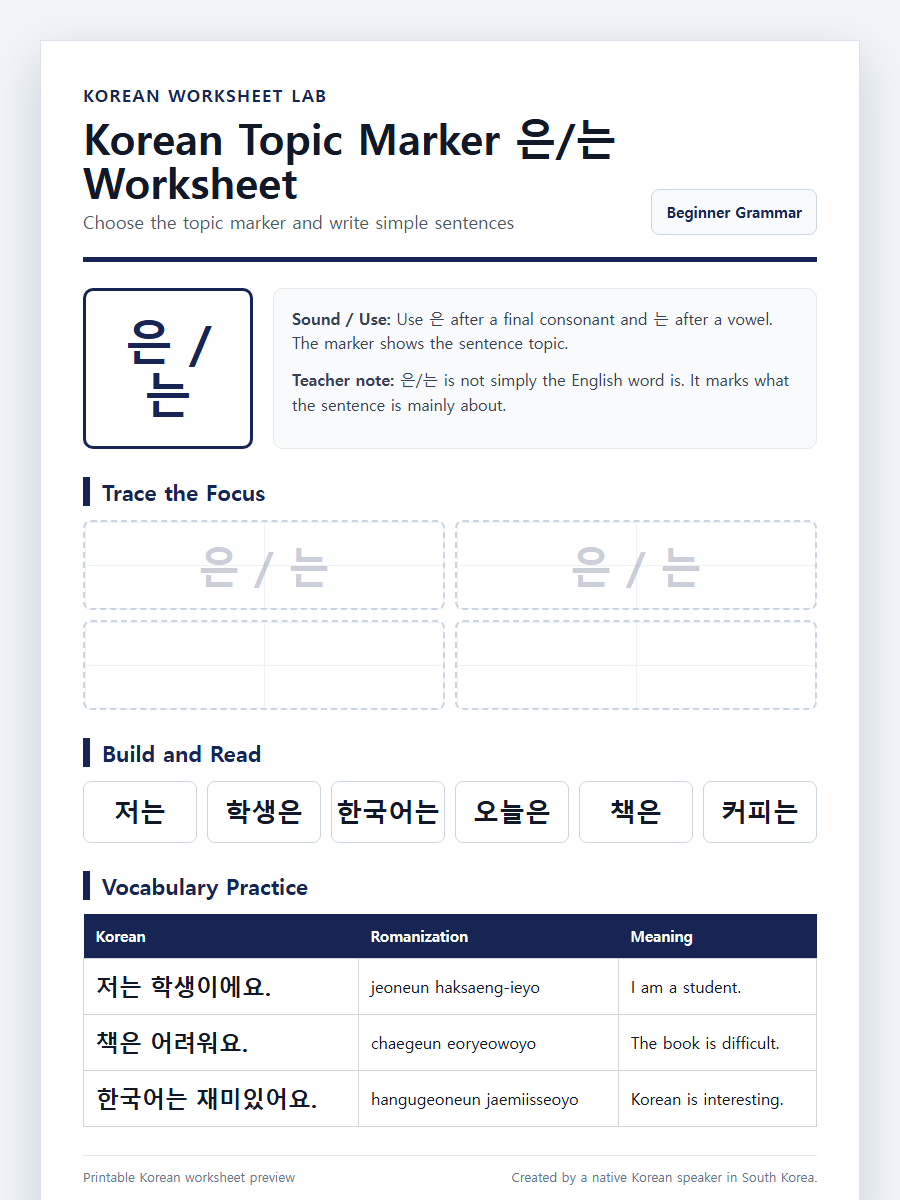
Use 은/는 to introduce, continue, or contrast the topic of a Korean sentence.
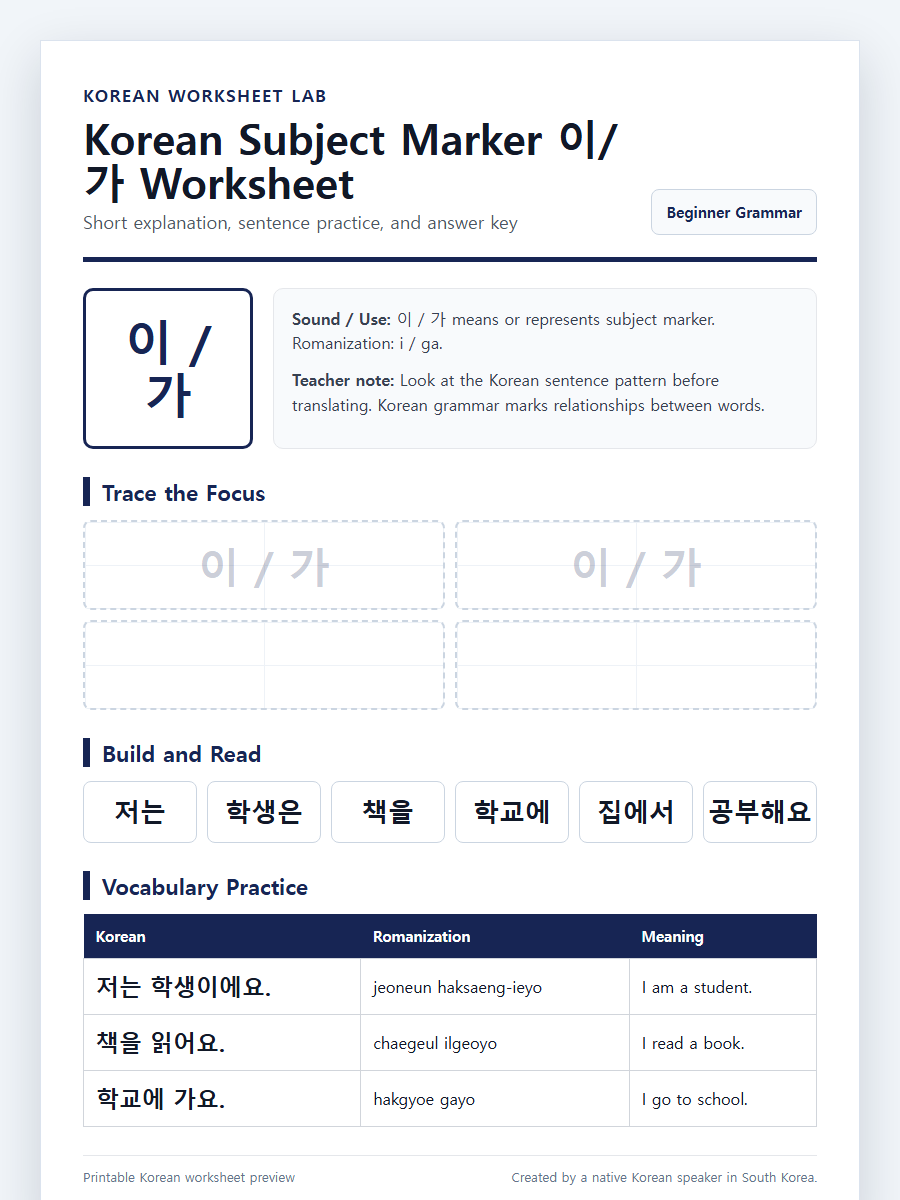
Use 이/가 when the subject is new, emphasized, identified, or directly described.
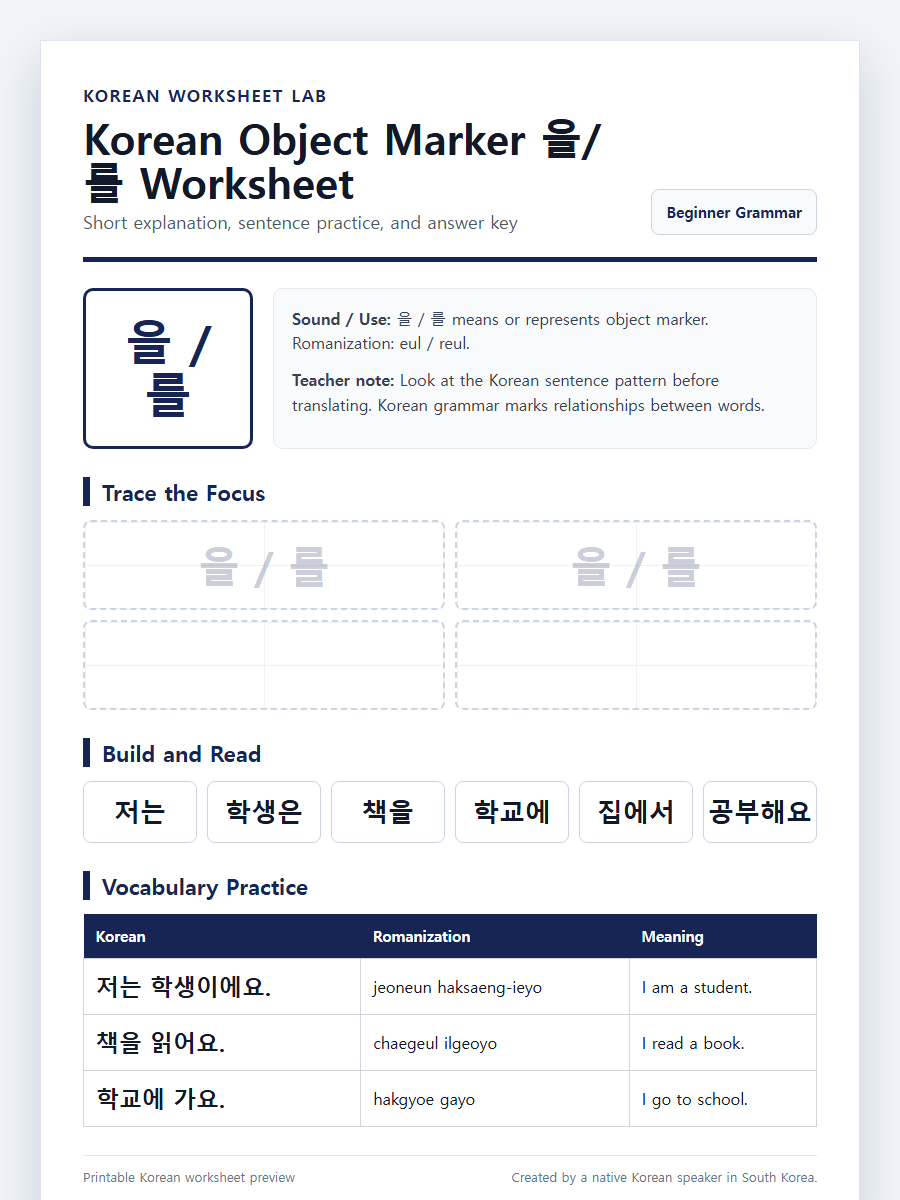
Use 을/를 after the noun that receives the action of a Korean verb.
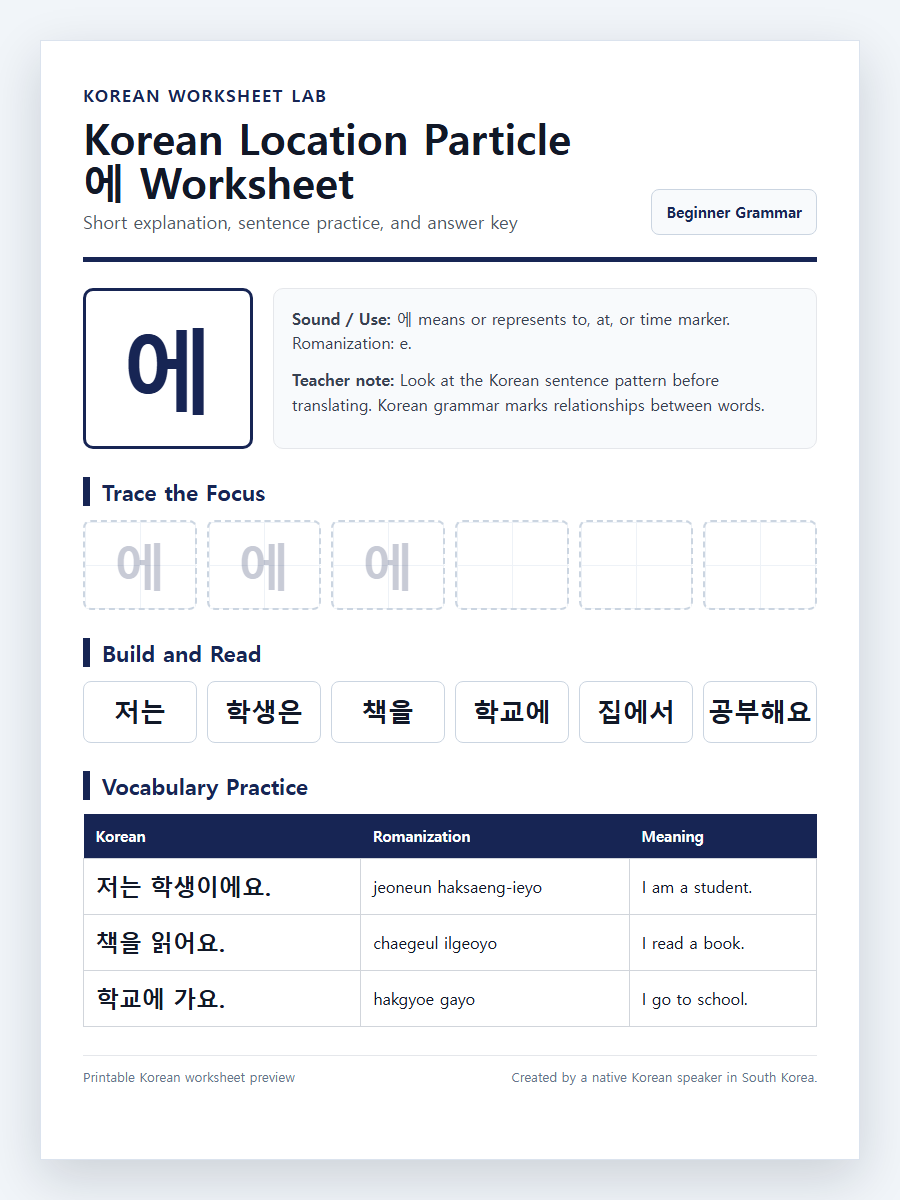
Use 에 for destinations, time, and static location in beginner Korean sentences.
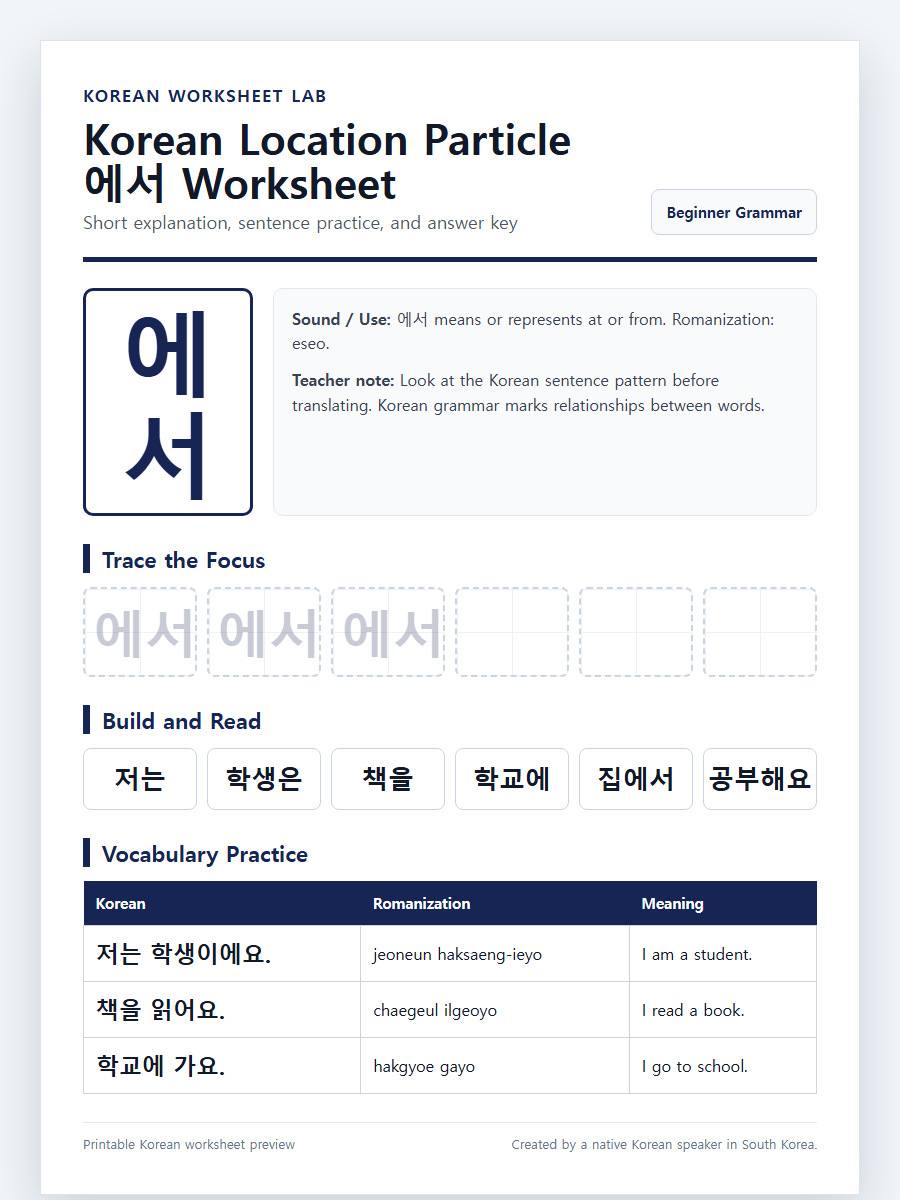
Use 에서 for actions happening in a place or movement starting from a place.
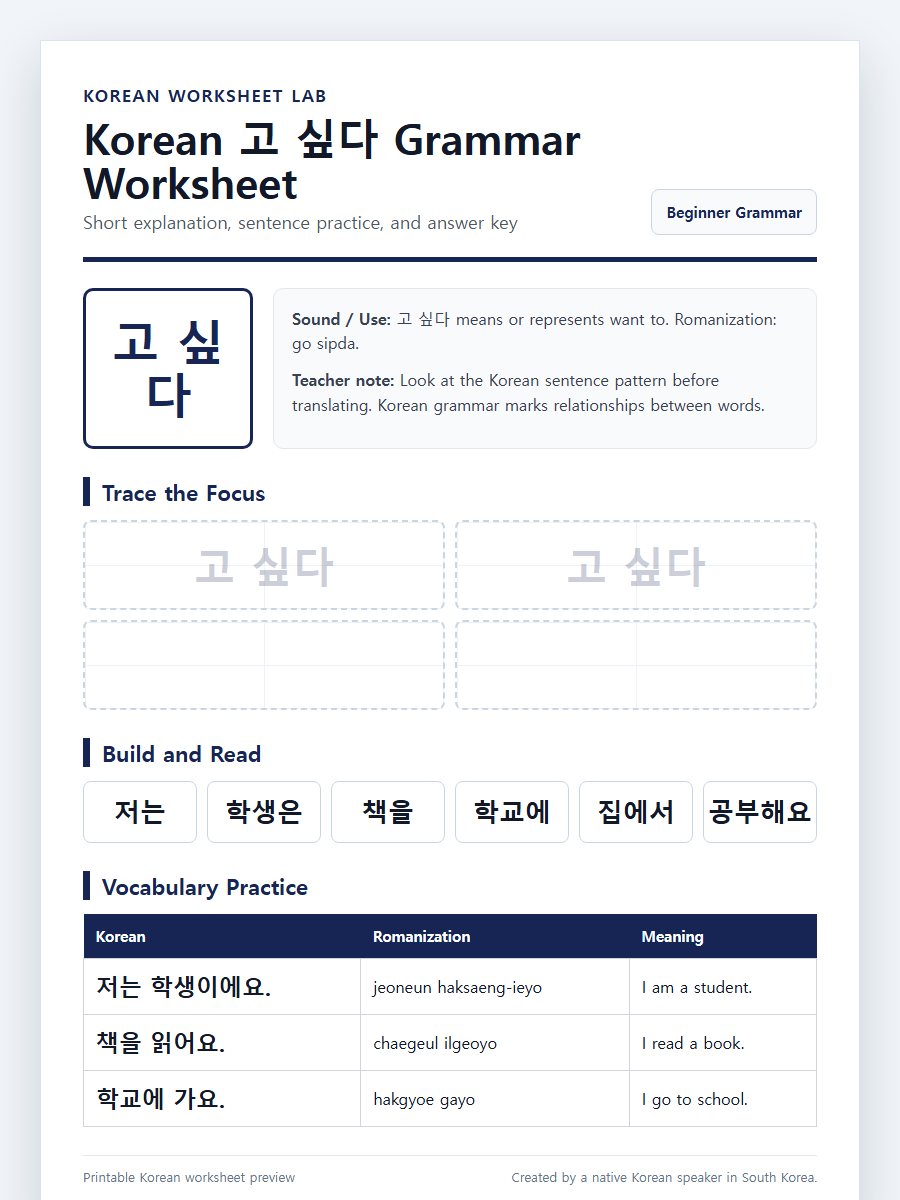
Attach 고 싶다 to a verb stem to express what someone wants to do.
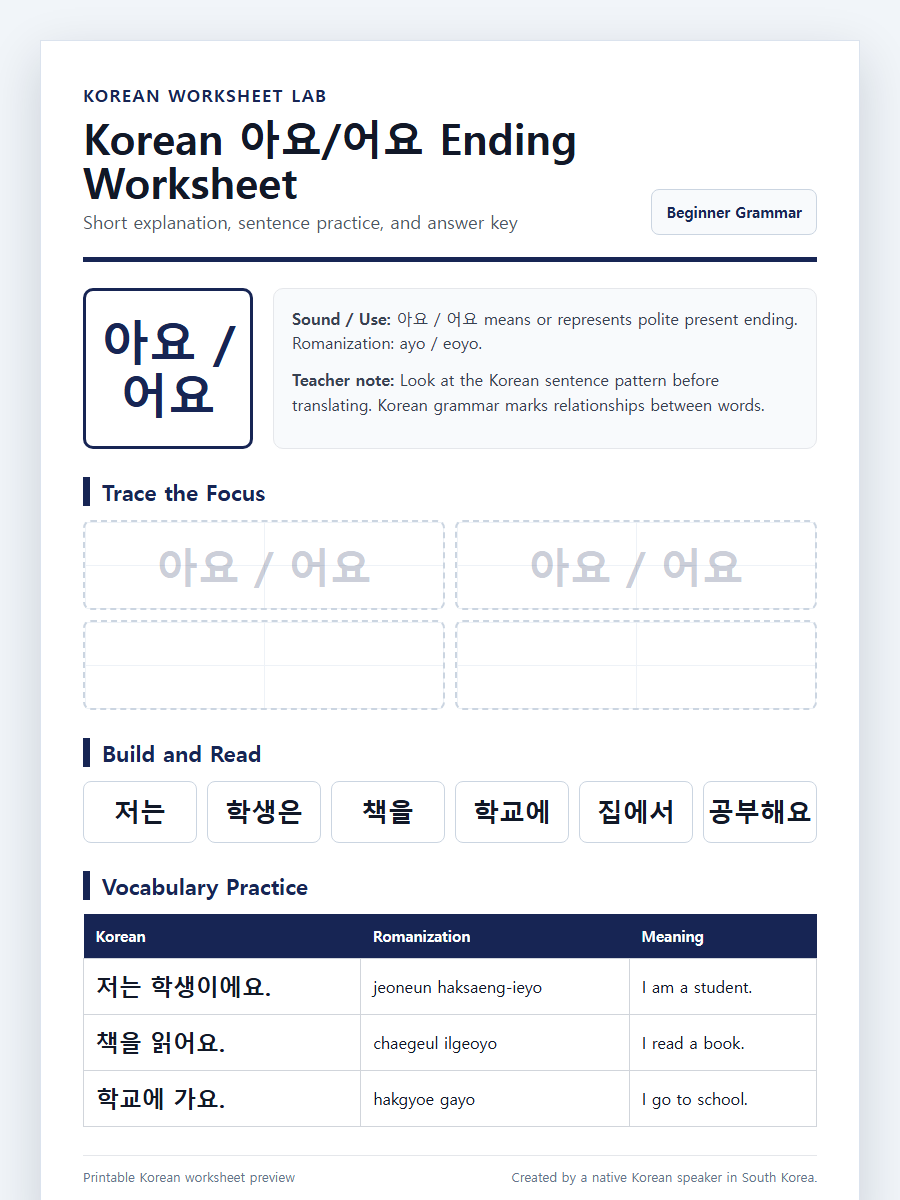
Use 아요/어요 to make polite everyday present-tense Korean sentences.
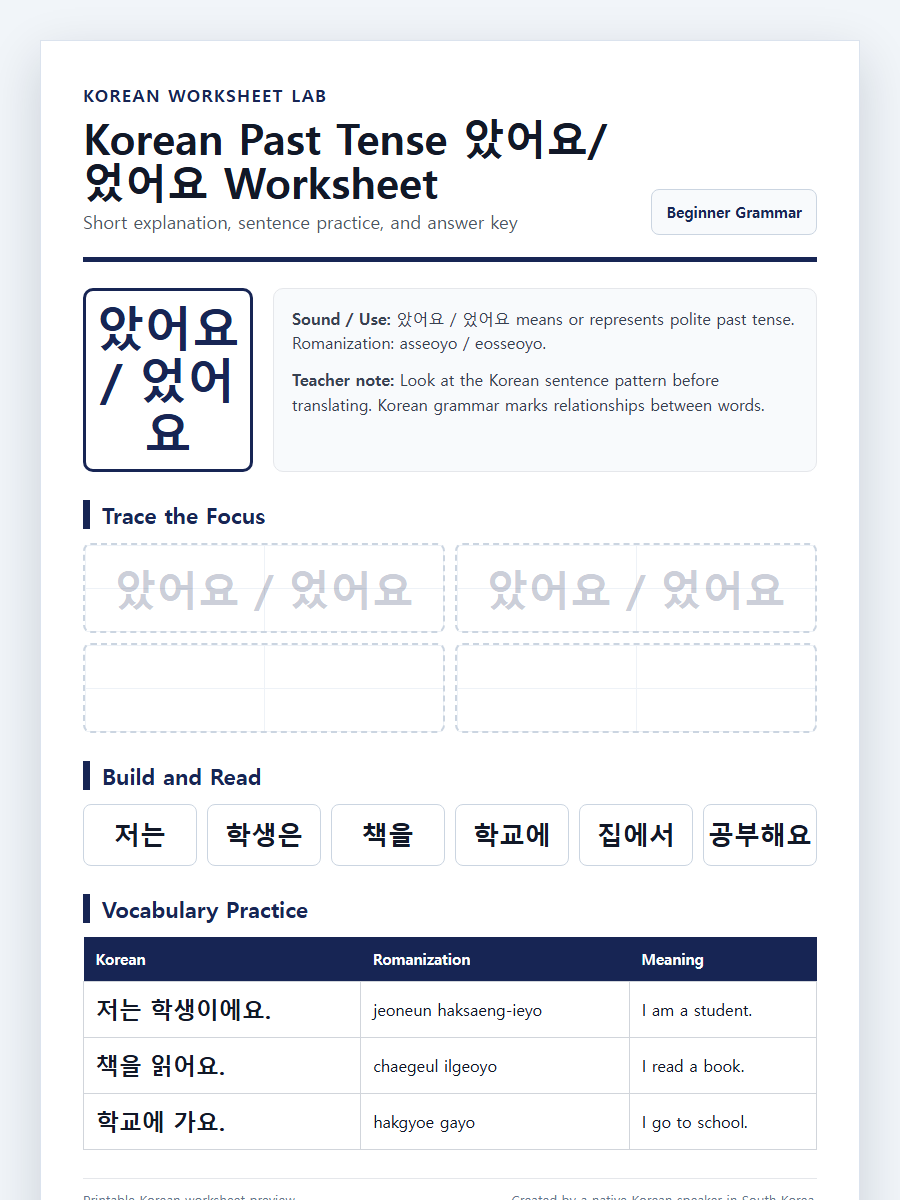
Make polite past tense forms from common Korean verb stems.
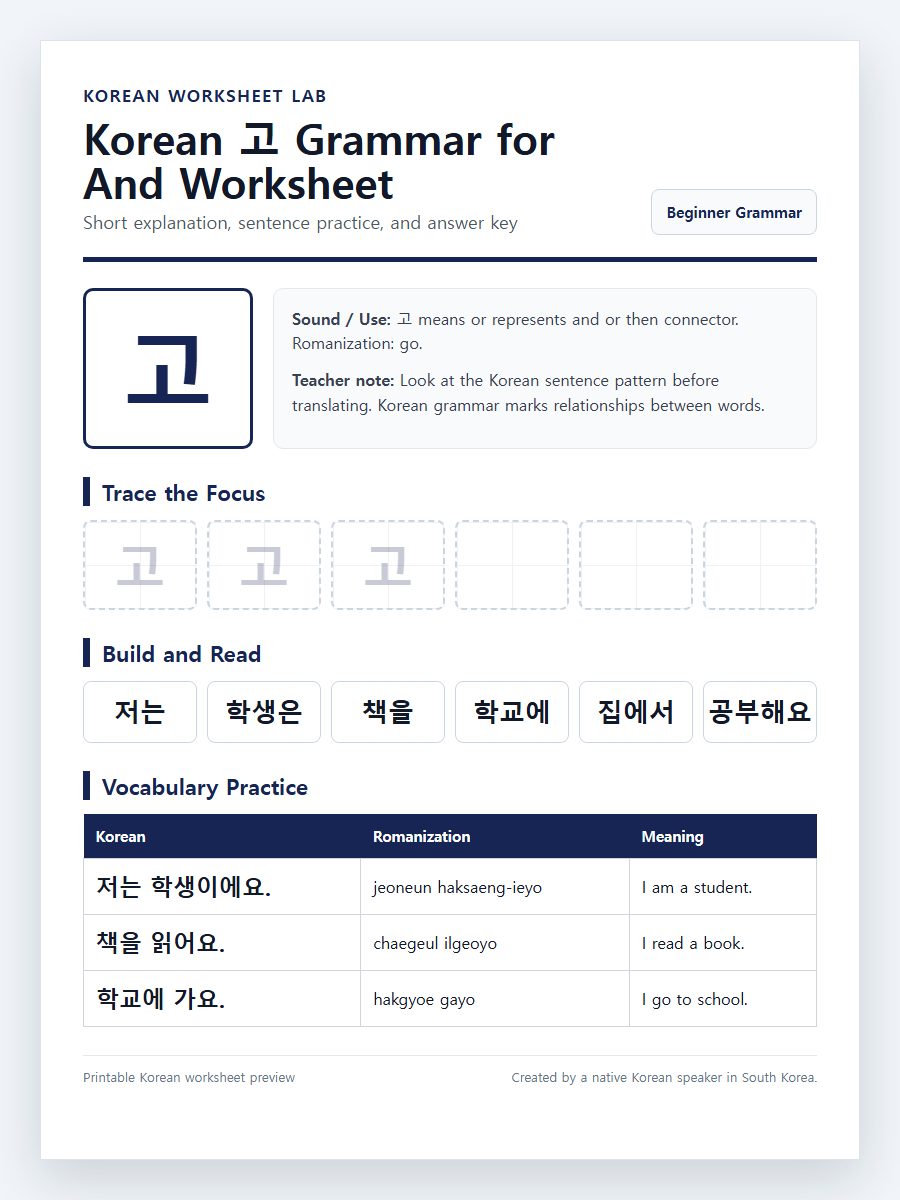
Connect actions or descriptions with 고 to show and, then, or a natural sequence.
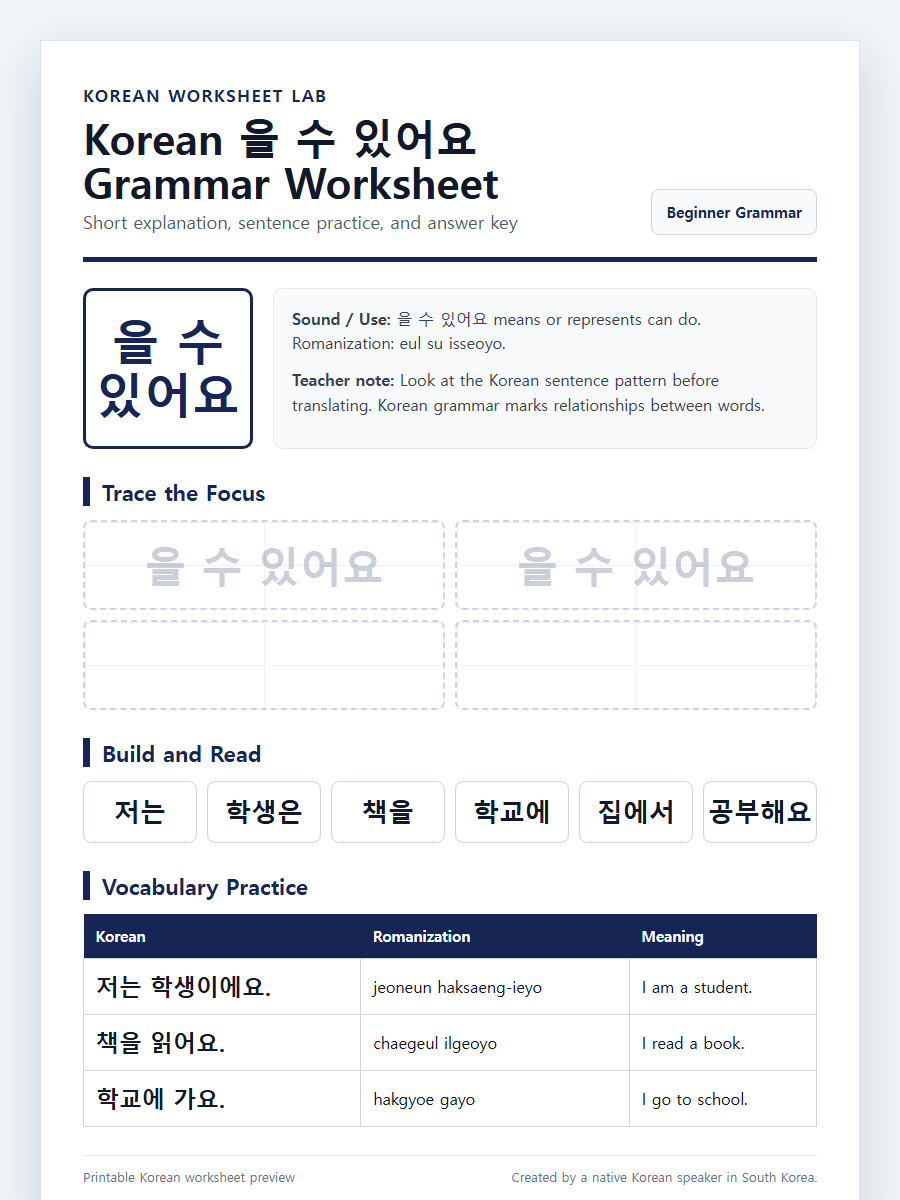
Use 을 수 있어요 to talk about ability or possibility in polite Korean.