P1
P2Korean Consonants Worksheet: Trace and Write Hangul Letters
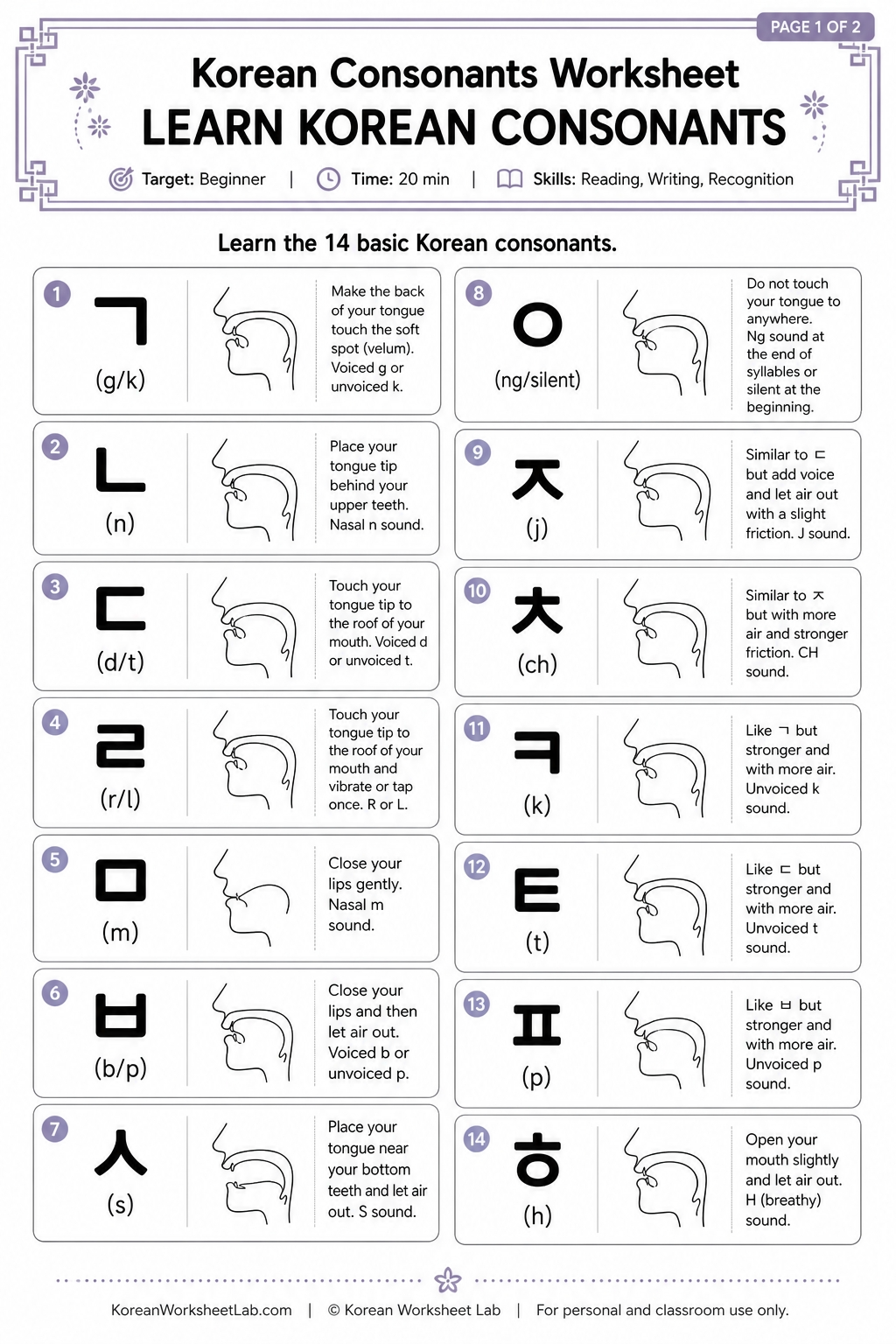
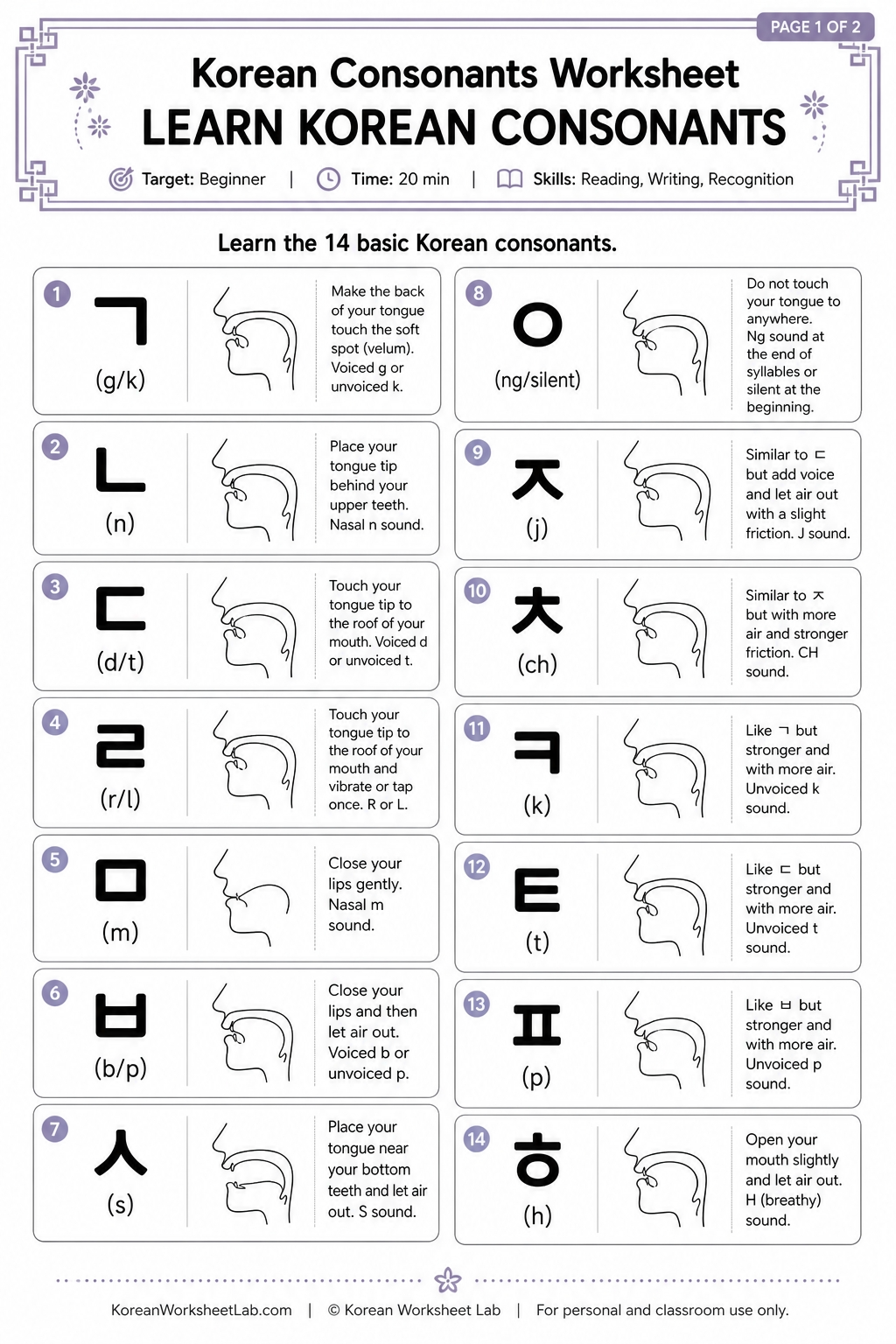
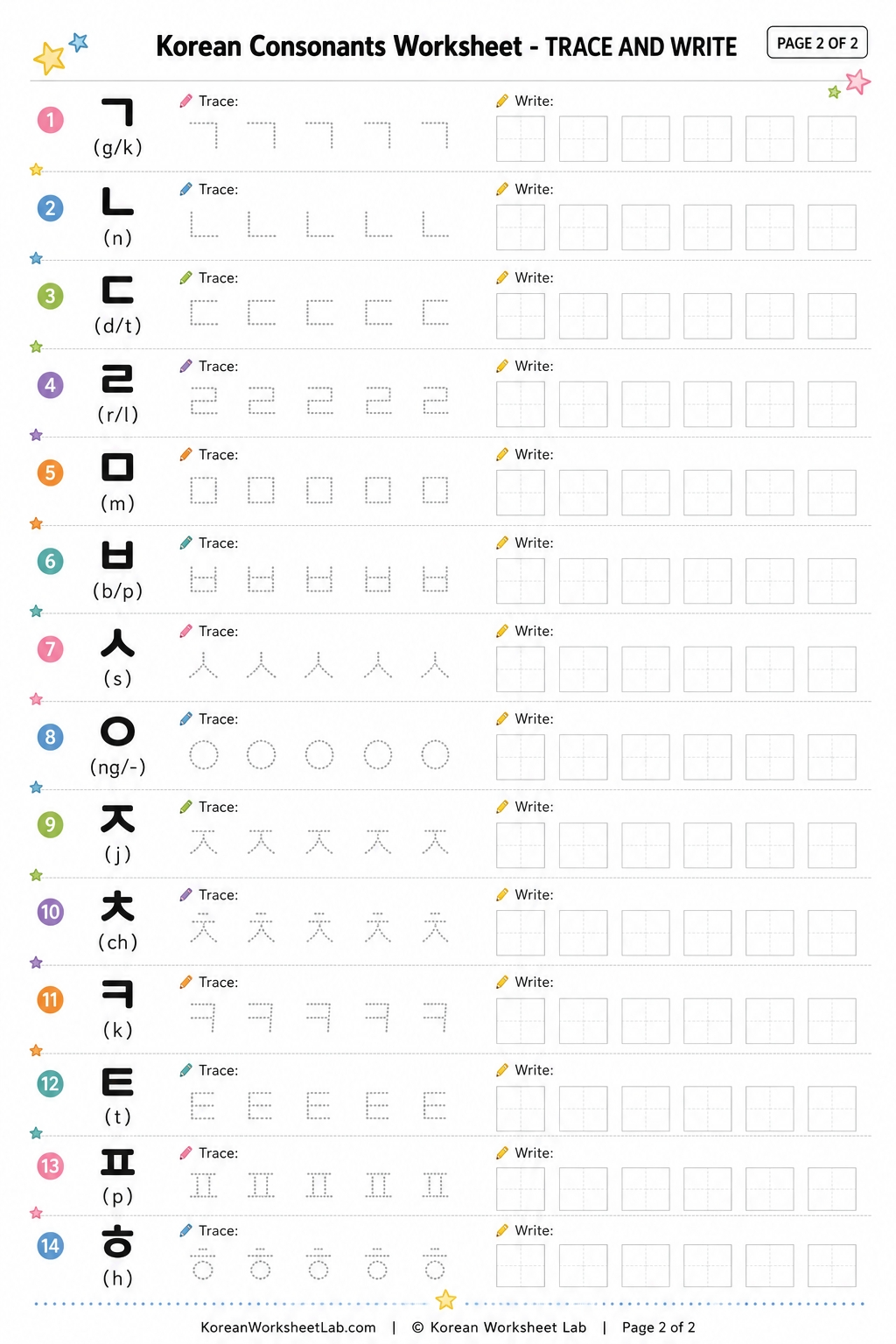
Learn the 14 basic Korean consonants with pronunciation notes, mouth-position guidance, tracing practice, writing boxes, and a printable Hangul consonants PDF for beginners.
Korean Education Resource Hub
A structured Korean learning path for beginners: Hangul, greetings, numbers, basic grammar, reading practice, worksheets, and culture.
12-week beginner roadmap
This roadmap gives complete beginners a practical sequence. Progress depends on study time and previous language experience, so use the weeks as a guide rather than a promise of fluency.
Weeks 1-2
Learn basic vowels and consonants, build syllable blocks, and practice reading short sound combinations without depending on romanization.
Open resourcesWeeks 3-4
Study greetings, numbers, days, time, family words, and the polite 아요/어요 sentence ending.
Open resourcesWeeks 5-8
Combine vocabulary with topic, subject, object, location, and direction particles in short daily-life sentences.
Open resourcesWeeks 9-12
Use short dialogues, graded reading, writing prompts, and review worksheets to move from recognition to independent answers.
Open resourcesA steady 20-30 minute routine is more useful than downloading a large packet once a month. Keep each week centered on one lesson topic.
Day 1
Learn
Read one explanation and study five to eight target forms.
Day 2
Recognize
Cover the English and identify the Korean before checking.
Day 3
Write
Complete one worksheet page slowly and correct letter spacing.
Day 4
Read aloud
Repeat examples and one short dialogue without rushing.
Day 5
Use
Create three original labels, phrases, or beginner sentences.
Day 6
Review
Redo only missed items and compare them with the answer support.
Day 7
Rest or listen
Take a break or notice familiar Korean in real media.
Month 1
Read basic Hangul and introduce yourself with memorized beginner phrases.
Month 2
Use core vocabulary and particles in short present-tense sentences.
Month 3
Read brief dialogues, answer comprehension questions, and write a simple daily-life paragraph.
Korean takes sustained practice. These milestones describe a useful beginner foundation, not a fixed completion time.
Use it briefly, then cover it and return to Hangul.
Finish and review one focused resource before downloading another.
Attach each new word to a phrase, sentence, picture, or personal example.
A short review after one day and one week is more useful than one long session.
This path is built for adult beginners who want a clear order instead of a random pile of PDFs. Start with Hangul, move into greetings and numbers, then use everyday vocabulary and short conversation practice.
Each recommended resource opens a full lesson page with explanations, examples, a worksheet preview, and a printable PDF. The goal is to help learners understand the material before they print anything.
Learn Hangul sounds and syllable blocks before memorizing long vocabulary lists.
Read the Korean aloud, use romanization only as support, then write or answer the worksheet.
Return to the same topic after one or two days and repeat only the hardest section.
Use related lessons to continue from alphabet study into real beginner Korean.
P1
P2Learn the 14 basic Korean consonants with pronunciation notes, mouth-position guidance, tracing practice, writing boxes, and a printable Hangul consonants PDF for beginners.
P1
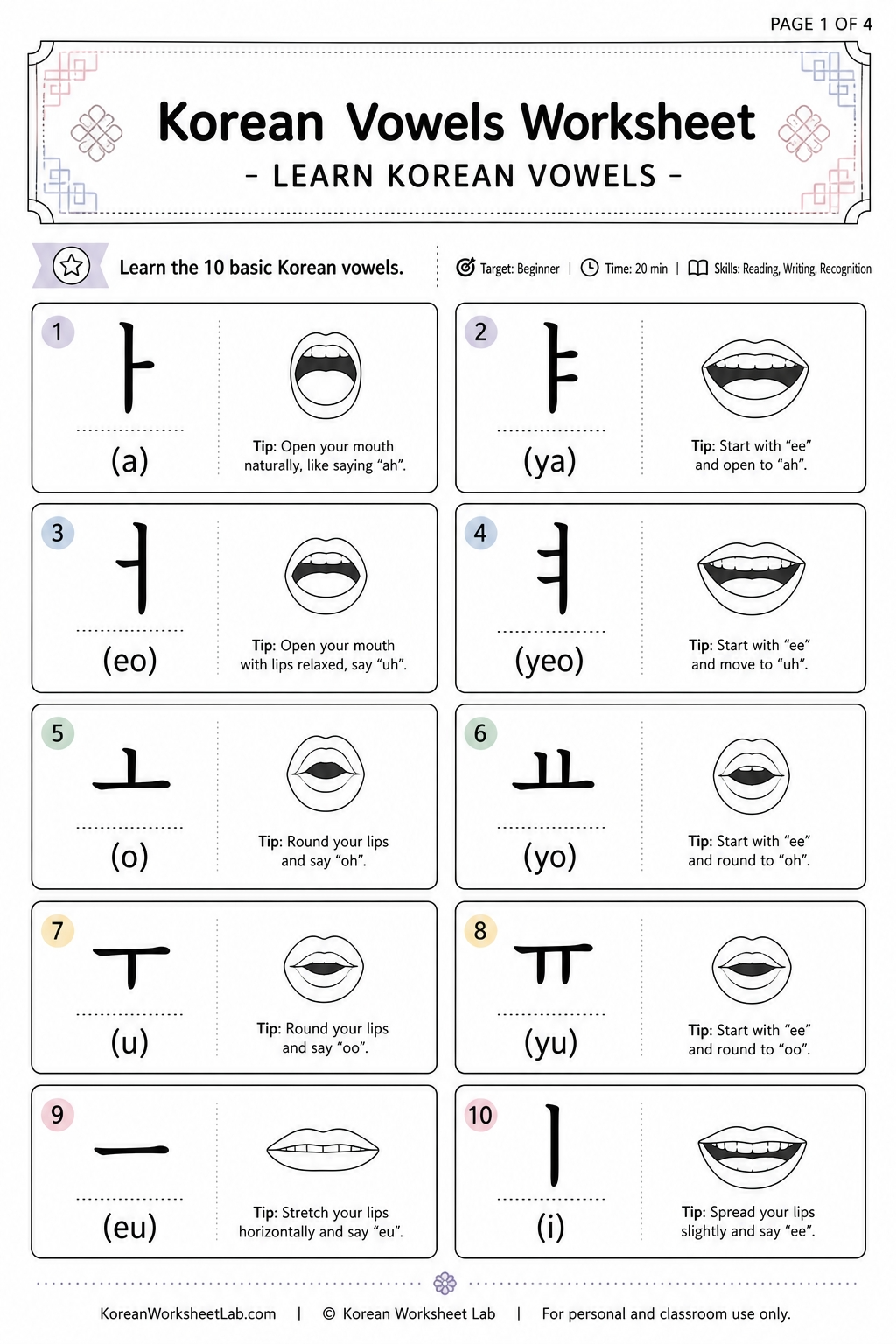
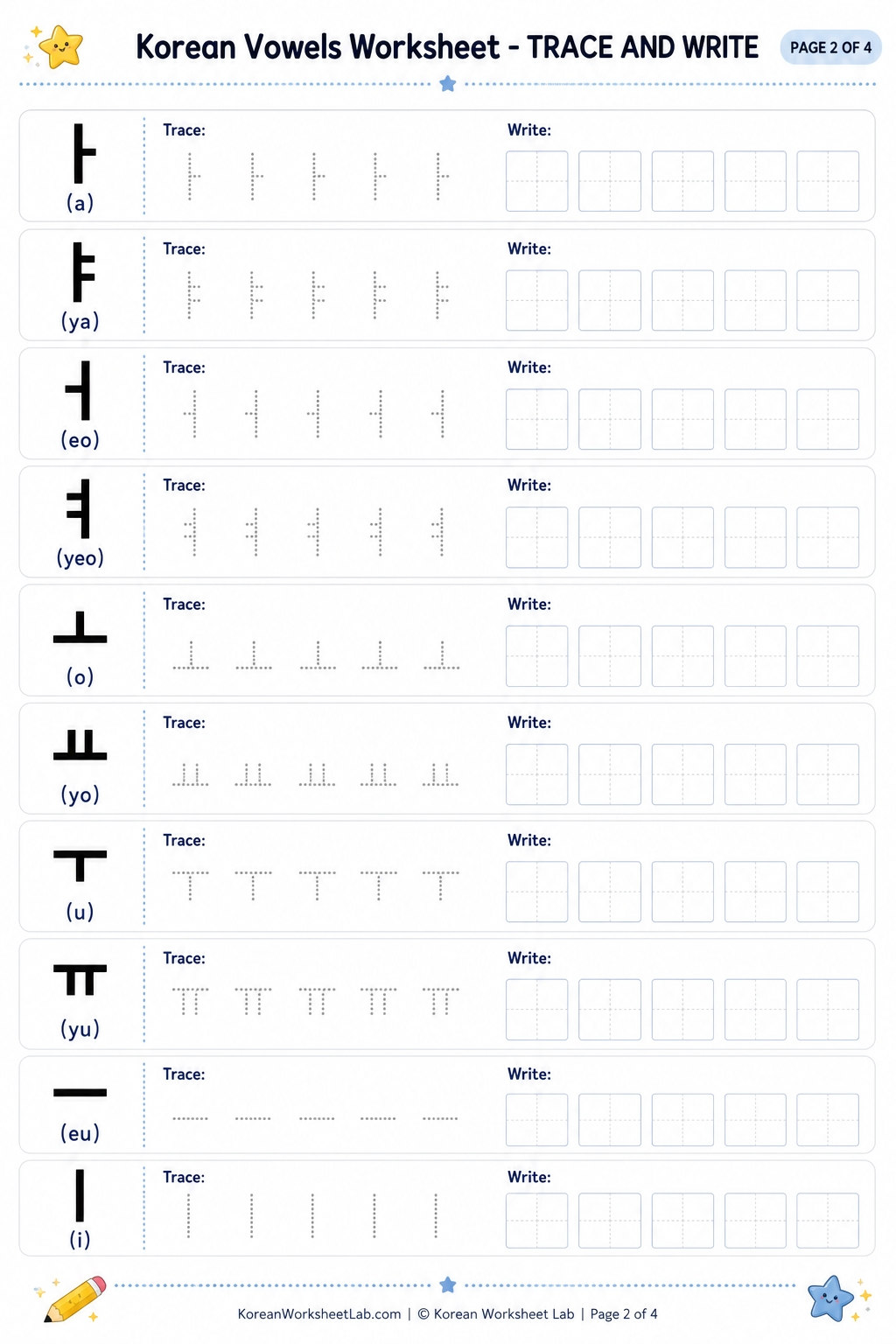
P2Learn the 10 basic Korean vowels with mouth-shape tips, beginner pronunciation notes, tracing practice, writing boxes, and a printable Hangul vowels PDF.

Download a Korean alphabet PDF in English with Hangul consonants, vowels, syllable blocks, kids tracing pages, and printable practice previews.

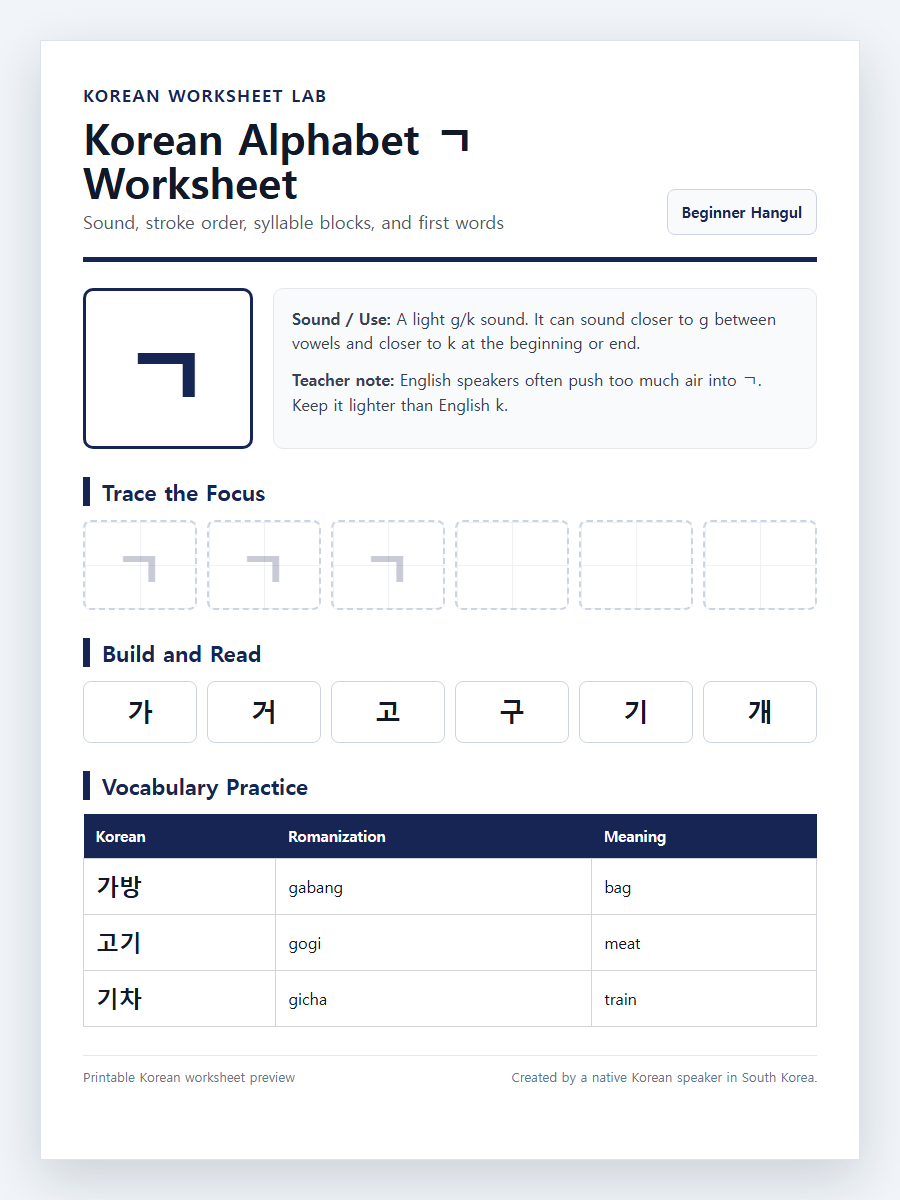
Learn the Korean consonant ㄱ with pronunciation guidance, stroke order practice, syllable building, and a printable worksheet.

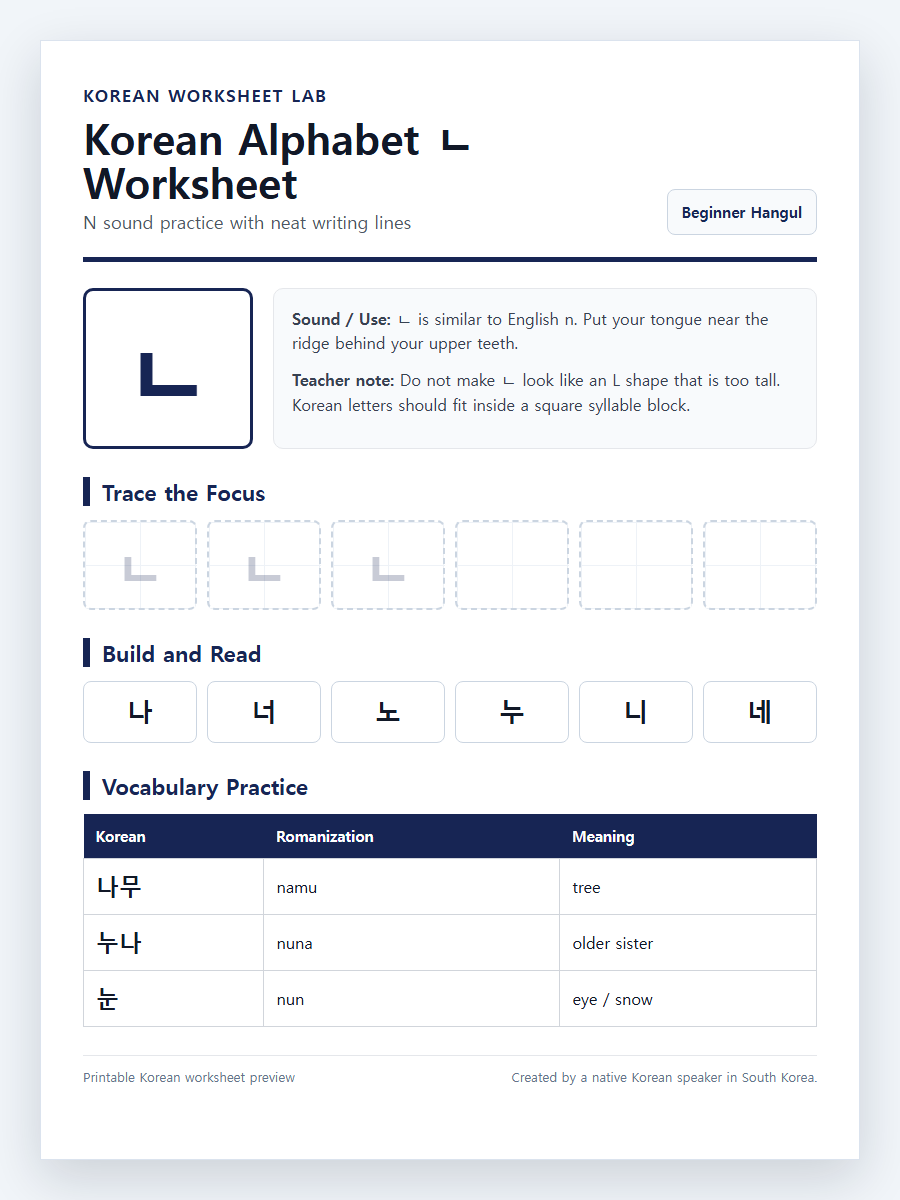
Practice ㄴ as a clean n sound and combine it with vowels to read beginner Korean syllables.

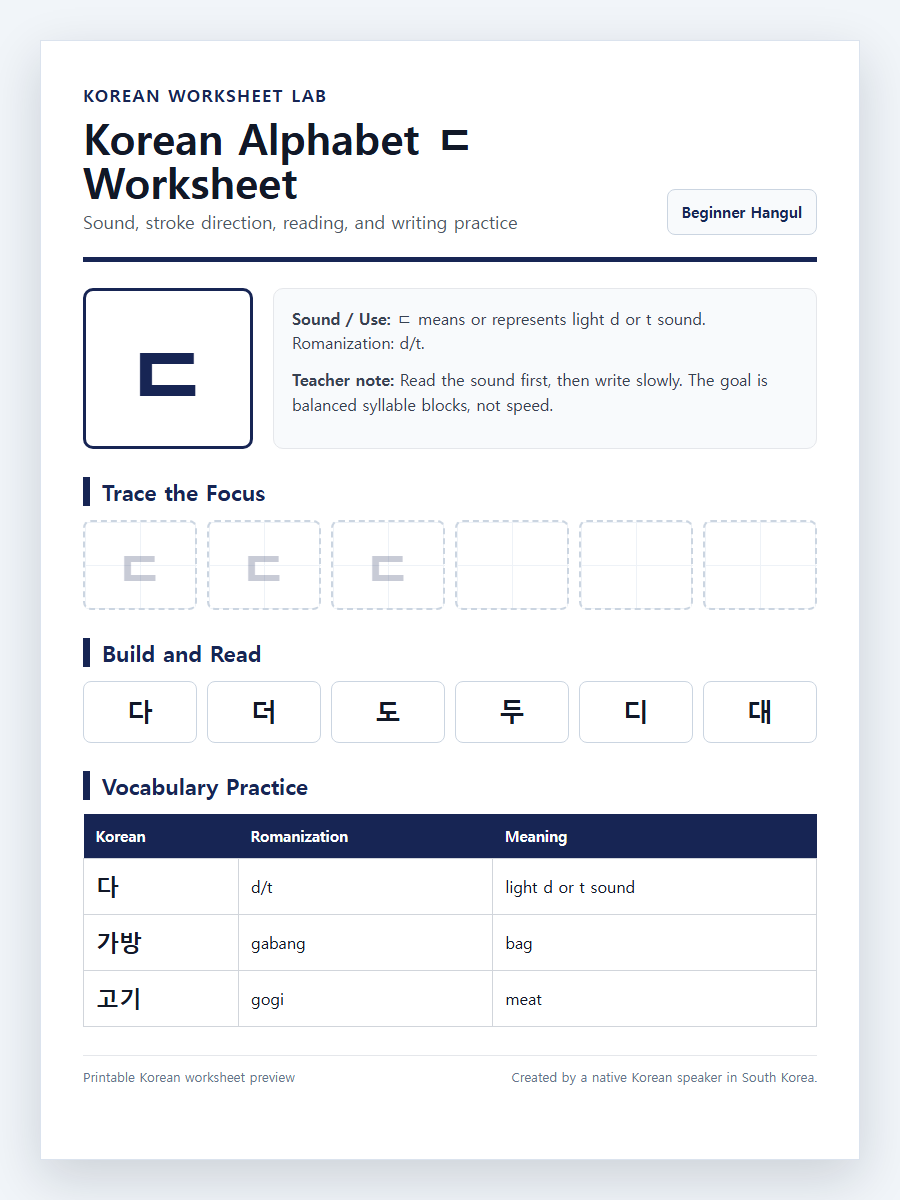
Study ㄷ with writing practice, sound notes, and useful Korean syllables for early reading.

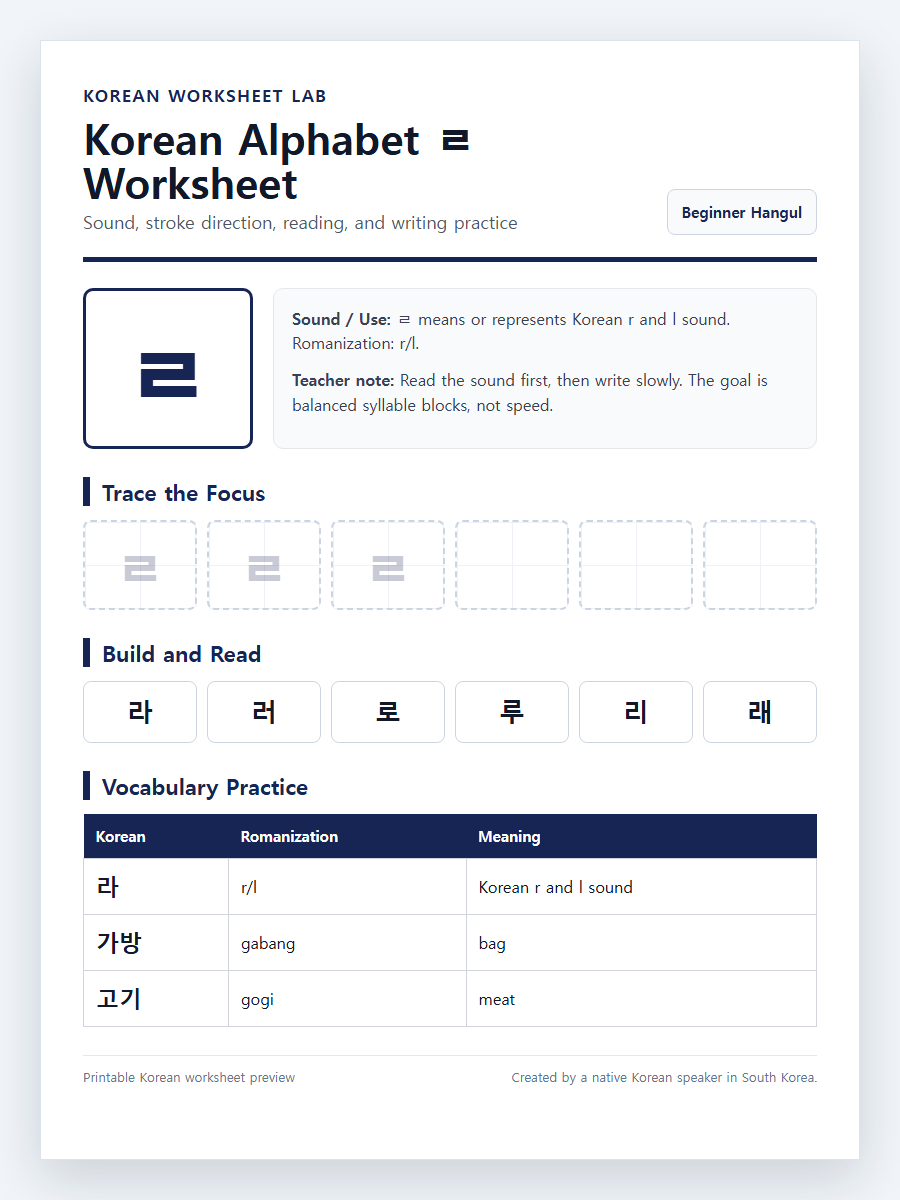
Learn ㄹ as a Korean sound between English r and l, then practice it in syllable blocks.

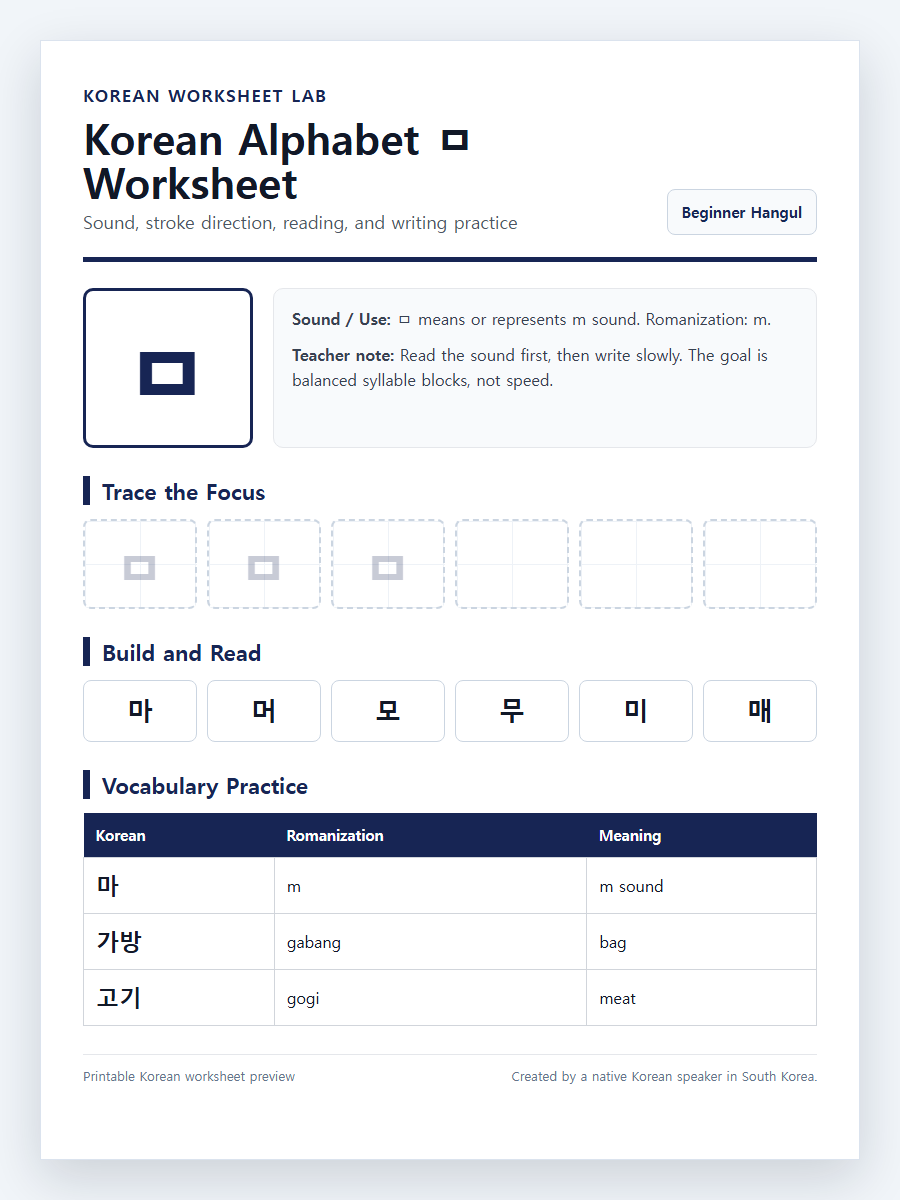
Practice the Korean consonant ㅁ with syllables such as 마 and words that actually use the focus sound.

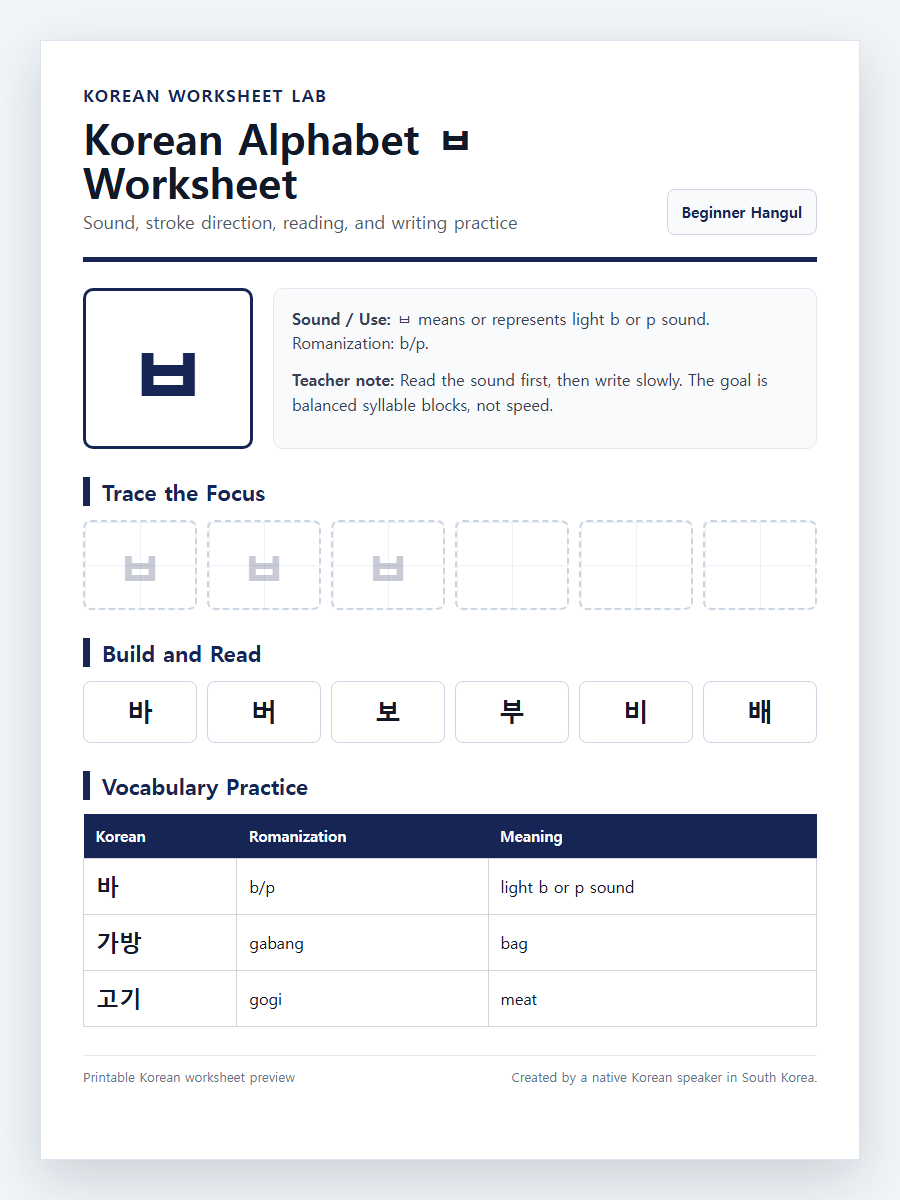
Learn ㅂ with beginner syllables, pronunciation notes, and Korean words that include the sound.

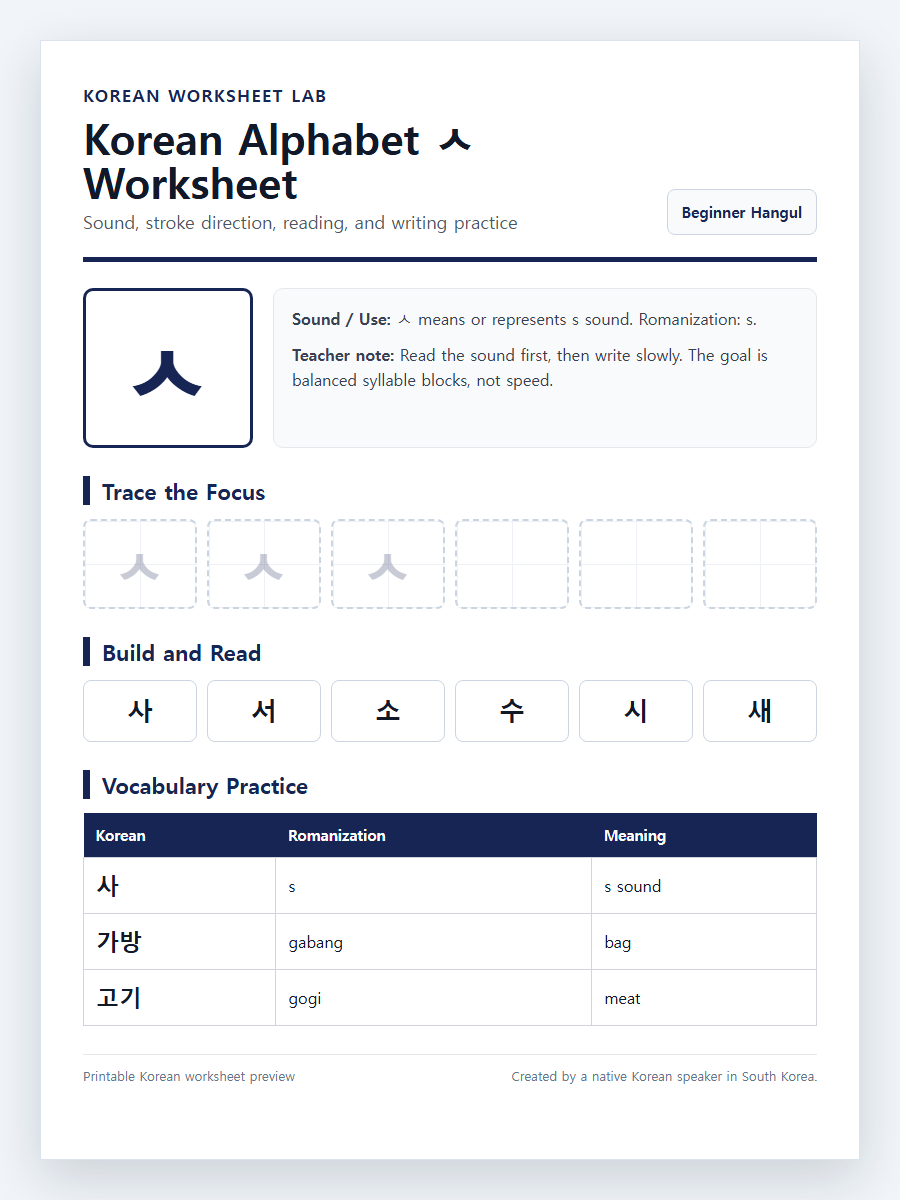
Practice ㅅ with clear stroke order, syllable reading, and beginner Korean vocabulary.

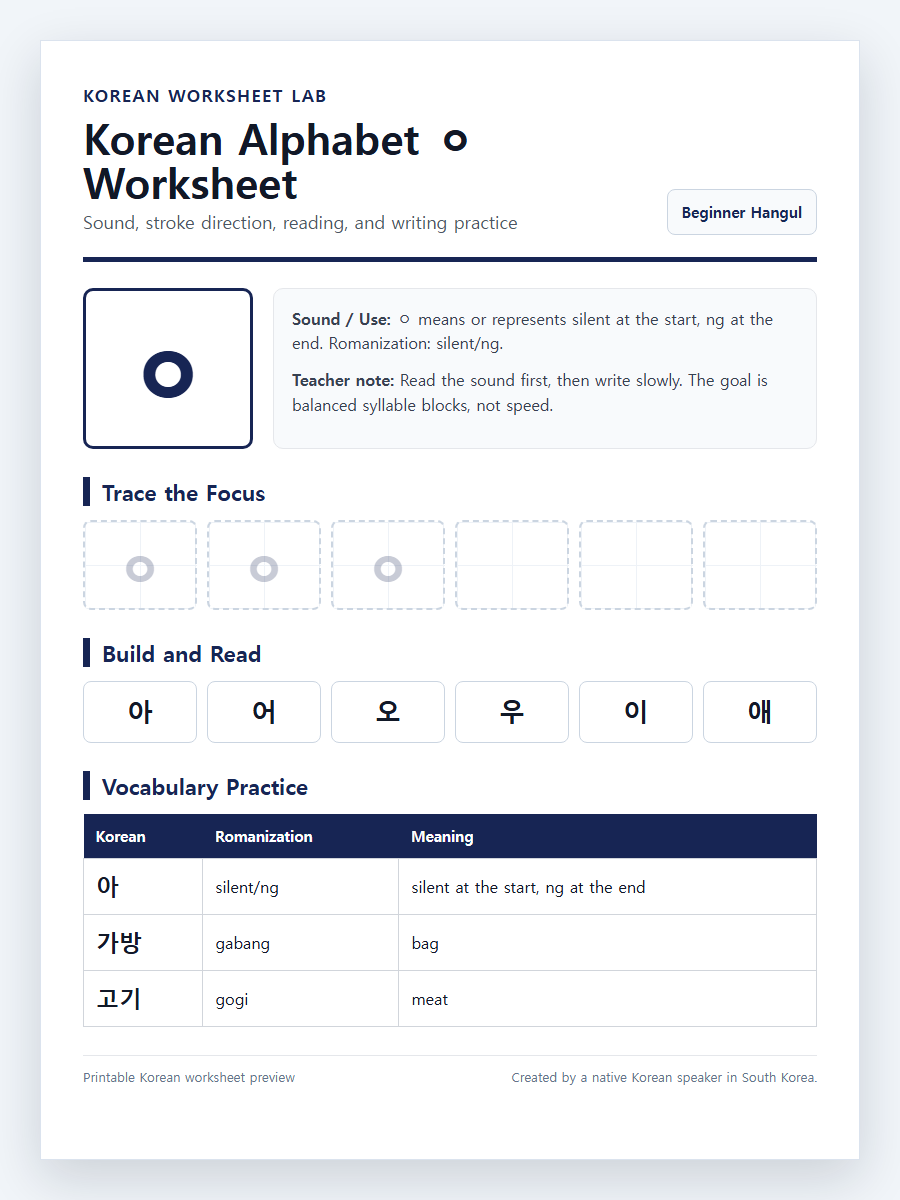
Learn how ㅇ is silent at the start of a syllable and becomes ng at the end.

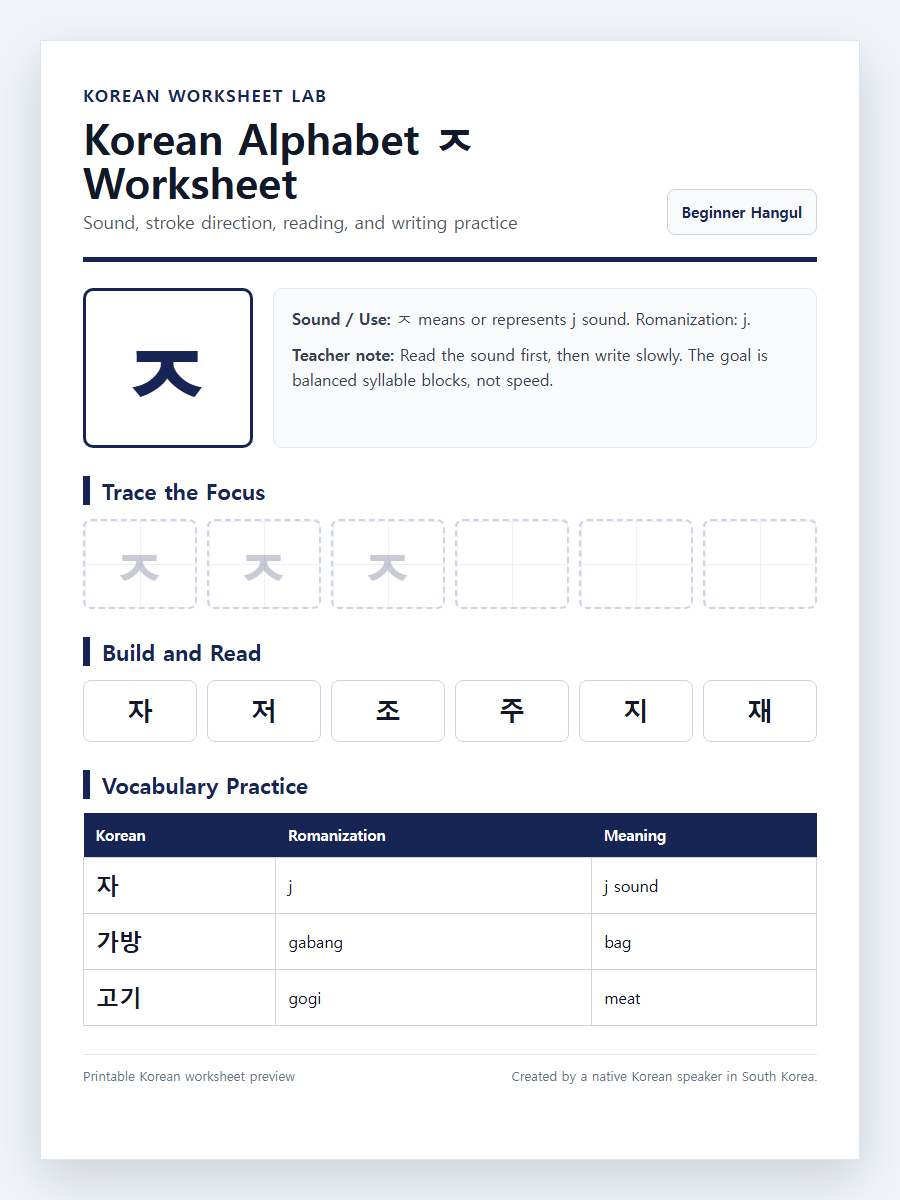
Study ㅈ with writing practice and useful beginner words such as 집 and 지도.

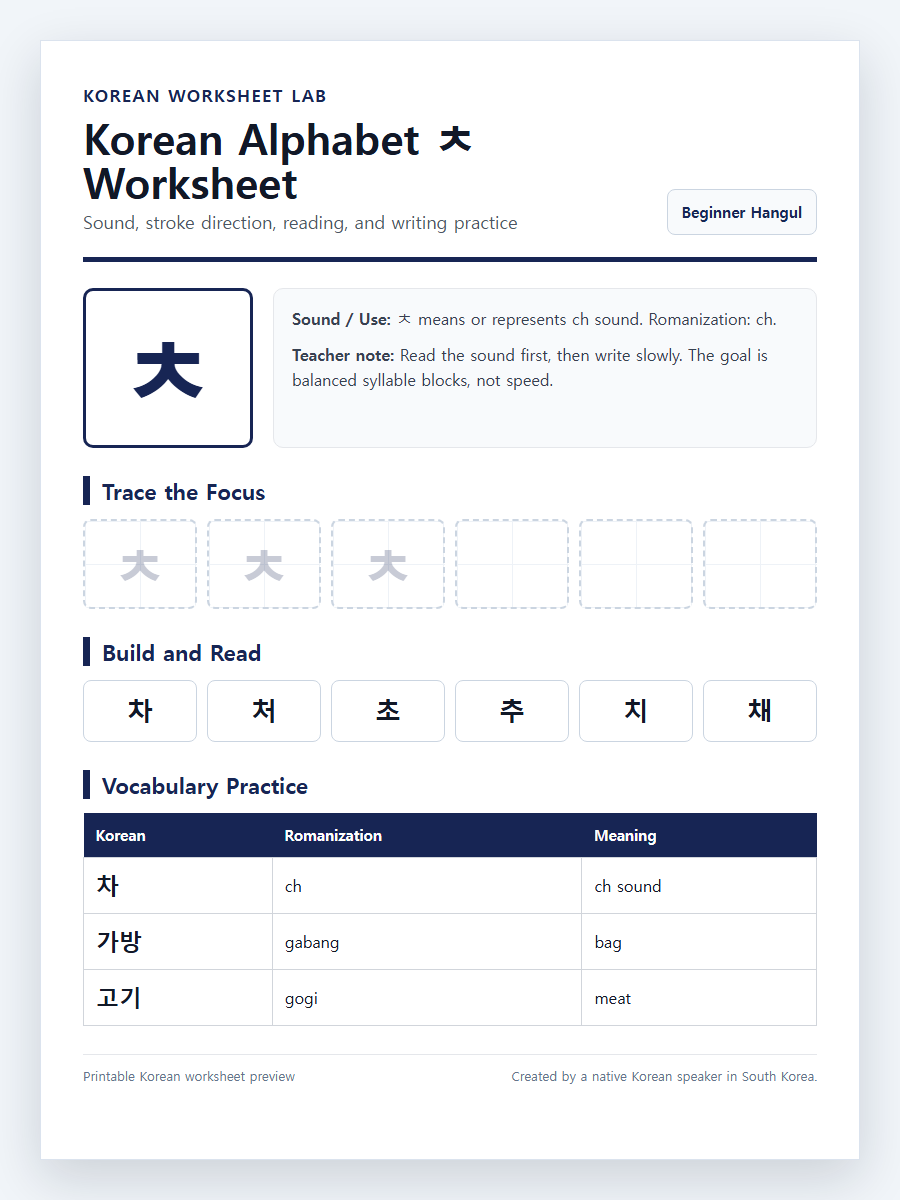
Practice ㅊ as an aspirated ch sound with words learners often meet early.

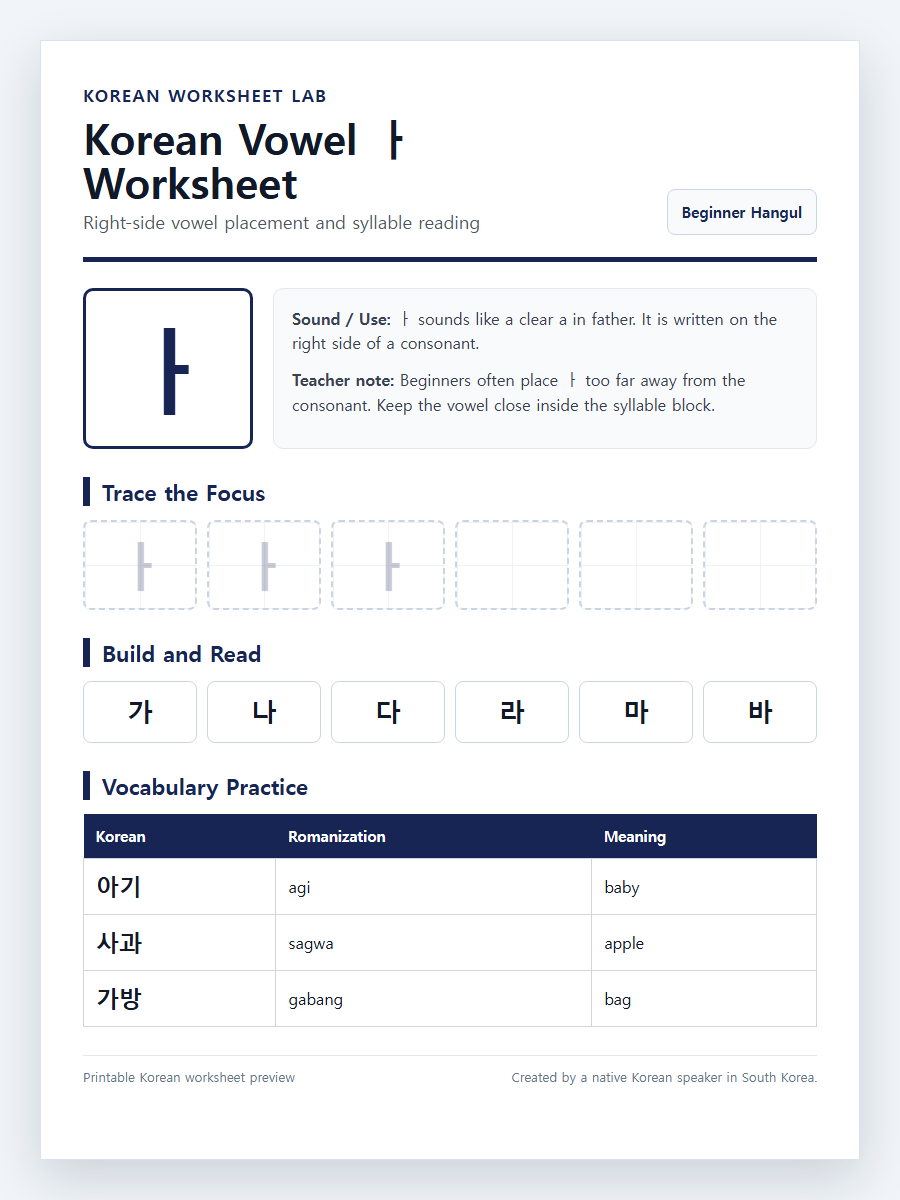
Learn the Korean vowel ㅏ and combine it with consonants to read syllables like 가, 나, 다, and 마.

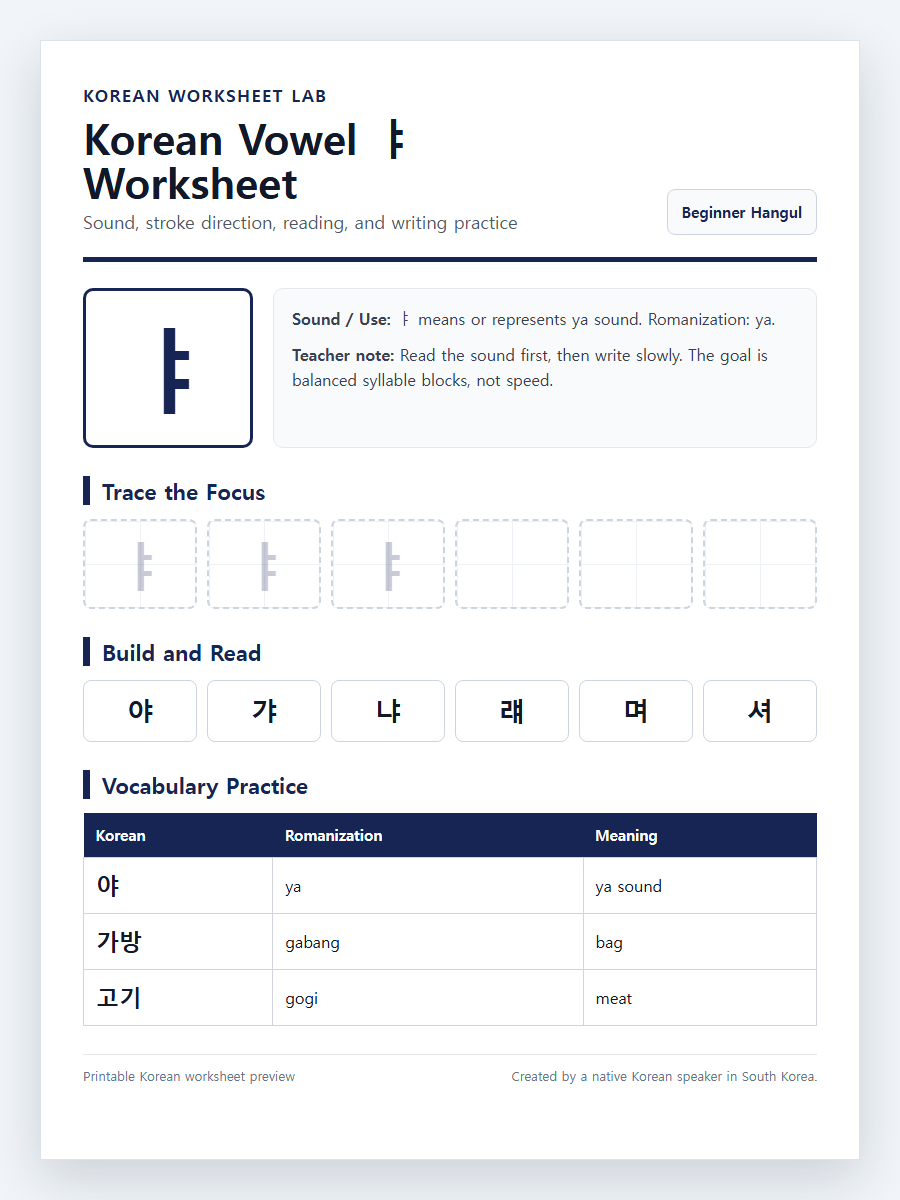
Practice ㅑ and learn how the extra short stroke changes ㅏ into a ya sound.

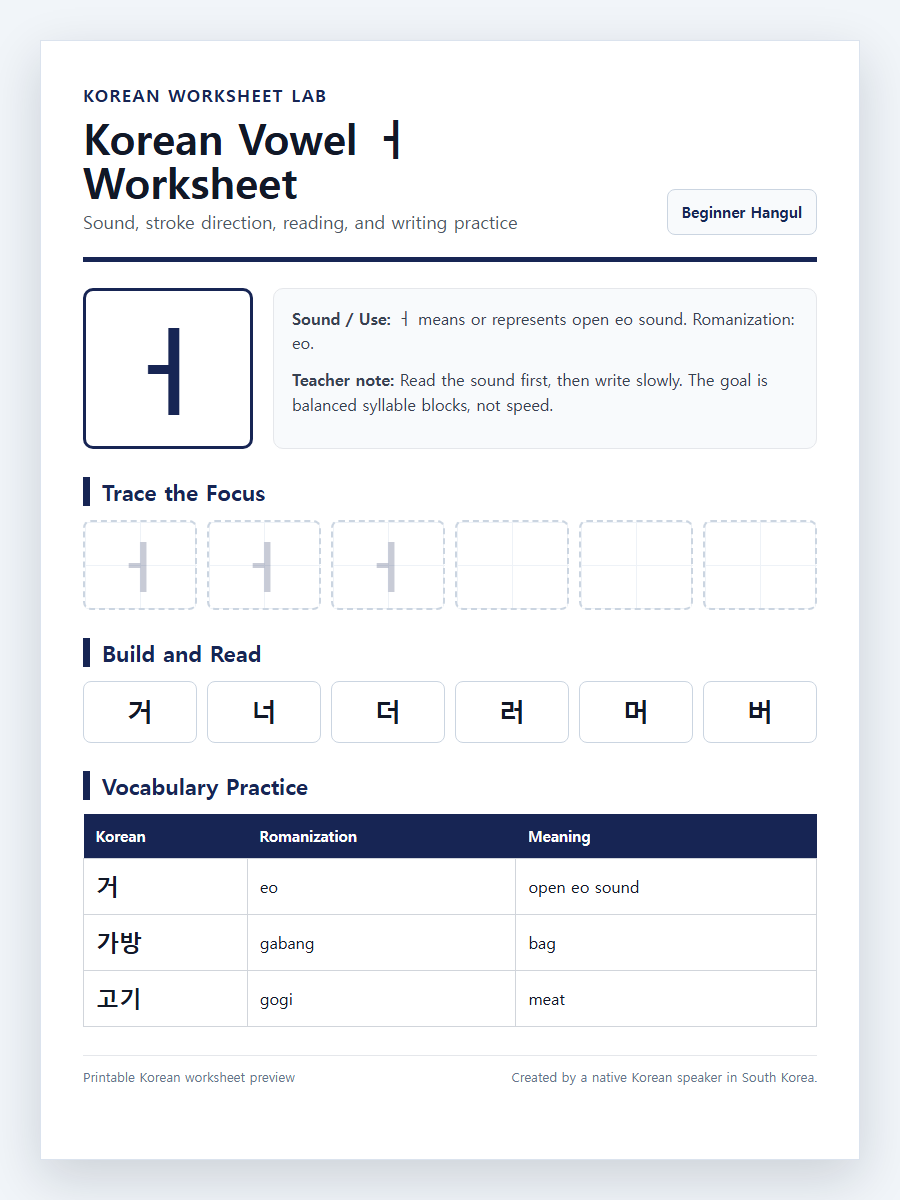
Learn ㅓ, a key Korean vowel that does not match one simple English spelling.
Yes. It is designed for learners who are starting Korean from Hangul and basic phrases.
It is better to read the lesson first, preview the worksheet, and then print the PDF for practice.
Yes. Adult beginner learners are the main audience, with some resources also useful for teachers and homeschoolers.