Week 1 · 45 minutes
First Hangul Lesson Plan
A classroom-ready first Hangul lesson with vowel and consonant recognition, syllable building, guided writing, assessment, and differentiation.
Pre-A1 to A11-24 learnersPrep 10 minutes
Open lesson plan Korean Education Resource Hub
Classroom-ready Korean teaching ideas for lesson planning, small groups, conversation practice, and review tests.
Classroom-ready resources
These plans connect direct instruction, guided practice, independent work, assessment, and differentiation. Each one includes realistic timing and links to the learner materials used in class.
Week 1 · 45 minutes
A classroom-ready first Hangul lesson with vowel and consonant recognition, syllable building, guided writing, assessment, and differentiation.
Week 2 · 45 minutes
Teach polite Korean greetings through model dialogue, partner role play, reading, writing, differentiation, assessment, and printable practice.
Week 3 · 50 minutes
A practical Korean numbers lesson plan using cafe prices, counters, ordering dialogue, team activities, assessment, homework, and differentiation.
Recognize ㅏ, ㅗ, ㄱ, ㄴ, and ㅁ.
Use 안녕하세요, 감사합니다, and 죄송합니다 appropriately.
Distinguish native and Sino-Korean number uses.
Repeat or extend a week when learners need more practice. This is a flexible starter sequence, not a promise that every class will progress at the same speed.
Your choices are saved on this device so you can return while planning.
0 of 6 planning steps complete
Use the same lesson sequence, shorten pair work, and add more individual pronunciation feedback.
Use mixed-ability pairs, visible timing, station roles, and a quick whole-class exit check.
Connect the lesson to a real object, family routine, or short home project.
Share large visual prompts, use breakout pairs, and collect answers through chat or a shared slide.
This section helps teachers, tutors, and homeschool instructors turn Korean worksheets into short lesson activities. Materials are easier to use when they include a lesson goal, example language, a preview, and a printable PDF.
Use the resource cards for warmups, homework, small-group practice, review stations, or quick formative checks.
Open the explanation first and choose one practice task for the class.
Turn the key vocabulary table into a quick read-and-repeat activity.
Print one page and ask learners to review the hardest row later.
Let students compare answers before using the answer support section.
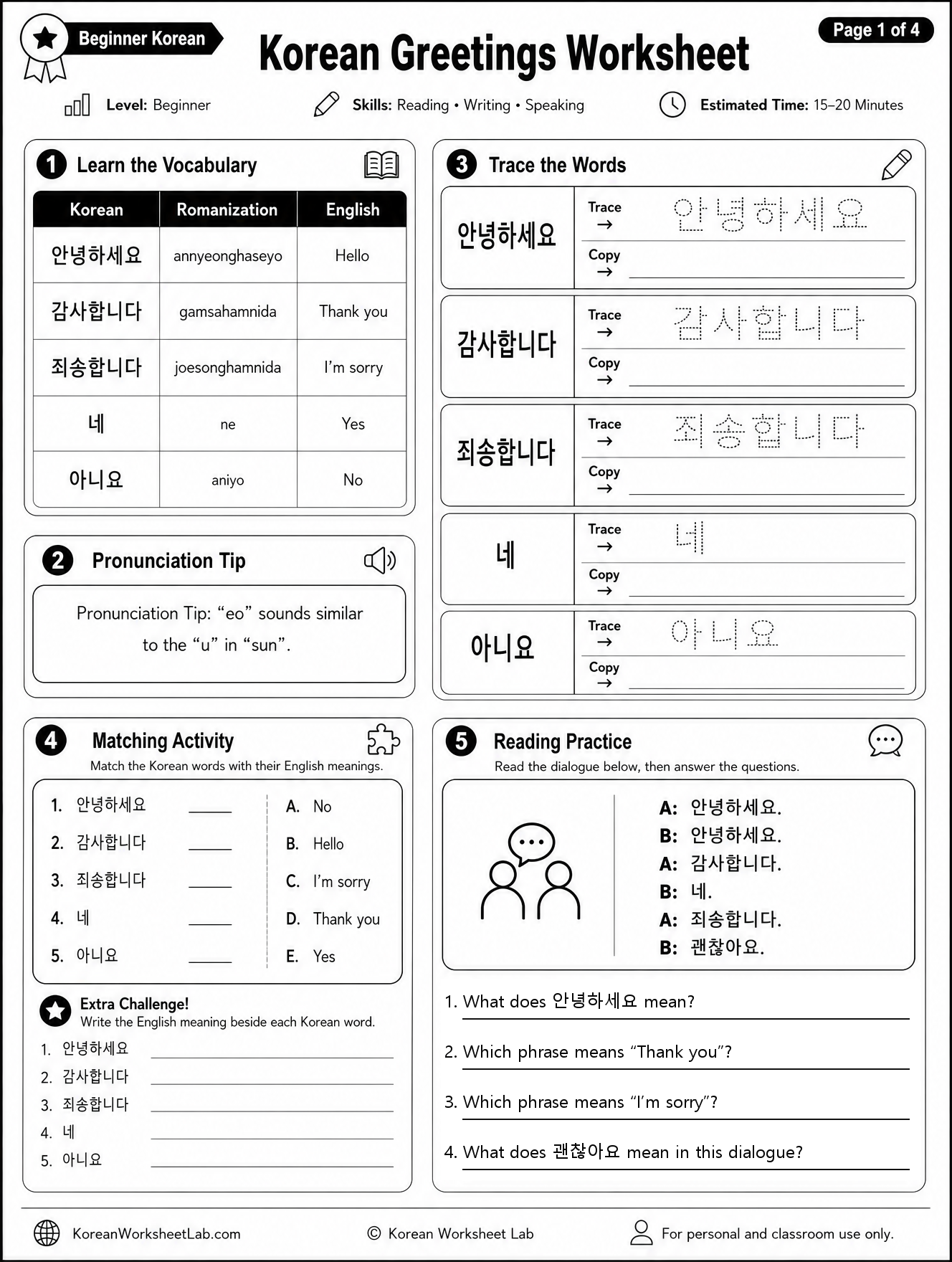 P1
P1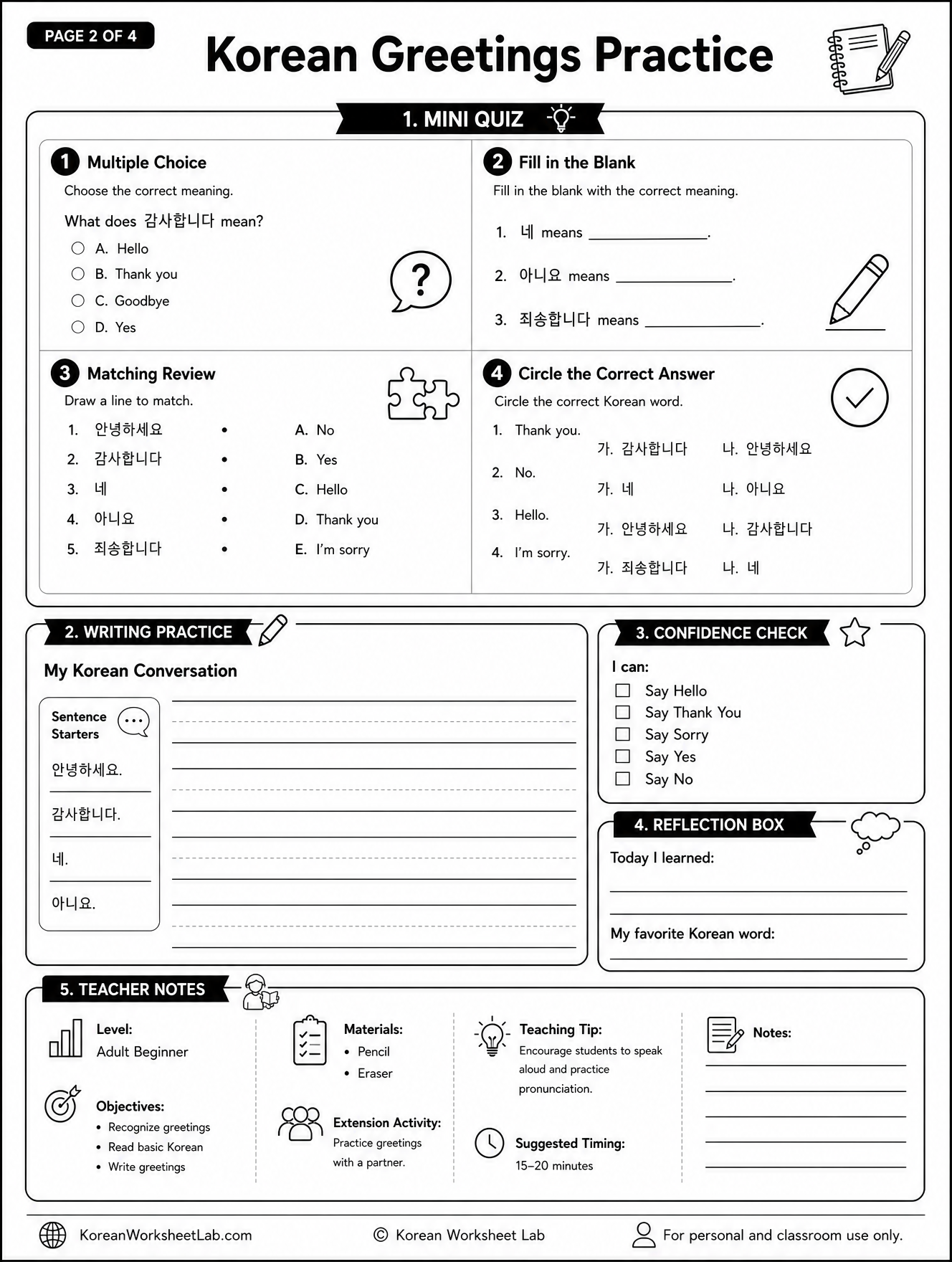 P2
P2Learn polite Korean greetings for meeting people, thanking someone, apologizing, and saying goodbye.
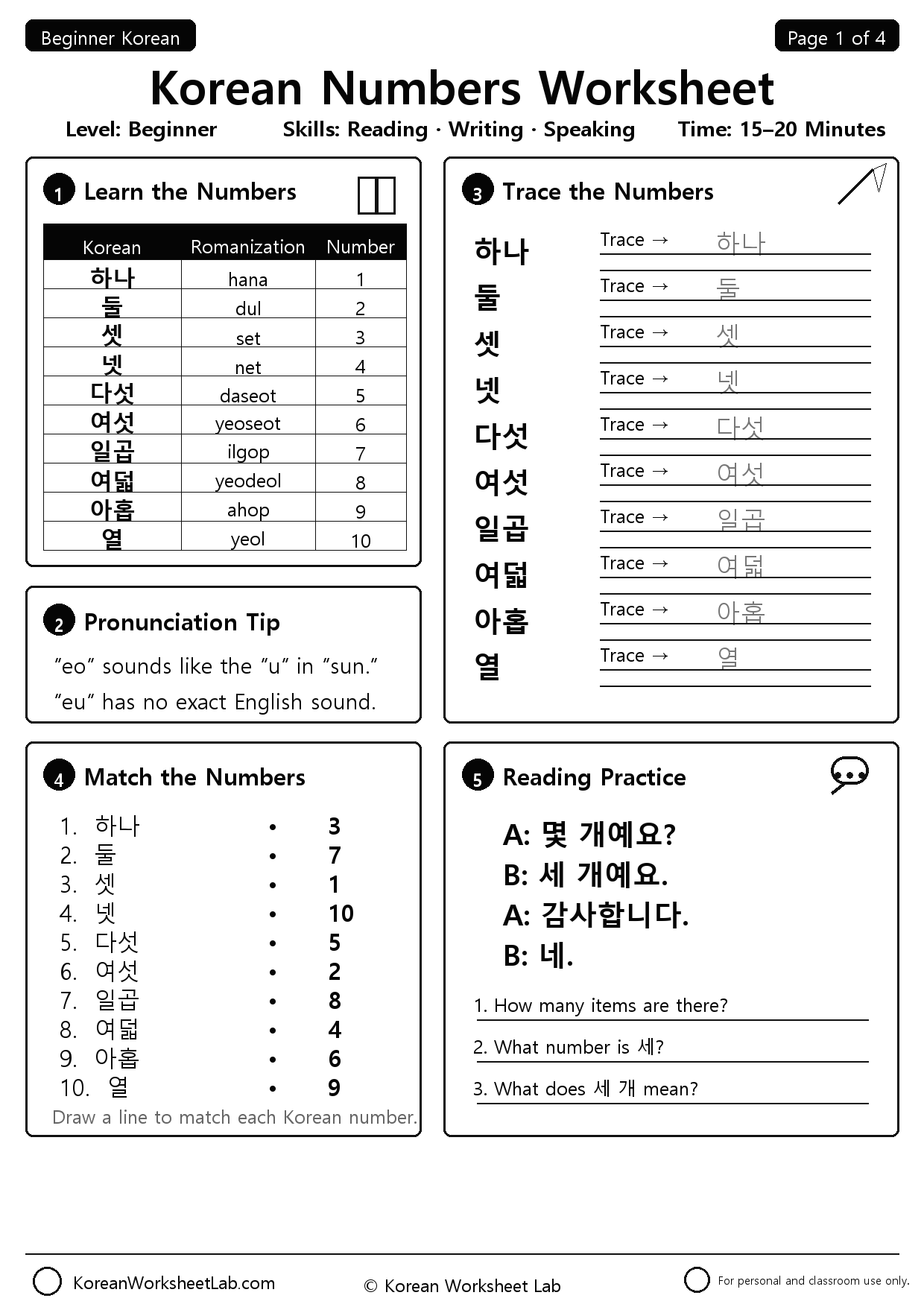 P1
P1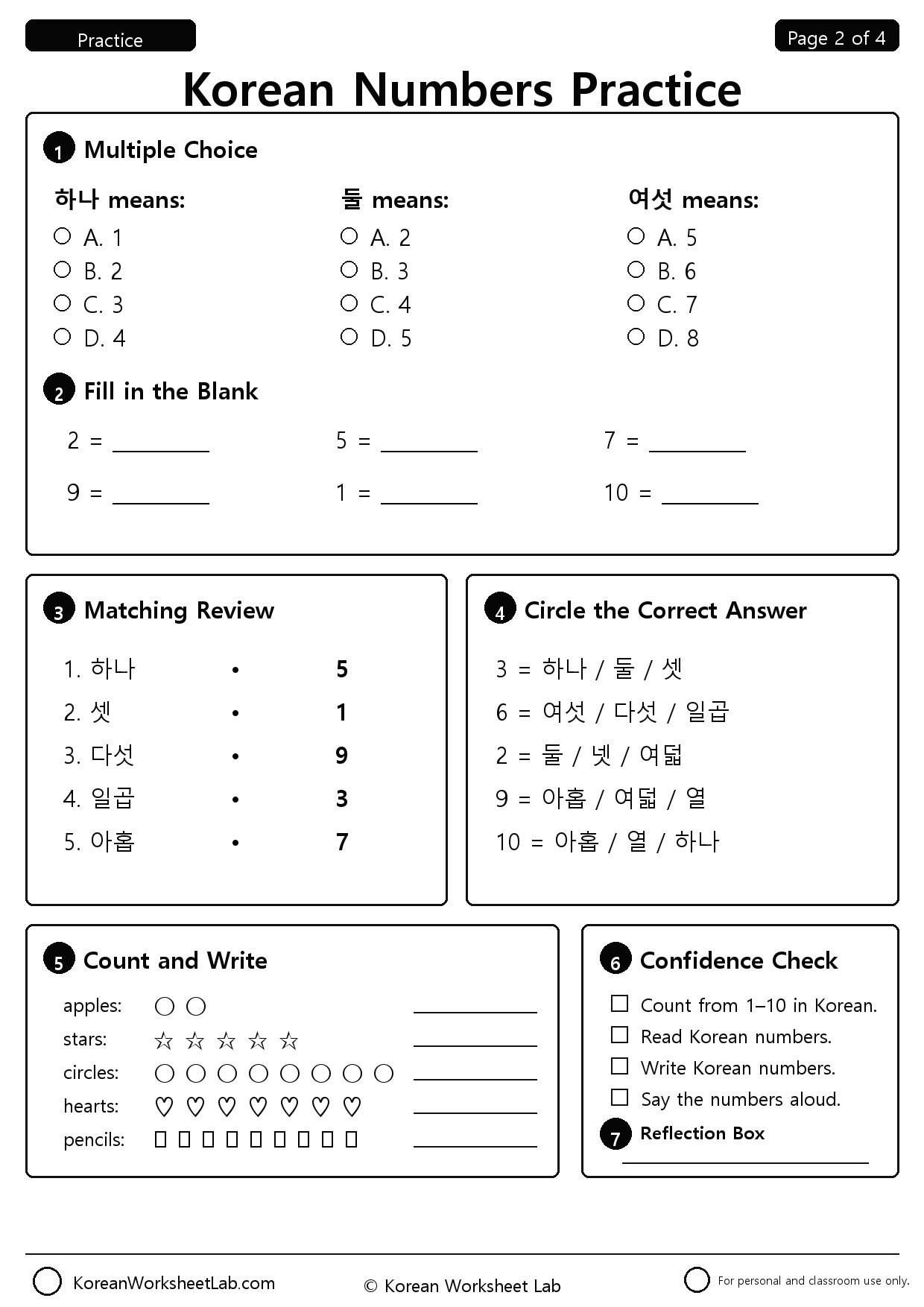 P2
P2Practice native Korean and Sino-Korean numbers with everyday examples for age, counting, time, and prices.
 P1
P1 P2
P2Learn how to ask and tell time in Korean with native-number hour forms, minute expressions, tracing practice, clock activities, answer key, and teacher notes.
 P1
P1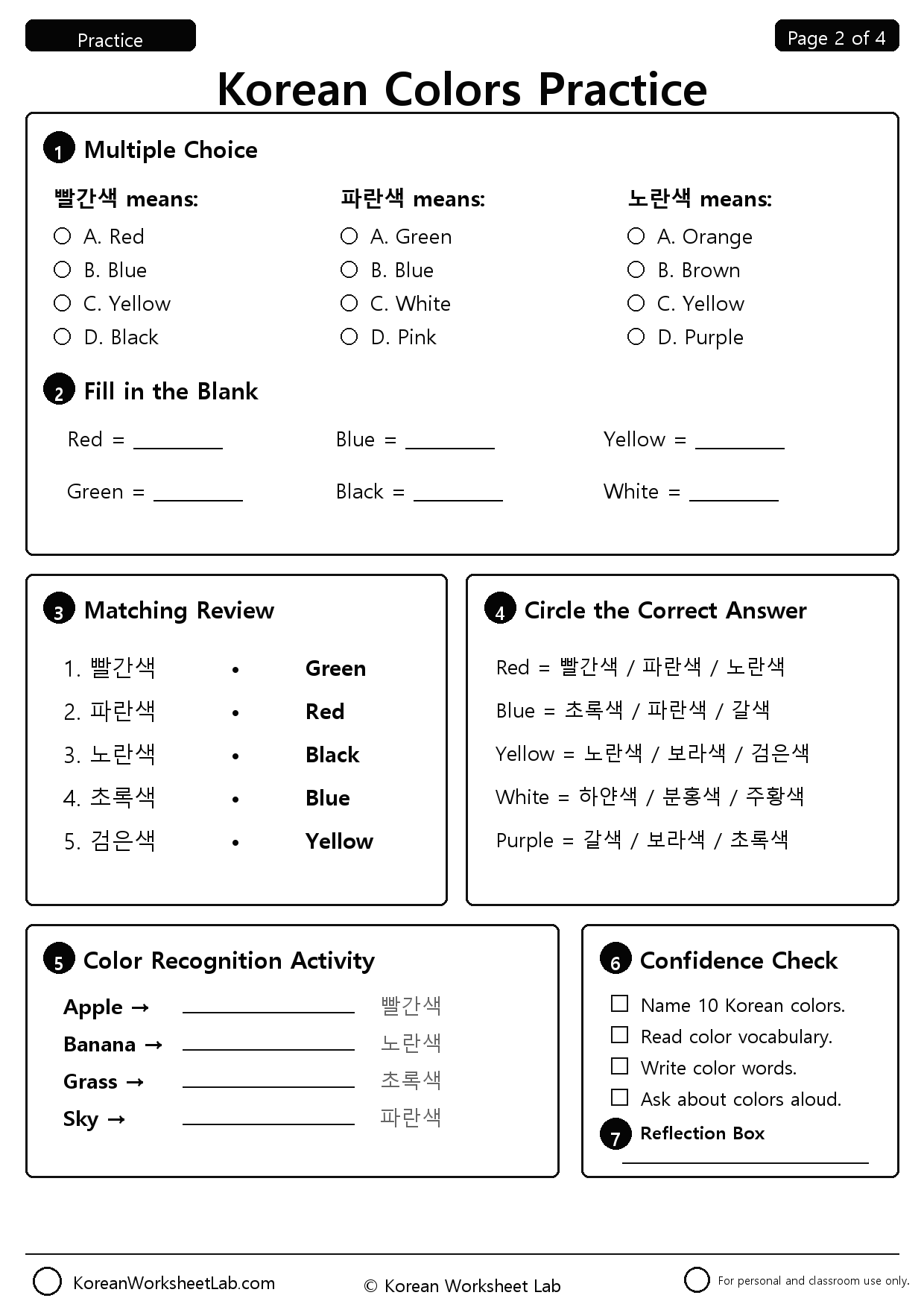 P2
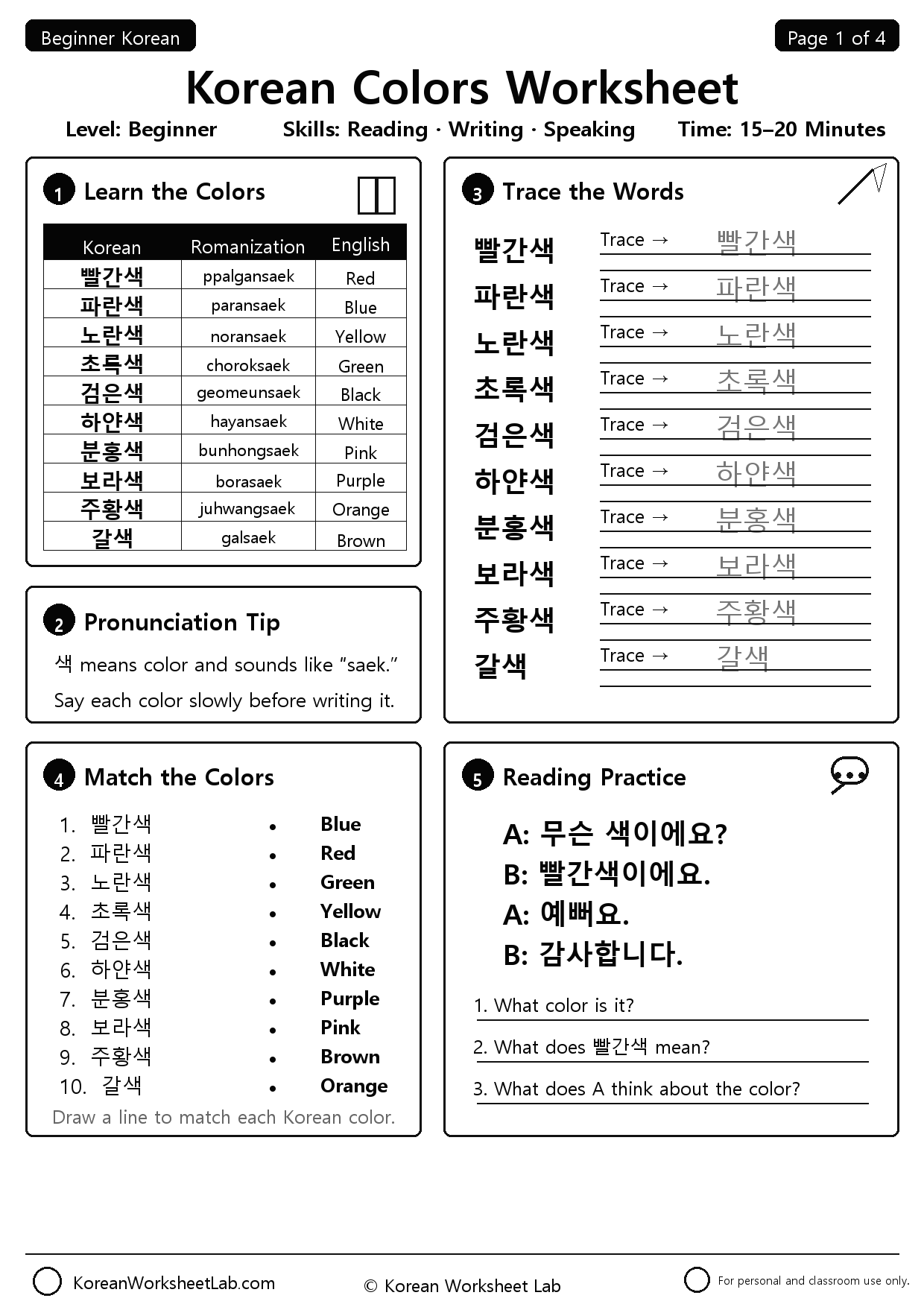
P2Learn 10 Korean color words with reading, writing, speaking practice, object recognition, teacher notes, and a printable PDF.
 P1
P1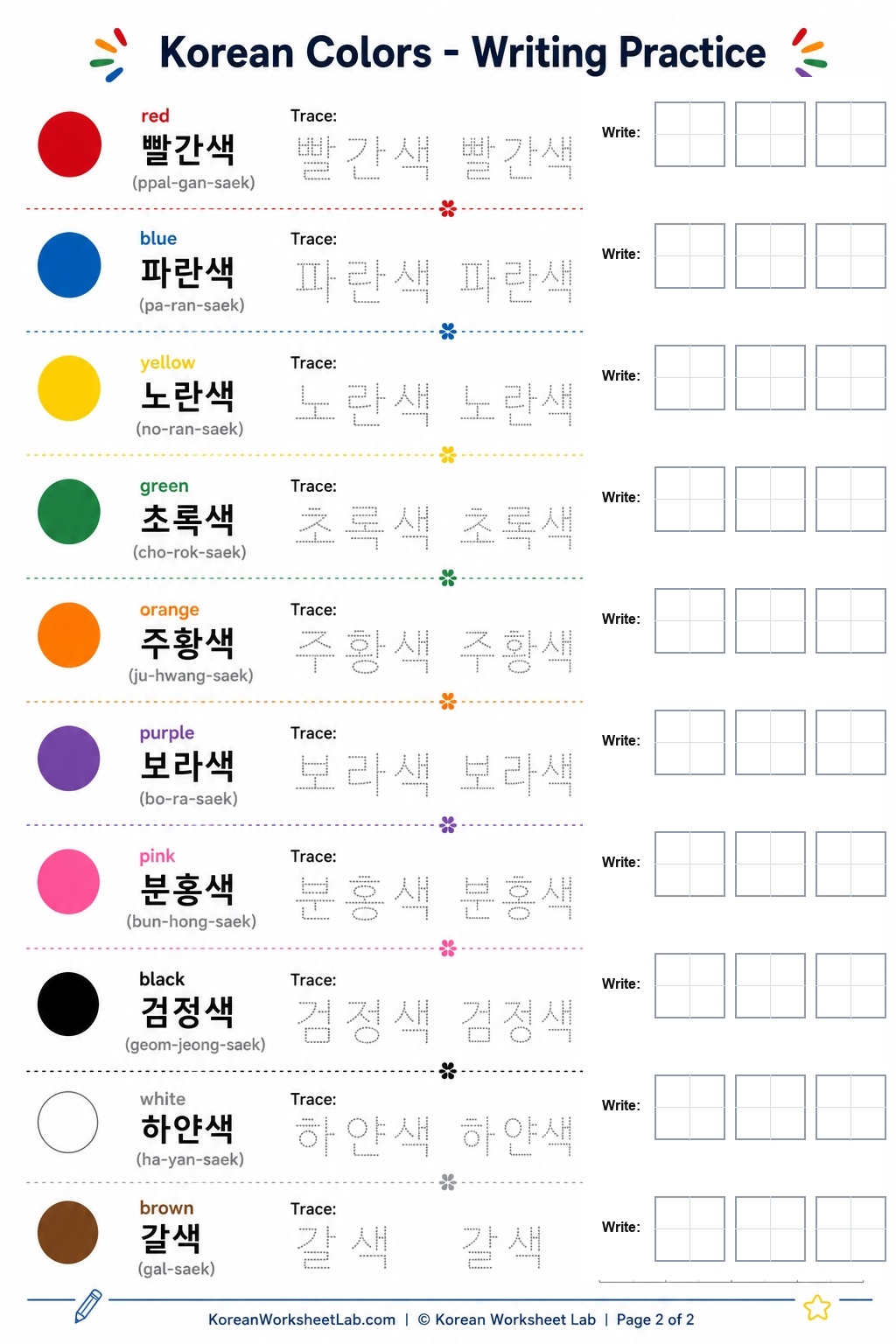 P2
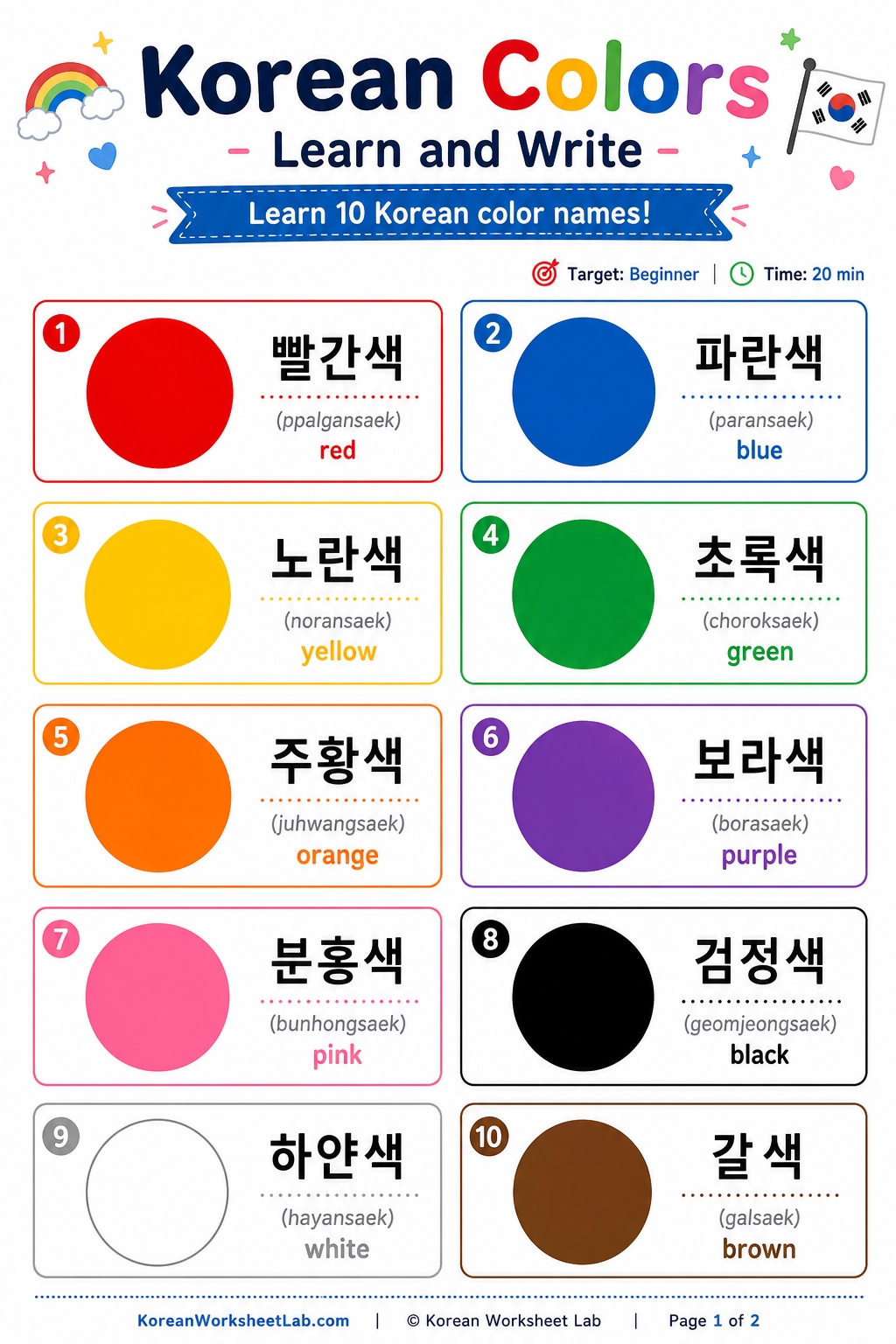
P2Learn 10 Korean color names with picture clues, color swatches, romanization support, tracing practice, writing boxes, and a printable 2-page worksheet for kids and beginners.
 P1
P1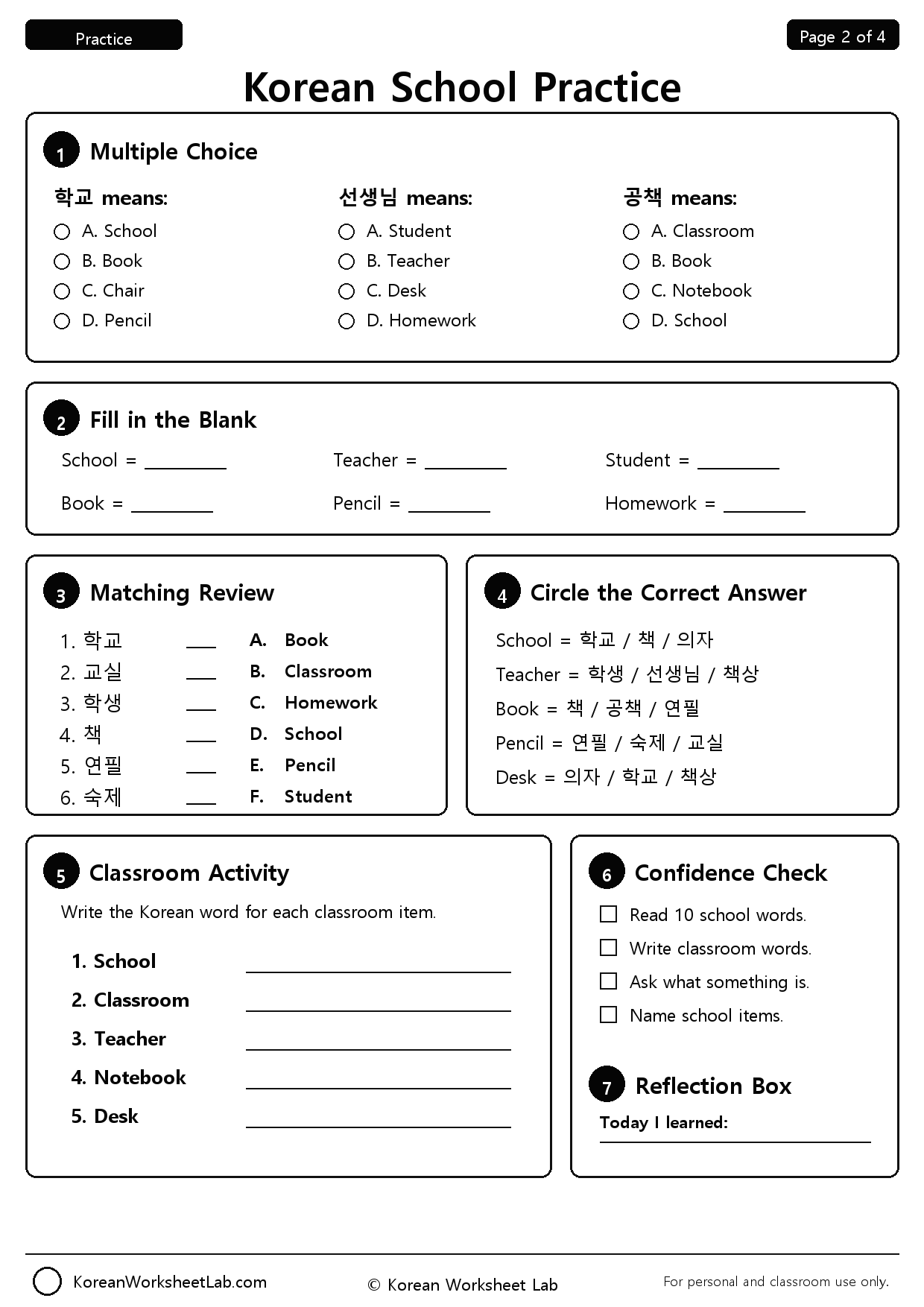 P2
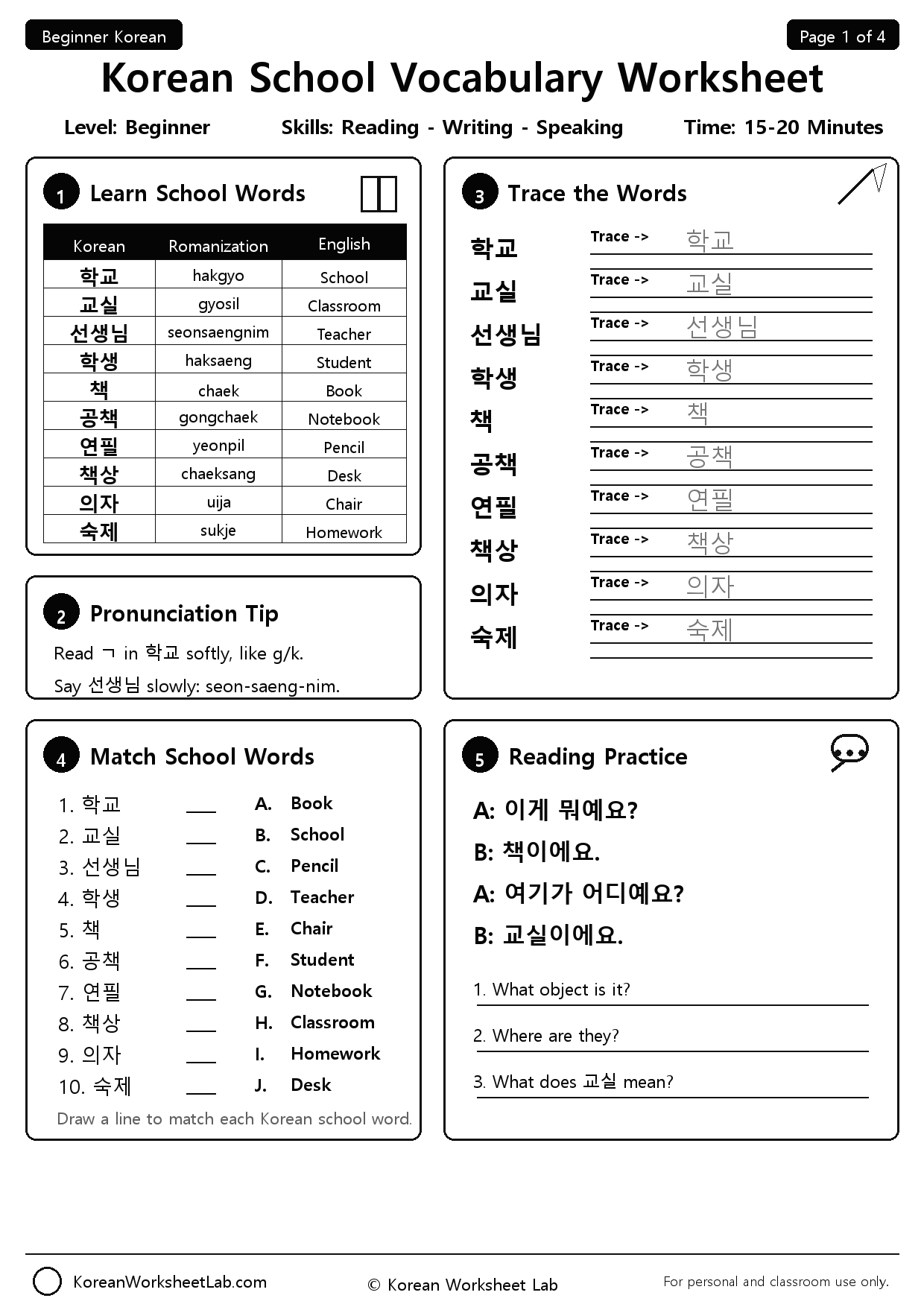
P2Learn 10 Korean school and classroom words with tracing, matching, reading practice, answer key, teacher notes, and a printable 4-page PDF worksheet.
 P1
P1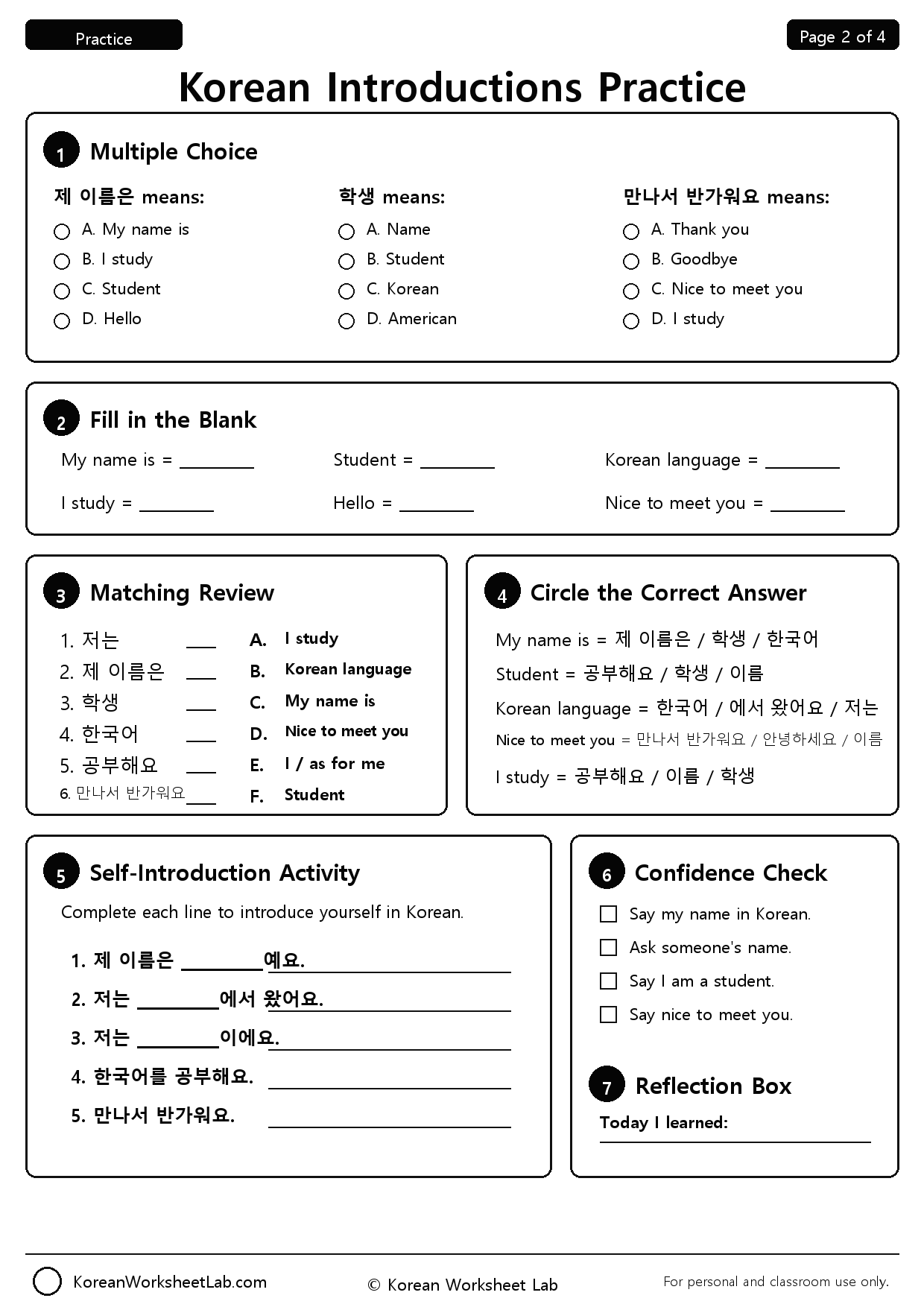 P2
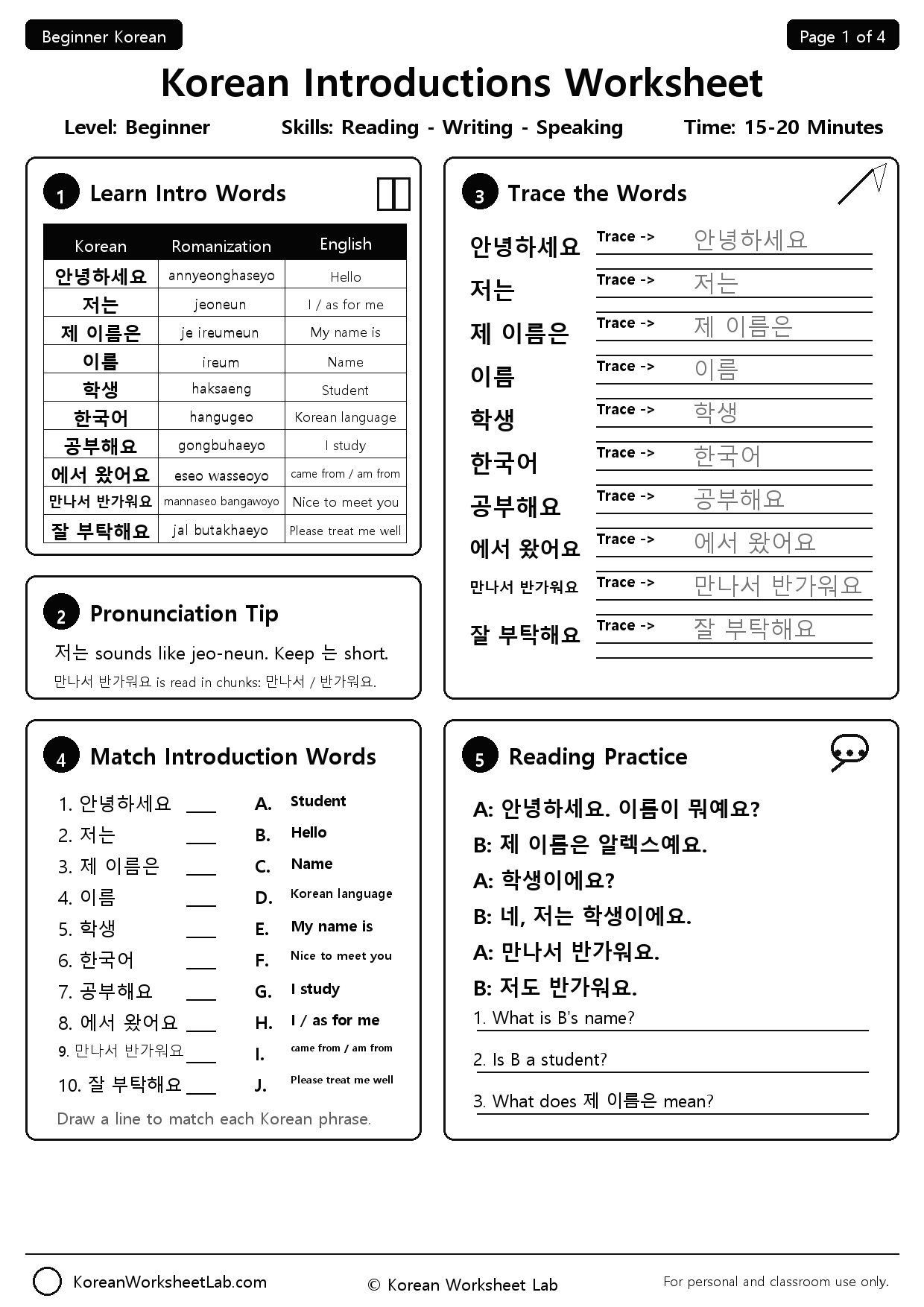
P2Practice Korean self-introduction phrases for saying your name, asking someone's name, saying where you are from, saying you are a student, and using nice-to-meet-you expressions with a printable 4-page worksheet set.
 P1
P1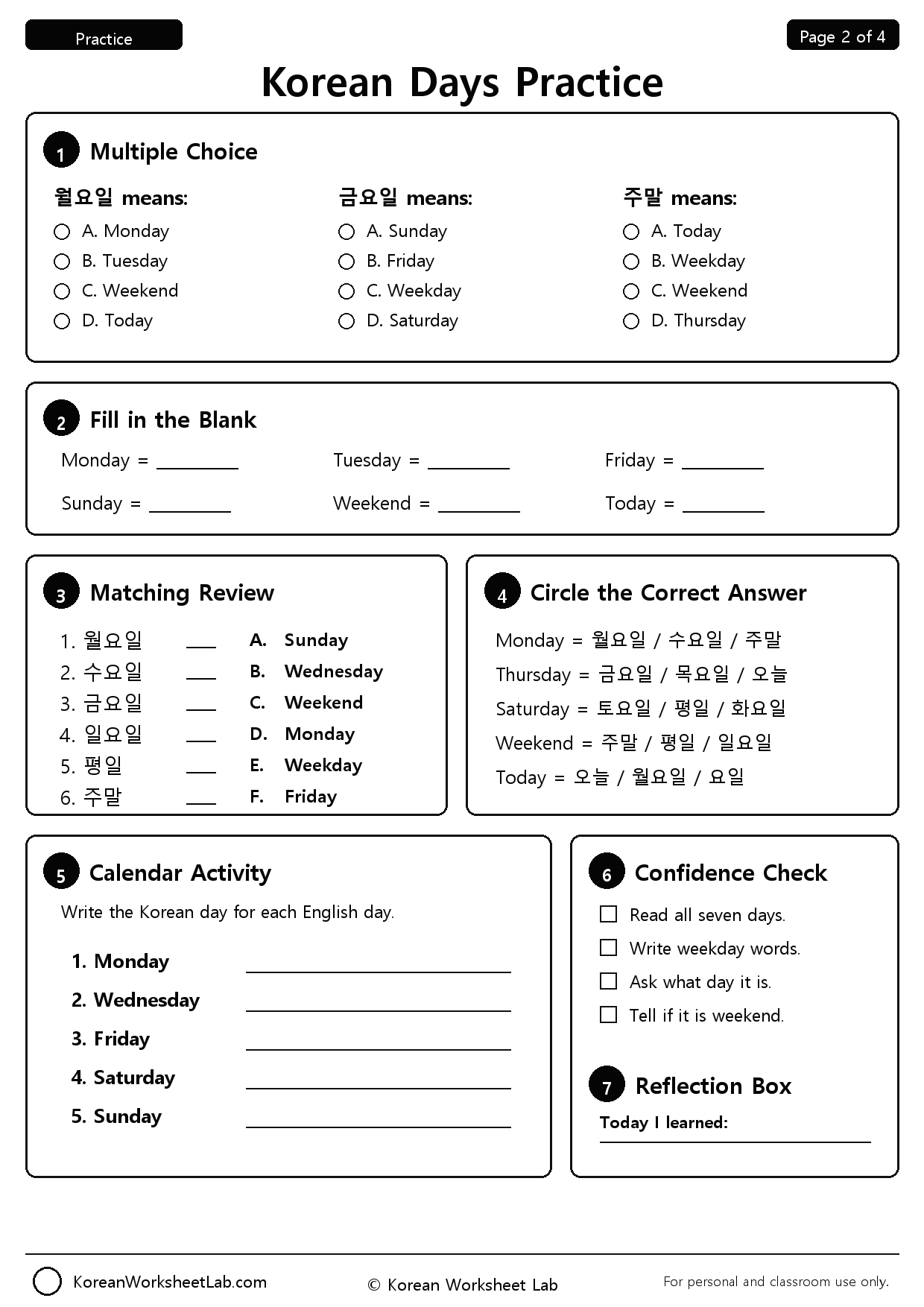 P2
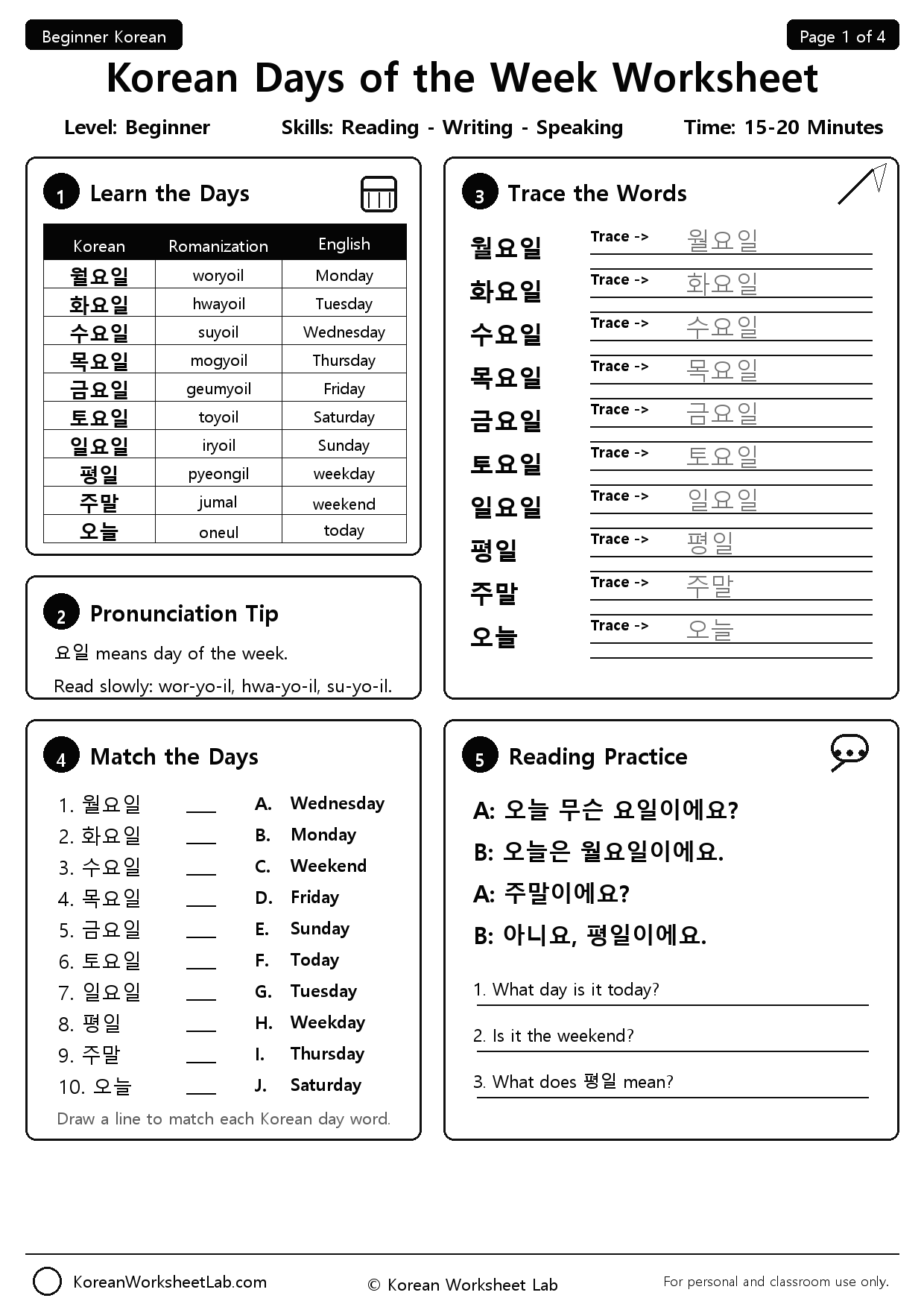
P2Learn the seven Korean days of the week plus weekday, weekend, and today with a printable 4-page worksheet set for schedules and calendar practice.
 P1
P1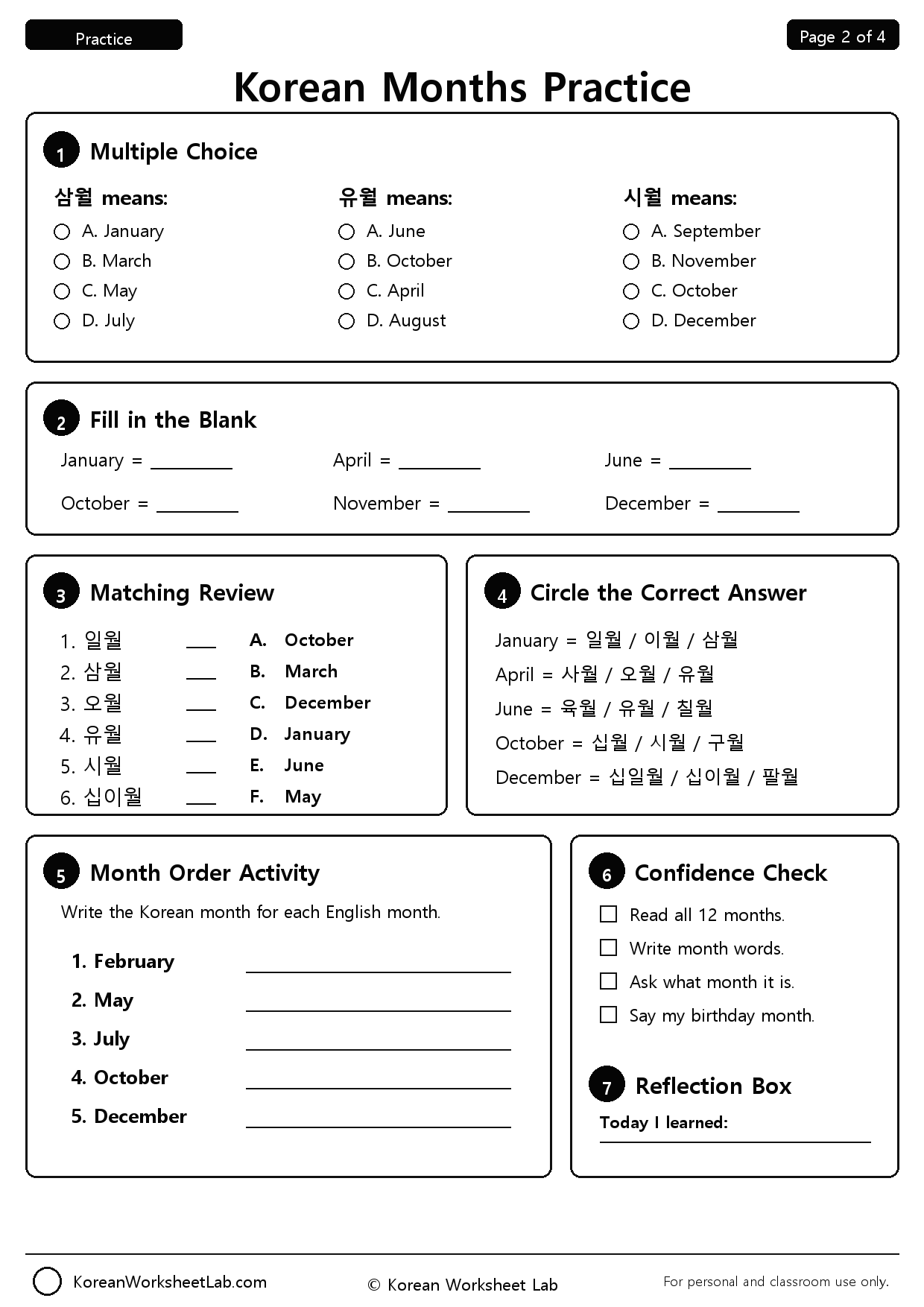 P2
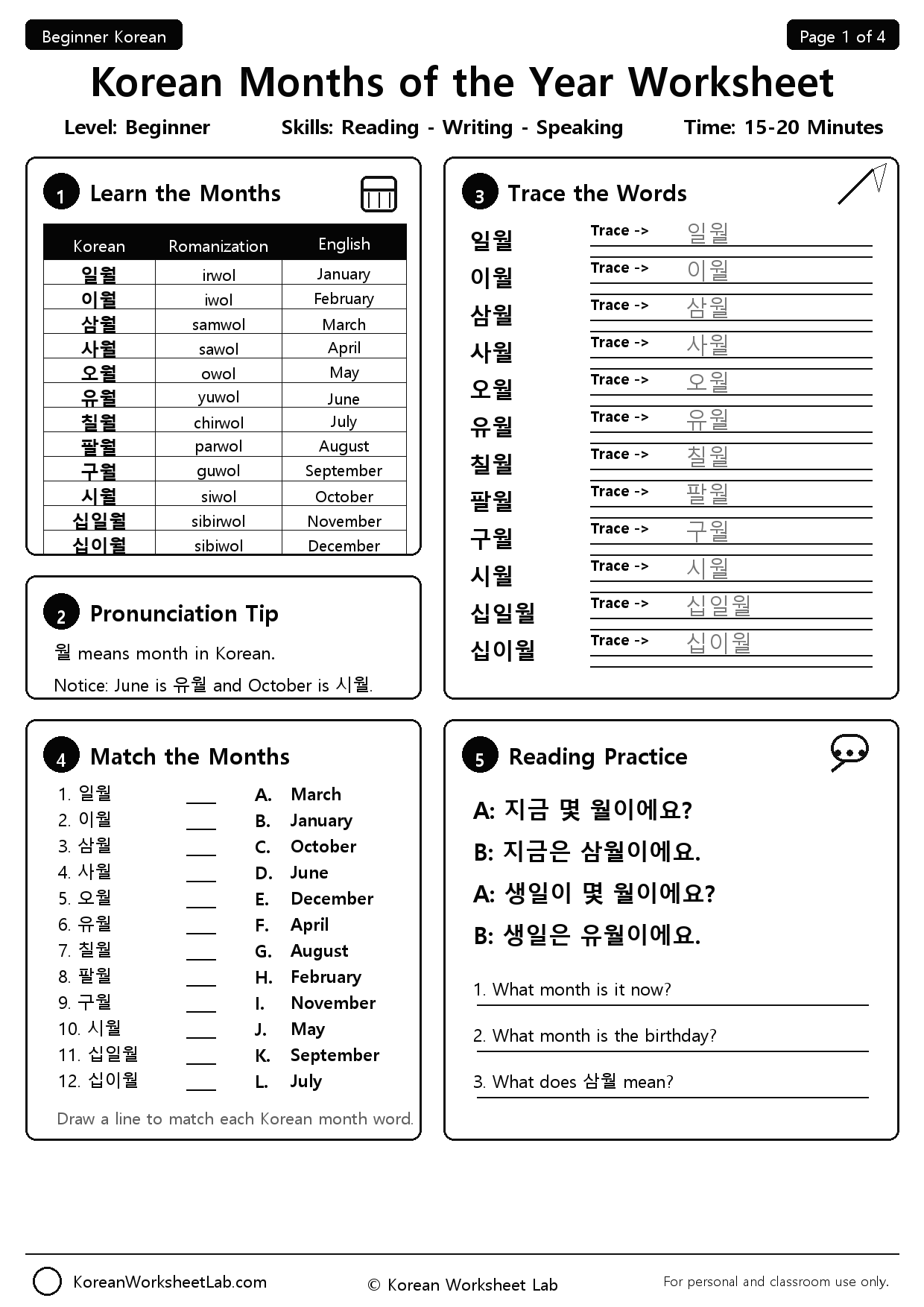
P2Learn the 12 Korean months of the year with a printable 4-page worksheet set for calendar practice, birthday months, reading, writing, and review.
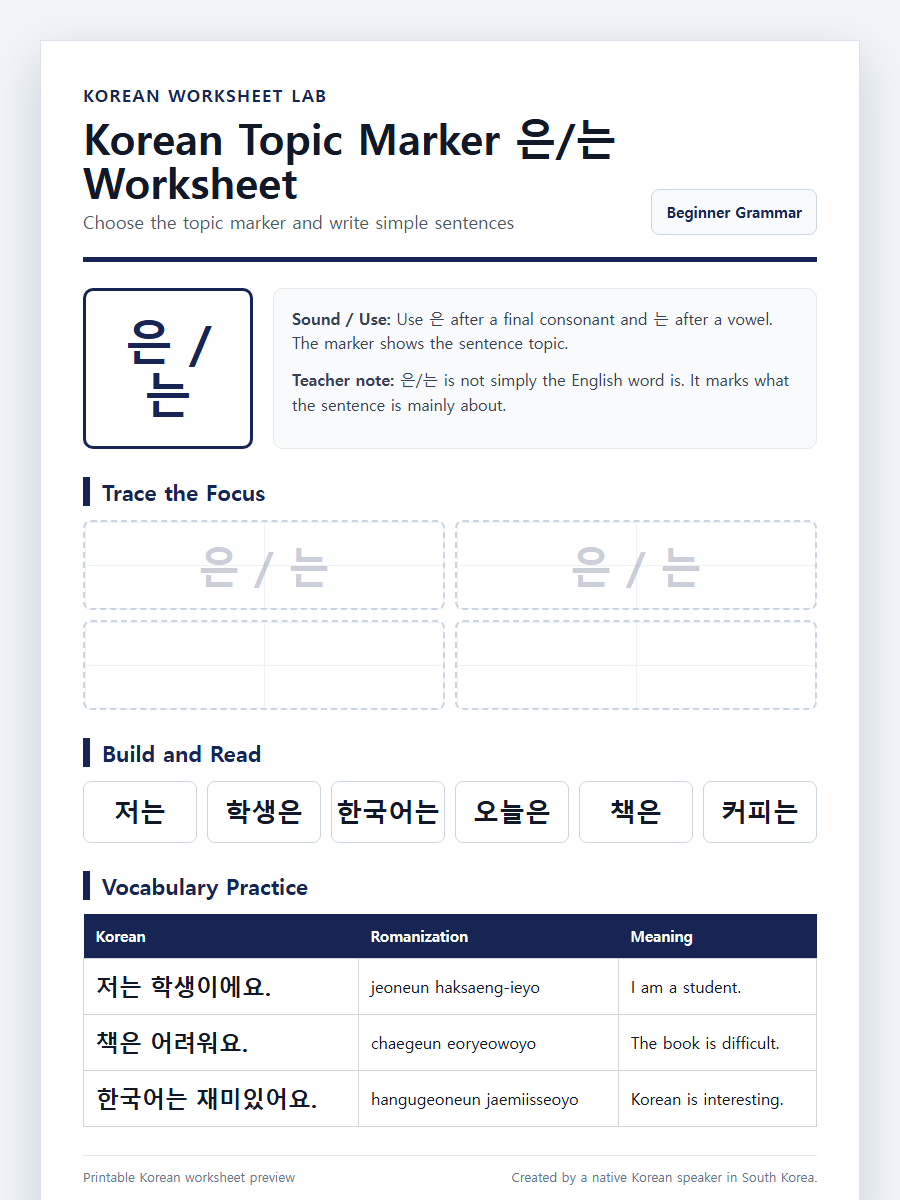
Use 은/는 to introduce, continue, or contrast the topic of a Korean sentence.
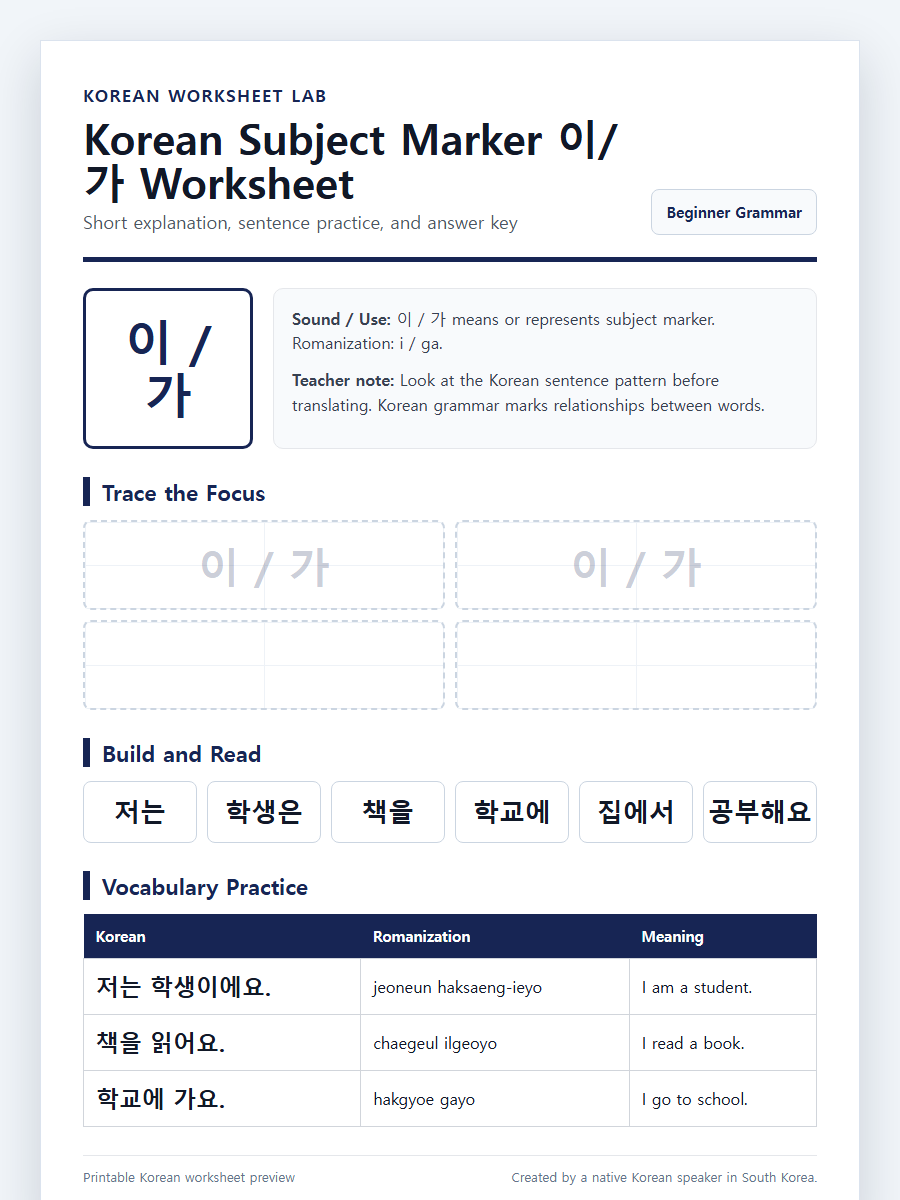
Use 이/가 when the subject is new, emphasized, identified, or directly described.
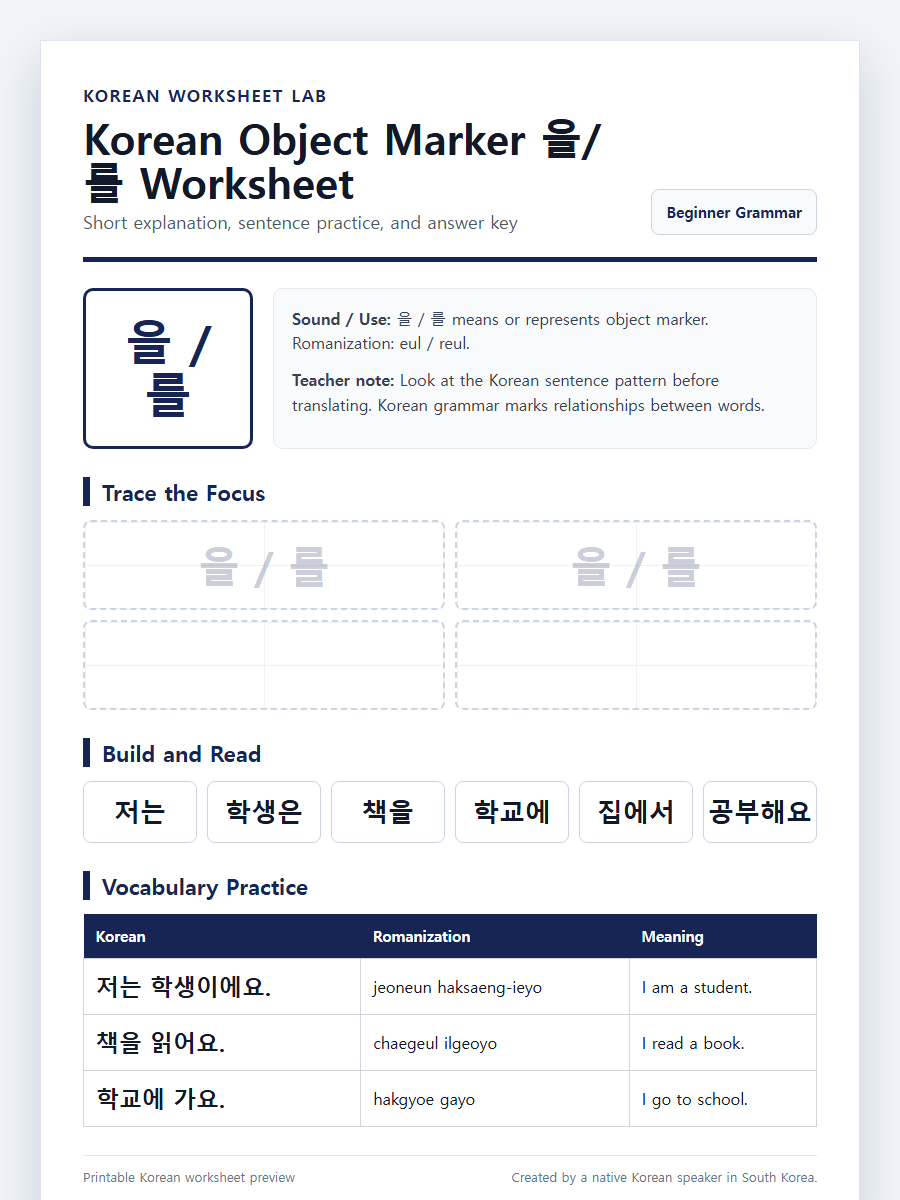
Use 을/를 after the noun that receives the action of a Korean verb.
Yes. They are suitable for beginner warmups, tutoring, homework, and review tasks.
Lesson pages include answer support, and printable answer-key structure can be expanded as the library grows.
No. Each resource is connected to a lesson page with context and guidance.