Basic consonants
ㄱ ㄴ ㄷ ㄹ ㅁ ㅂ ㅅ ㅇ ㅈ ㅊ ㅋ ㅌ ㅍ ㅎ
Fourteen core consonants. Their sound can change with position and surrounding sounds.
Learn hangul with clear explanations, learning objectives, key vocabulary, worksheet previews, and printable Korean PDFs.
Start here
Follow the course in order if you are starting from zero. Each step teaches one reading skill before introducing the next.
Learn the ten core vowel shapes and sounds.
Study this stepConnect fourteen consonant shapes with their sounds.
Study this stepCombine consonants and vowels into square blocks.
Study this stepRecognize ㄲ, ㄸ, ㅃ, ㅆ, and ㅉ.
Study this stepRead vowels such as ㅐ, ㅔ, ㅘ, ㅝ, and ㅢ.
Study this stepAdd a final consonant and read closed syllables.
Study this stepMove from blocks to useful beginner words.
Study this stepRead short sentences with spaces and particles.
Study this stepCheck recognition, writing, and reading skills.
Study this stepPermanent reference
Hangul letters form square syllable blocks. Learn the basic sets first, then use the expanded sets as a reference while reading.
ㄱ ㄴ ㄷ ㄹ ㅁ ㅂ ㅅ ㅇ ㅈ ㅊ ㅋ ㅌ ㅍ ㅎ
Fourteen core consonants. Their sound can change with position and surrounding sounds.
ㅏ ㅑ ㅓ ㅕ ㅗ ㅛ ㅜ ㅠ ㅡ ㅣ
Ten core vowels built from vertical or horizontal lines with short strokes.
ㄲ ㄸ ㅃ ㅆ ㅉ
Tense consonants use tighter articulation. They are not simply two separately pronounced letters.
ㅐ ㅒ ㅔ ㅖ ㅘ ㅙ ㅚ ㅝ ㅞ ㅟ ㅢ
Combined vowel forms. Several pairs sound similar in modern Seoul Korean and need listening practice.
가
ㄱ + ㅏ
ga
고
ㄱ + ㅗ
go
한
ㅎ + ㅏ + ㄴ
han
A vertical vowel such as ㅏ sits to the right of the first consonant. A horizontal vowel such as ㅗ sits below it. A final consonant, or batchim, goes at the bottom.
Romanization is a temporary cue, not a substitute for Hangul. Korean keyboards place consonants mostly on the left and vowels on the right.
Write from top to bottom and left to right. Consistent order makes letter spacing and syllable blocks easier to control.
Use the vowel and consonant printables as desk references while completing reading and writing practice.
English spellings are approximate. Listen for Korean contrasts and learn how position changes a consonant.
These are not fixed English g, d, b, and j sounds. They vary by position and phonetic environment.
It is silent at the beginning of a syllable and represents an ng sound in final position.
ㅅ can sound closer to sh before ㅣ and related y-vowels, as in 시.
ㅋ, ㅌ, ㅍ, and ㅊ release more air than their plain counterparts.
ㄲ, ㄸ, ㅃ, ㅆ, and ㅉ use a tighter, tenser articulation rather than extra breath.
Final consonants are restricted to a smaller set of ending sounds and may link to a following vowel.
Move from controlled formation to independent writing. Recognition alone does not build reliable handwriting.
Read aloud at each level. Accuracy comes before speed, and romanization should disappear as soon as possible.
ㅏ ㅗ ㅜ · ㄱ ㄴ ㅁ
가 나 다 · 모 무 미
나무 · 바다 · 우유 · 한국
저는 학생이에요. 우유를 마셔요.
오늘은 토요일이에요. 저는 집에서 한국어를 공부해요.
Use this short diagnostic before moving to vocabulary. Say each answer aloud before opening the answer line.
Which letter represents the n sound?
ㄴ
Which vowel is read approximately as a?
ㅏ
Combine ㄱ and ㅗ.
고
Read 나무 without romanization.
namu · tree
Which letter is the batchim in 한?
ㄴ
Read 저는 학생이에요.
I am a student.
Compare mouth shape and learn them inside words instead of trusting eo and o spellings.
ㅜ uses rounded lips; ㅡ uses a flatter, more neutral mouth position.
ㅋ has a stronger burst of air. It is not merely a louder ㄱ.
ㅍ is aspirated. Hold a hand near your mouth to notice the extra air.
Its sound changes by position and does not equal one fixed English r or l.
Cover English spellings and decode the Hangul block directly.
Your checks are saved on this device.
0% complete
Read the matching lesson first, preview every available page, and then use the printable for focused practice.
Pronunciation notes, mouth-shape guidance, tracing, and independent writing.
Open lessonA complete consonant chart, articulation guidance, tracing, and writing boxes.
Open lessonFinal-consonant reading, useful examples, guided practice, and review.
Open lessonHangul is systematic, but confident reading still requires practice. Most beginners can understand the basic design quickly, then improve through repeated syllable and word reading.
There is no fixed time. Many learners recognize the basic letters within days, while accurate pronunciation, batchim, and fluent reading take longer.
Use romanization briefly as a pronunciation reminder, then cover it. Reading Hangul directly prevents spelling habits that do not match Korean sounds.
No. Start with open consonant-vowel syllables such as 가, 나, and 다. Add final consonants after those blocks feel familiar.
Yes. Large letters, short tracing tasks, sound practice, and visual matching work well when sessions stay brief.
Study letters in small groups, say each sound, build syllables immediately, and review missed forms after one day and one week.
Korean alphabet lessons with stroke order, syllable building, pronunciation notes, and printable Hangul worksheets.
Each page is built as a learning resource, not just a PDF link. Read the lesson first, preview the worksheet, and then print the PDF for active practice.
A short explanation of the topic and why it matters.
Clear goals for learners, parents, and teachers.
Korean, romanization, and English meaning in one table.
Nearby lessons to continue studying without guessing.
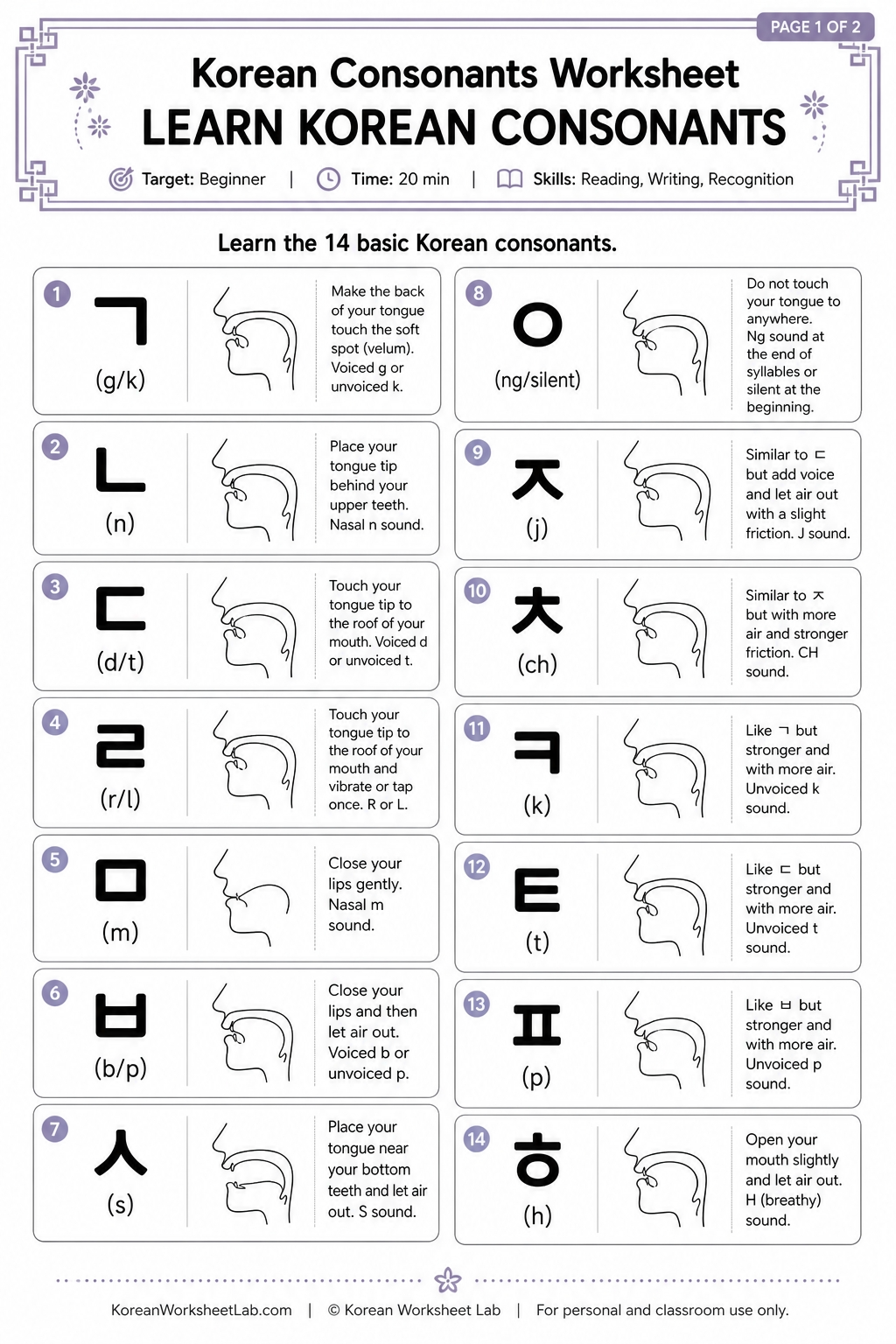 P1
P1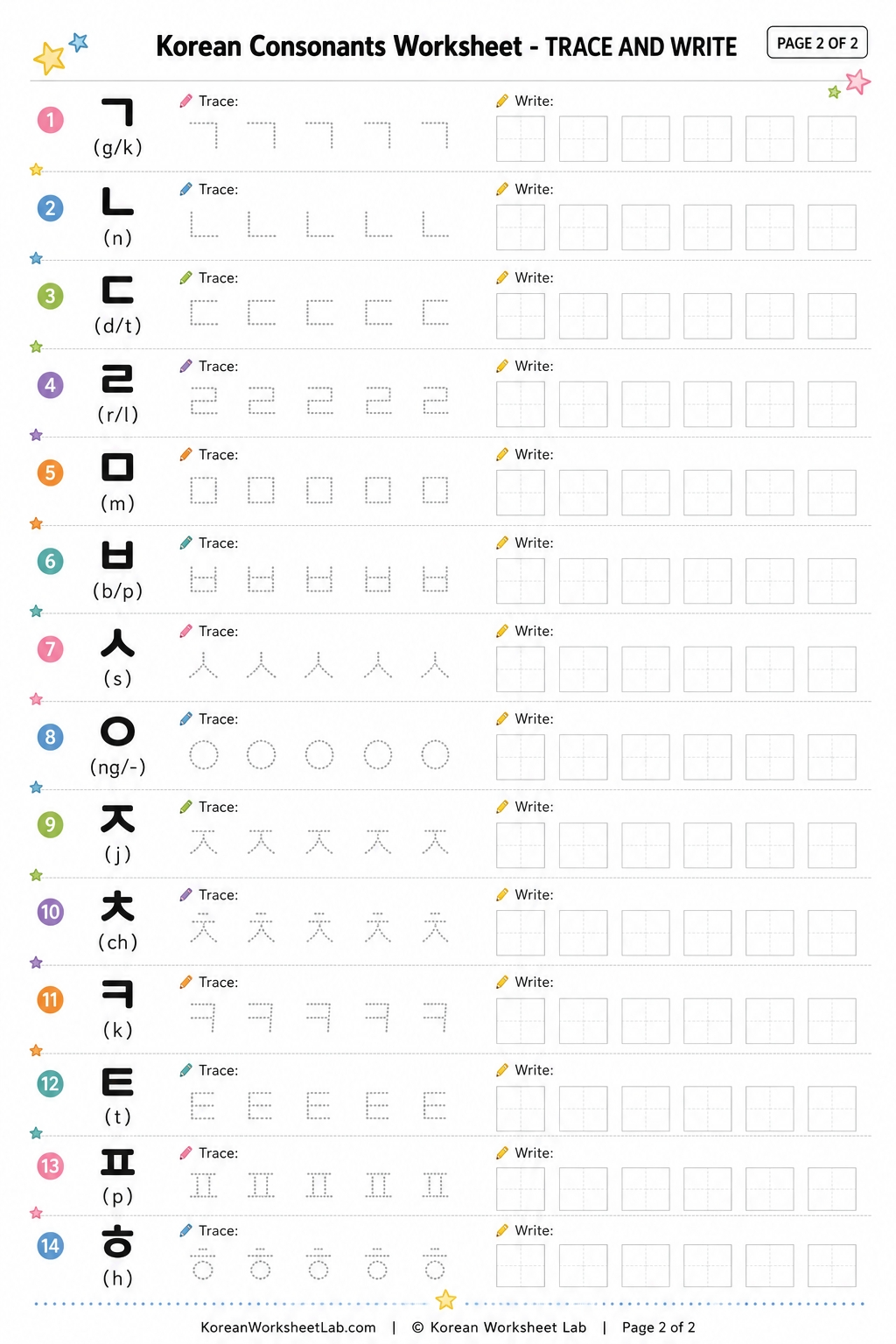 P2
P2Learn the 14 basic Korean consonants with pronunciation notes, mouth-position guidance, tracing practice, writing boxes, and a printable Hangul consonants PDF for beginners.
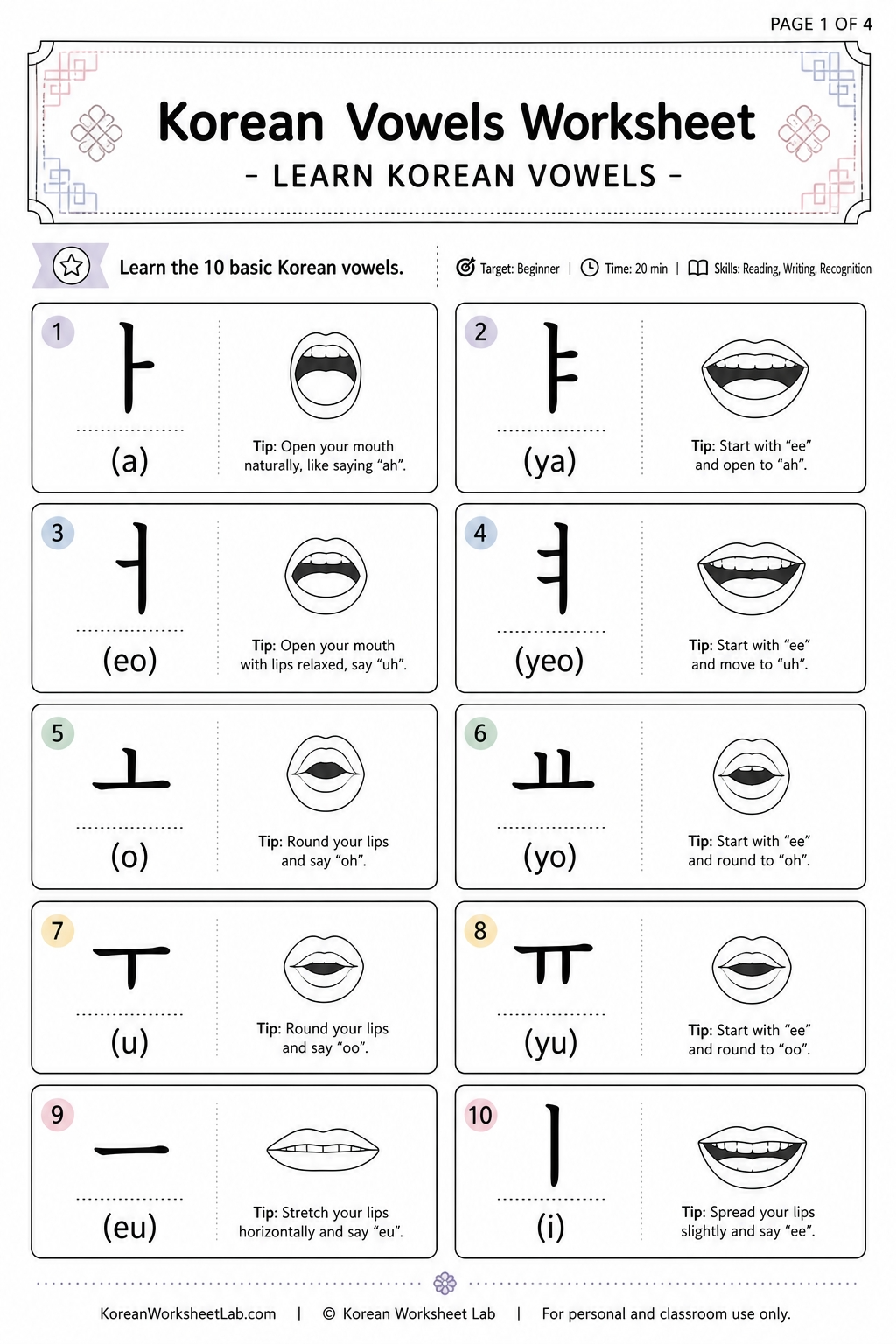 P1
P1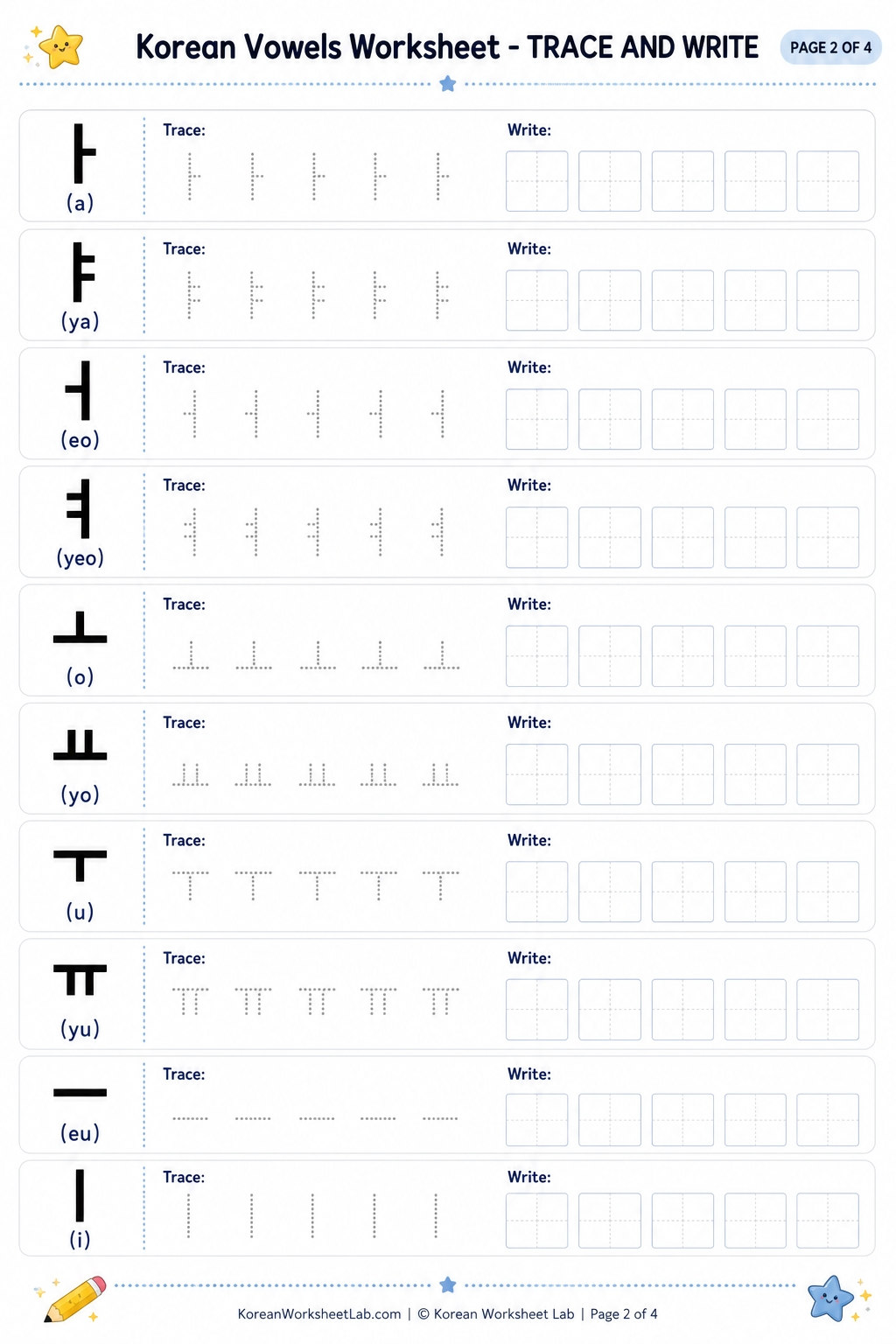 P2
P2Learn the 10 basic Korean vowels with mouth-shape tips, beginner pronunciation notes, tracing practice, writing boxes, and a printable Hangul vowels PDF.
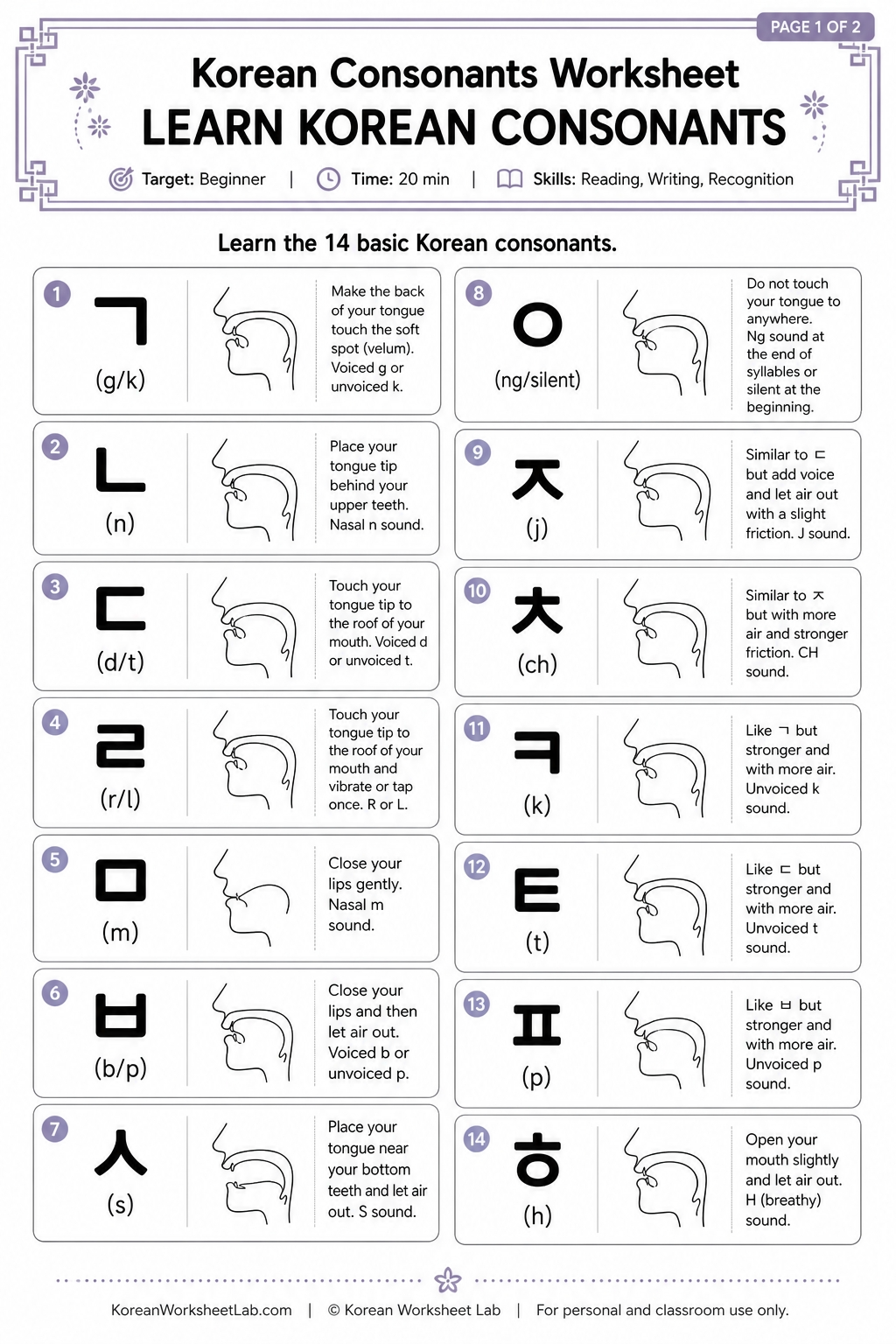
Download a Korean alphabet PDF in English with Hangul consonants, vowels, syllable blocks, kids tracing pages, and printable practice previews.
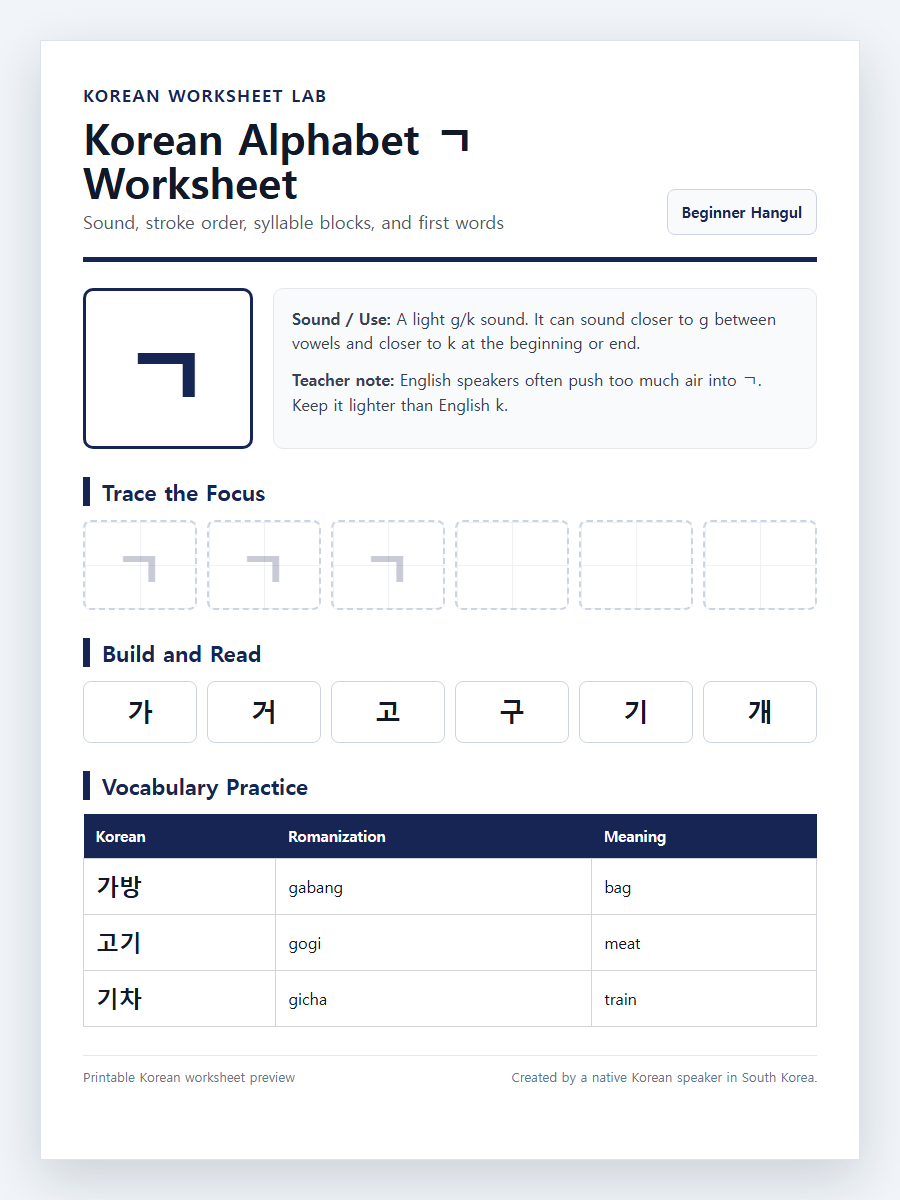
Learn the Korean consonant ㄱ with pronunciation guidance, stroke order practice, syllable building, and a printable worksheet.
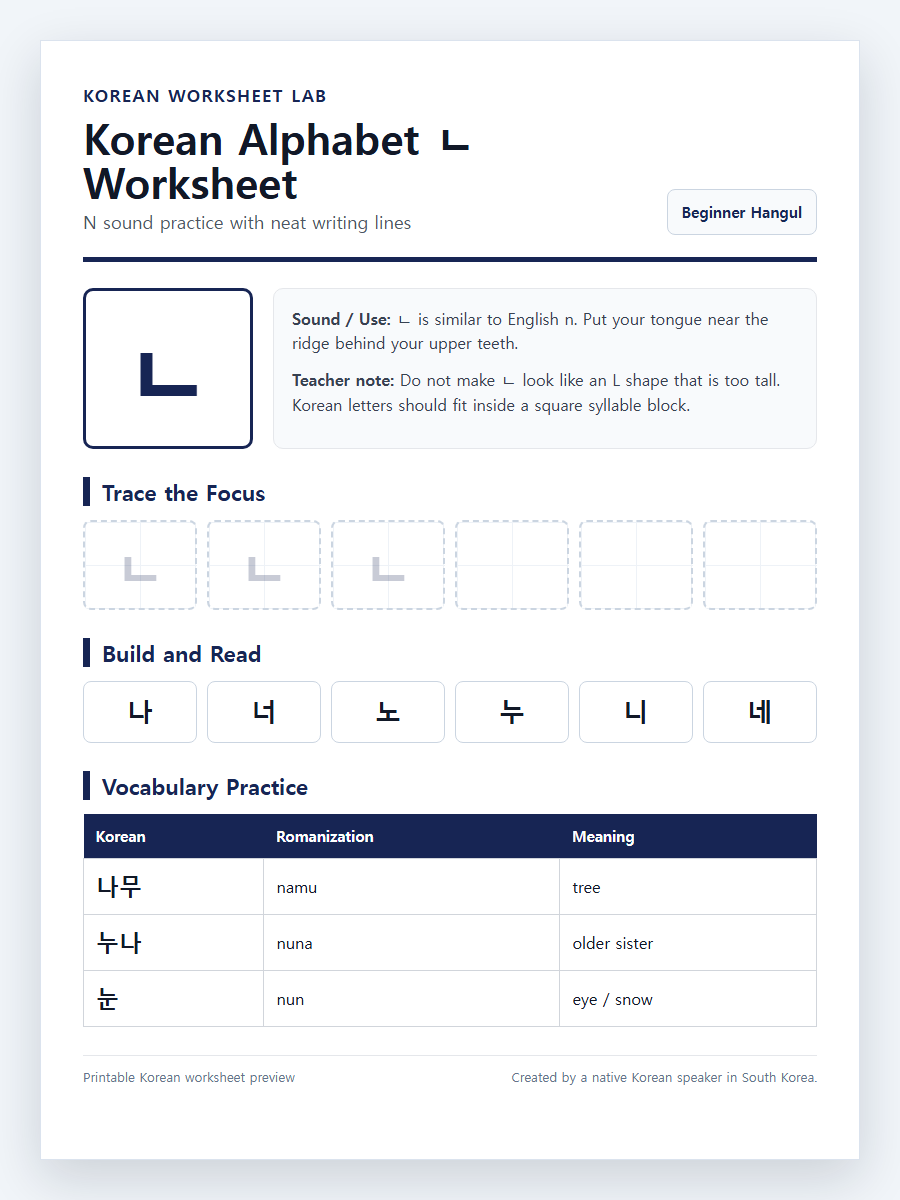
Practice ㄴ as a clean n sound and combine it with vowels to read beginner Korean syllables.
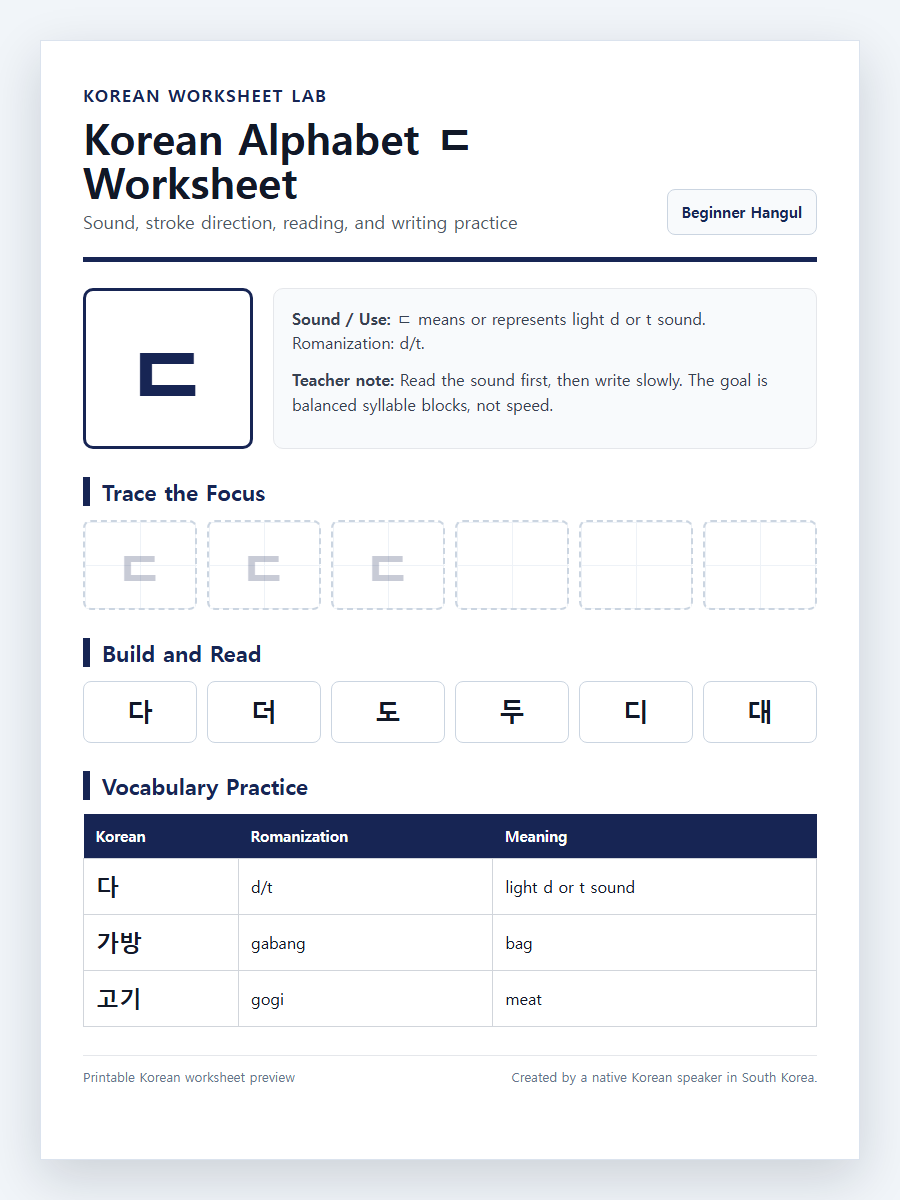
Study ㄷ with writing practice, sound notes, and useful Korean syllables for early reading.
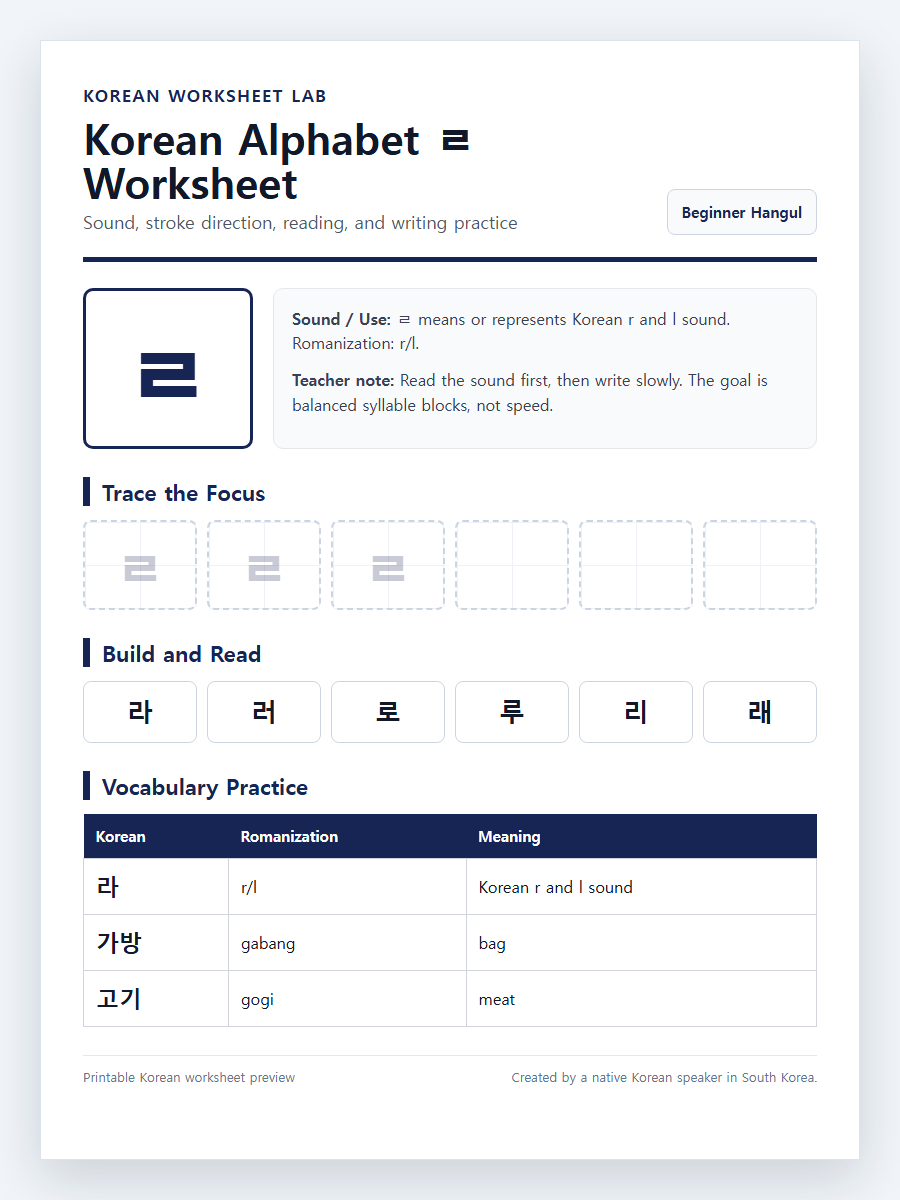
Learn ㄹ as a Korean sound between English r and l, then practice it in syllable blocks.
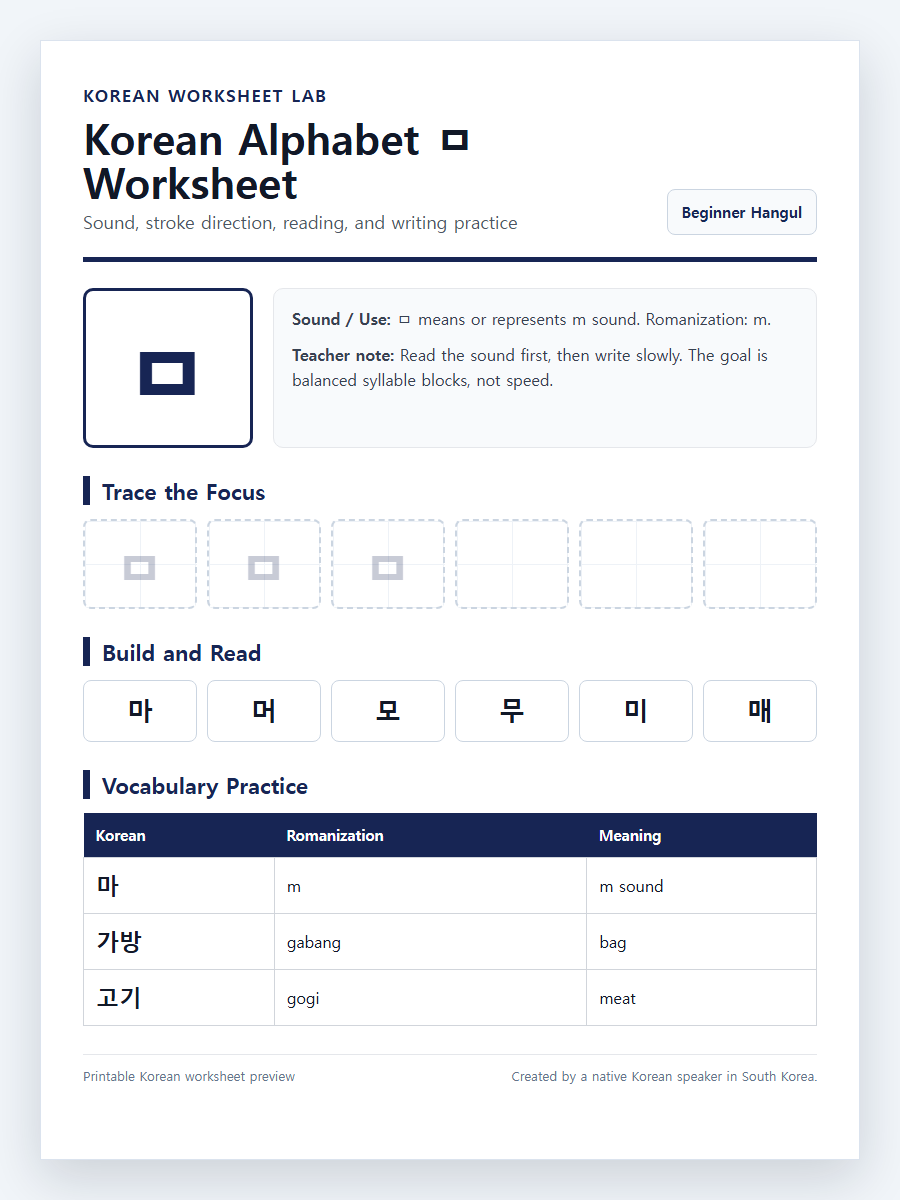
Practice the Korean consonant ㅁ with syllables such as 마 and words that actually use the focus sound.
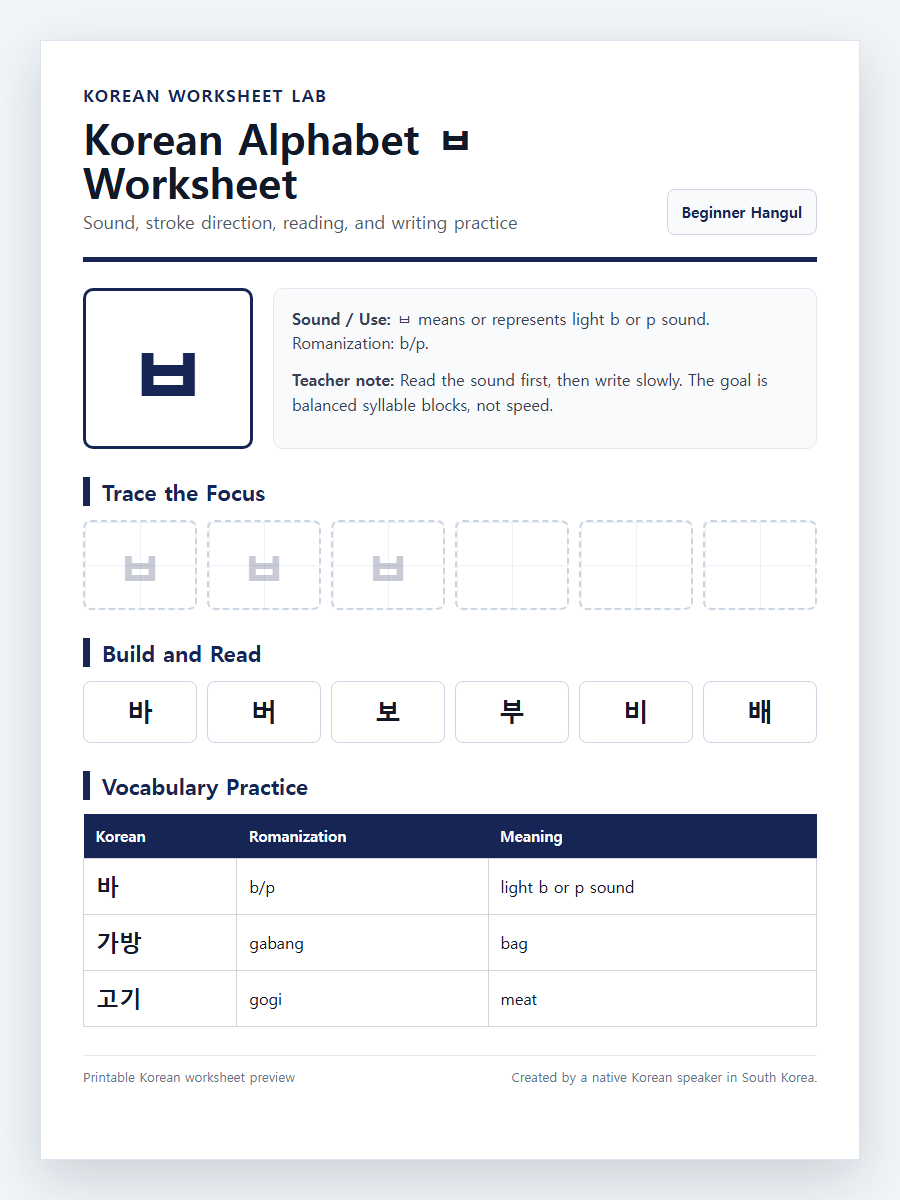
Learn ㅂ with beginner syllables, pronunciation notes, and Korean words that include the sound.
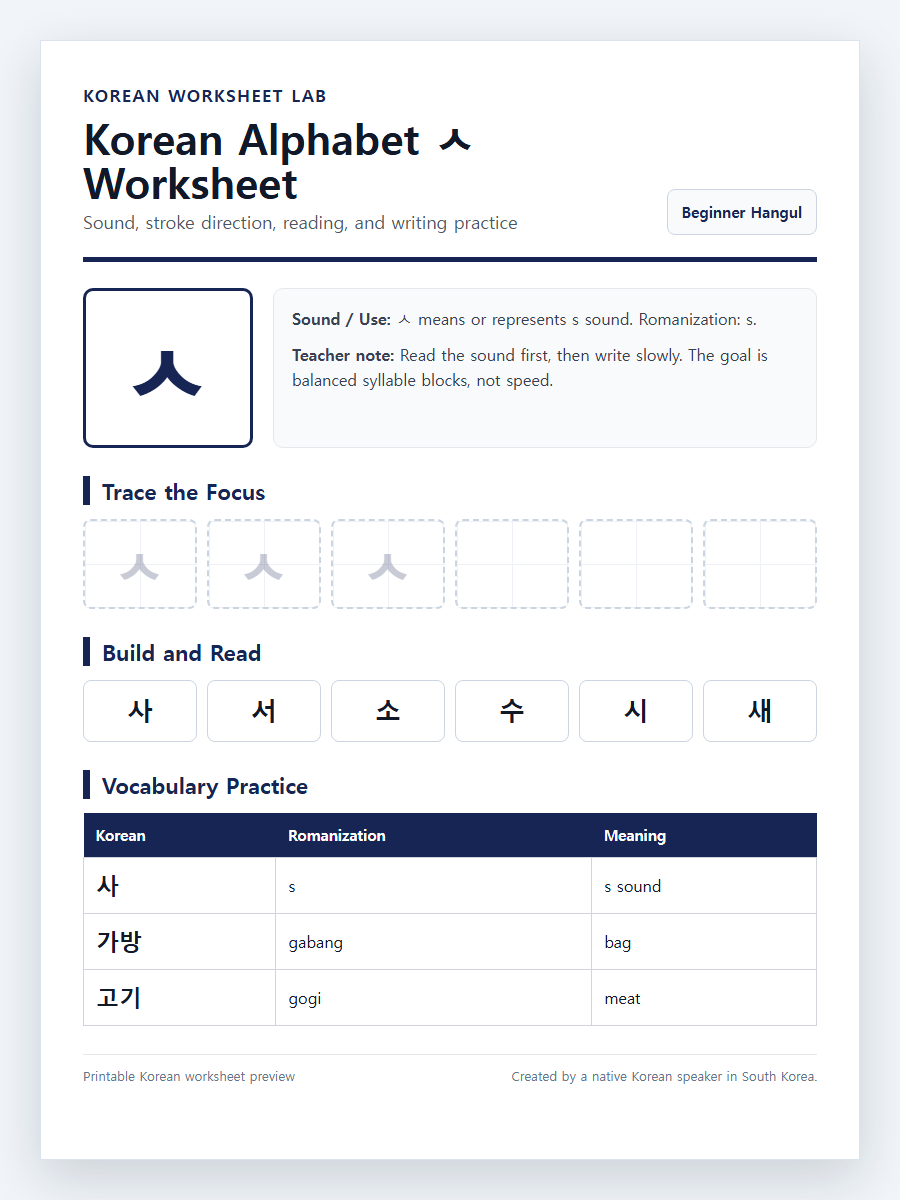
Practice ㅅ with clear stroke order, syllable reading, and beginner Korean vocabulary.
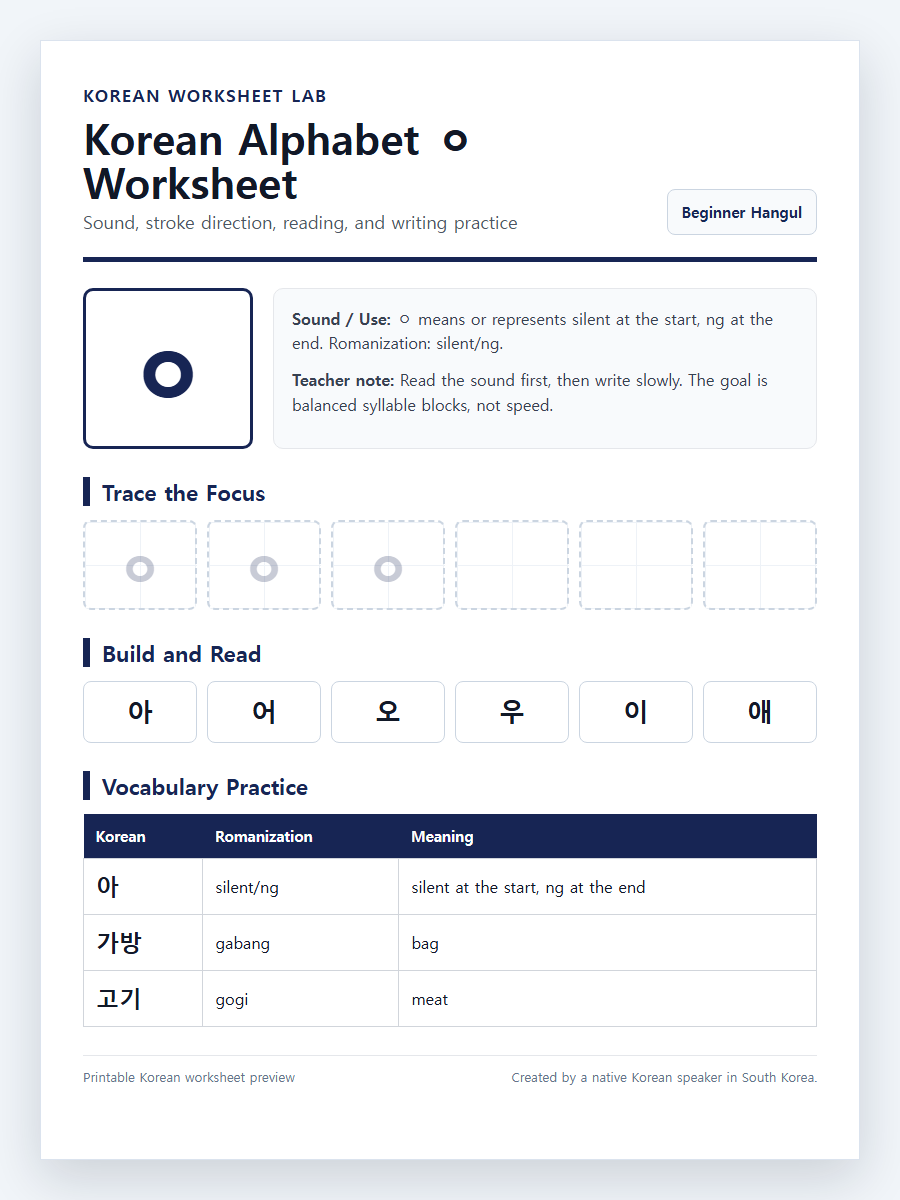
Learn how ㅇ is silent at the start of a syllable and becomes ng at the end.
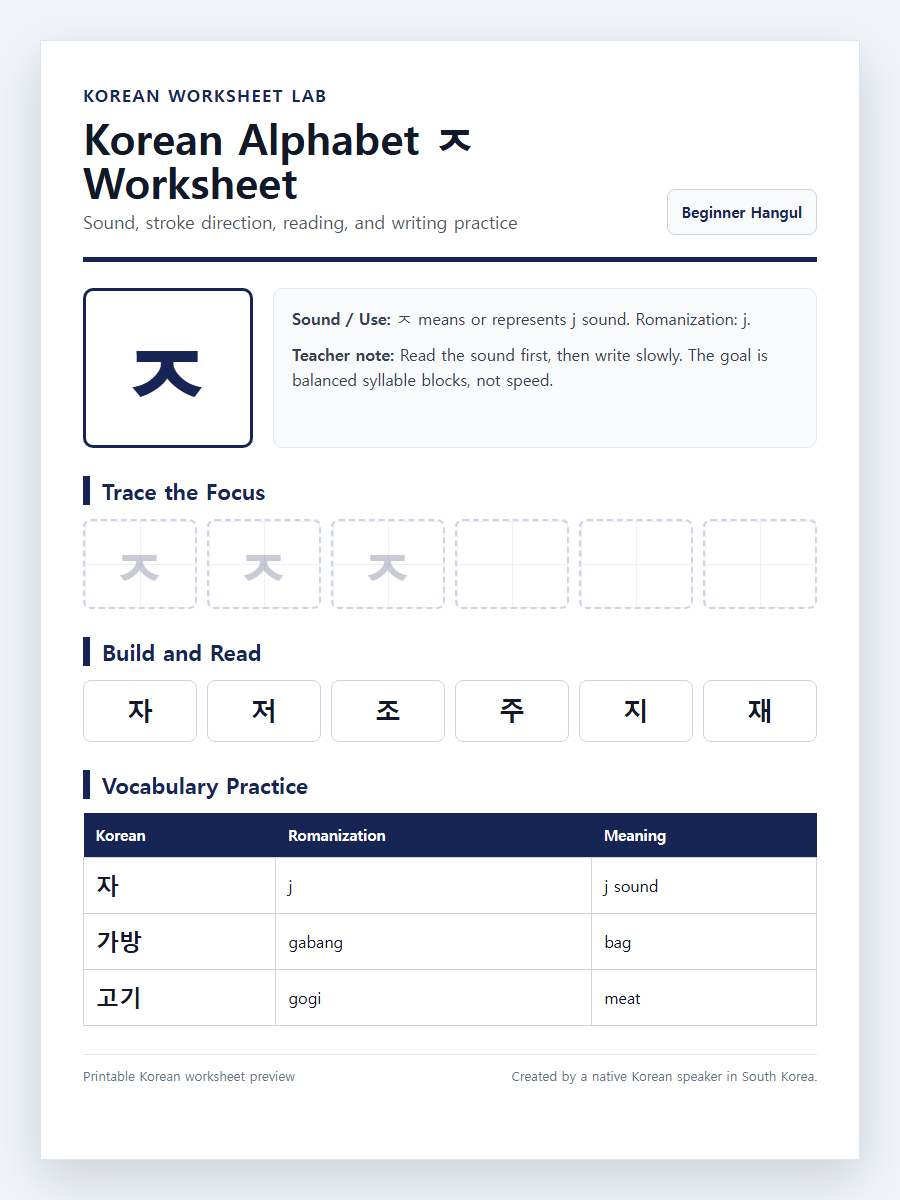
Study ㅈ with writing practice and useful beginner words such as 집 and 지도.
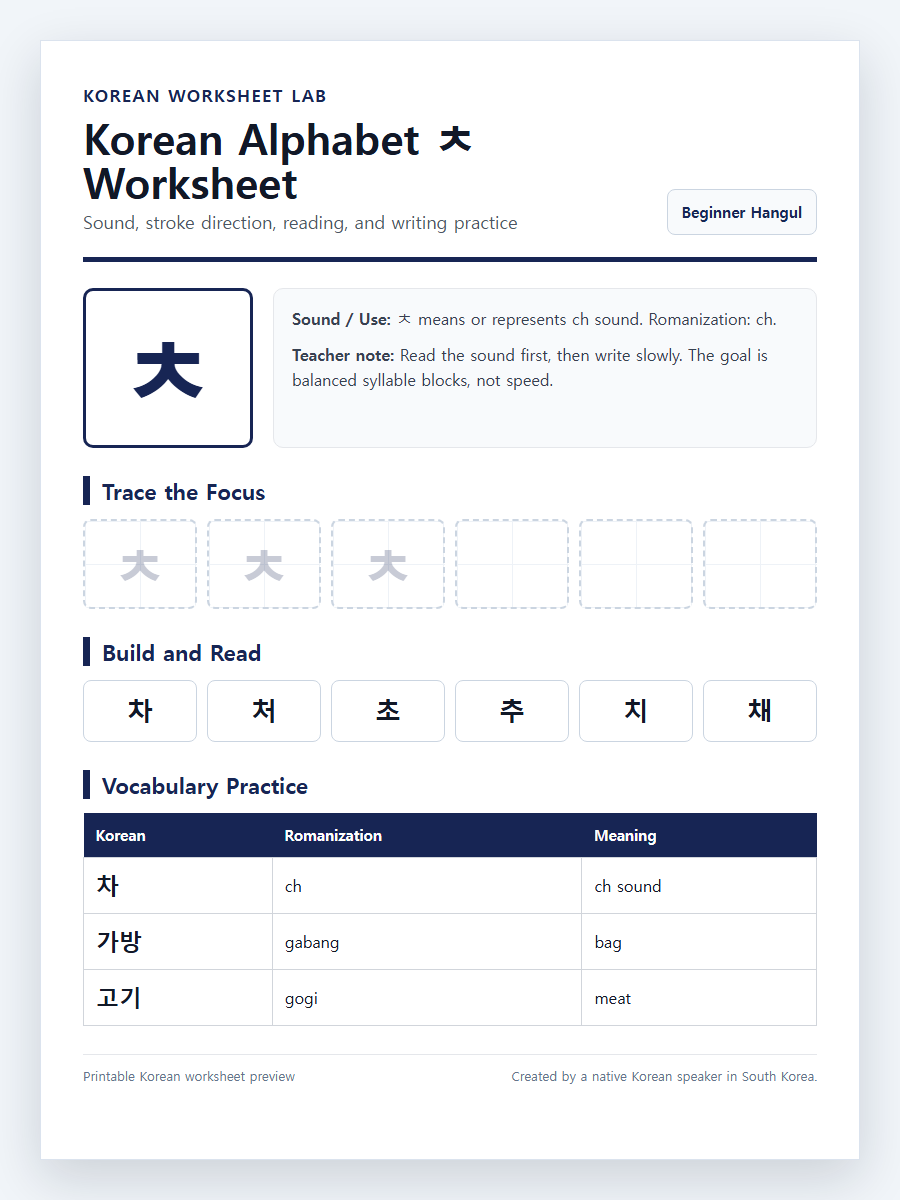
Practice ㅊ as an aspirated ch sound with words learners often meet early.
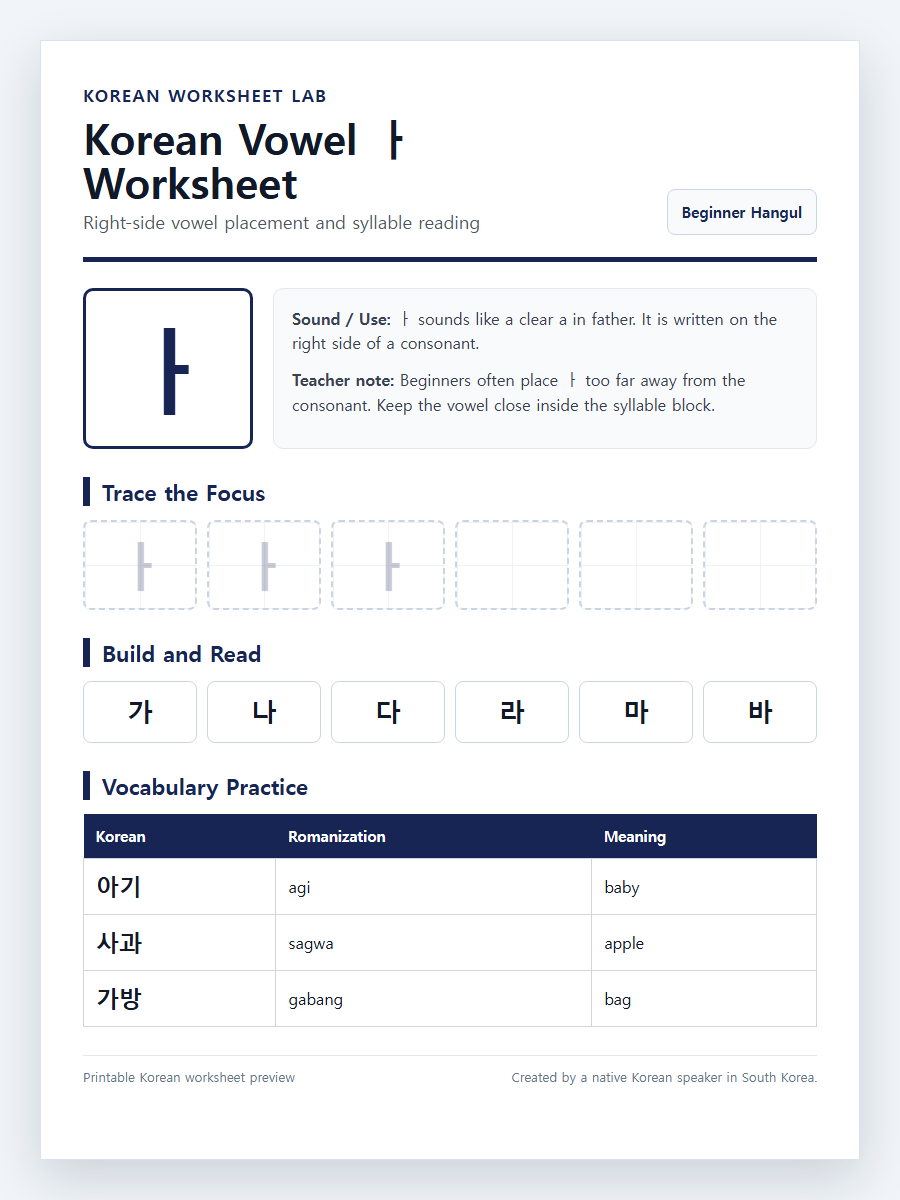
Learn the Korean vowel ㅏ and combine it with consonants to read syllables like 가, 나, 다, and 마.
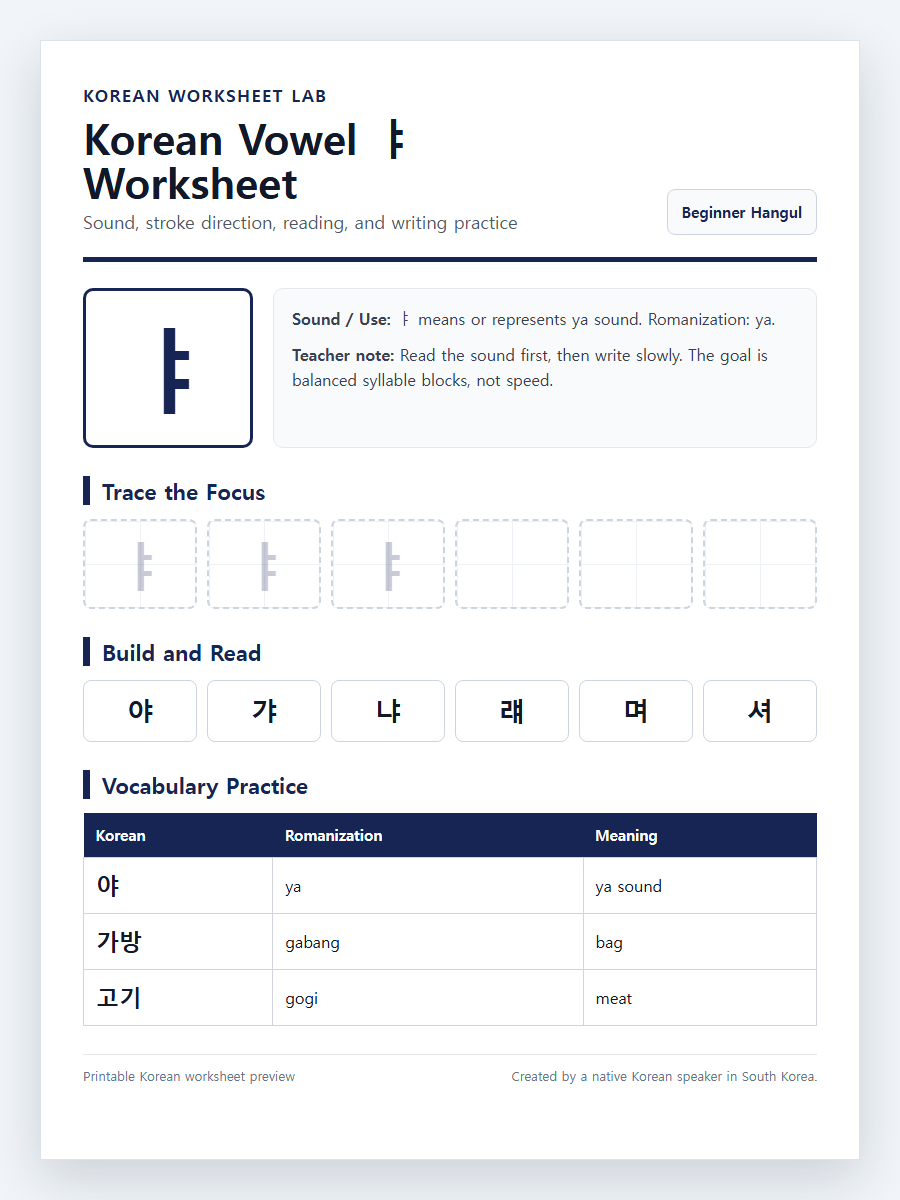
Practice ㅑ and learn how the extra short stroke changes ㅏ into a ya sound.
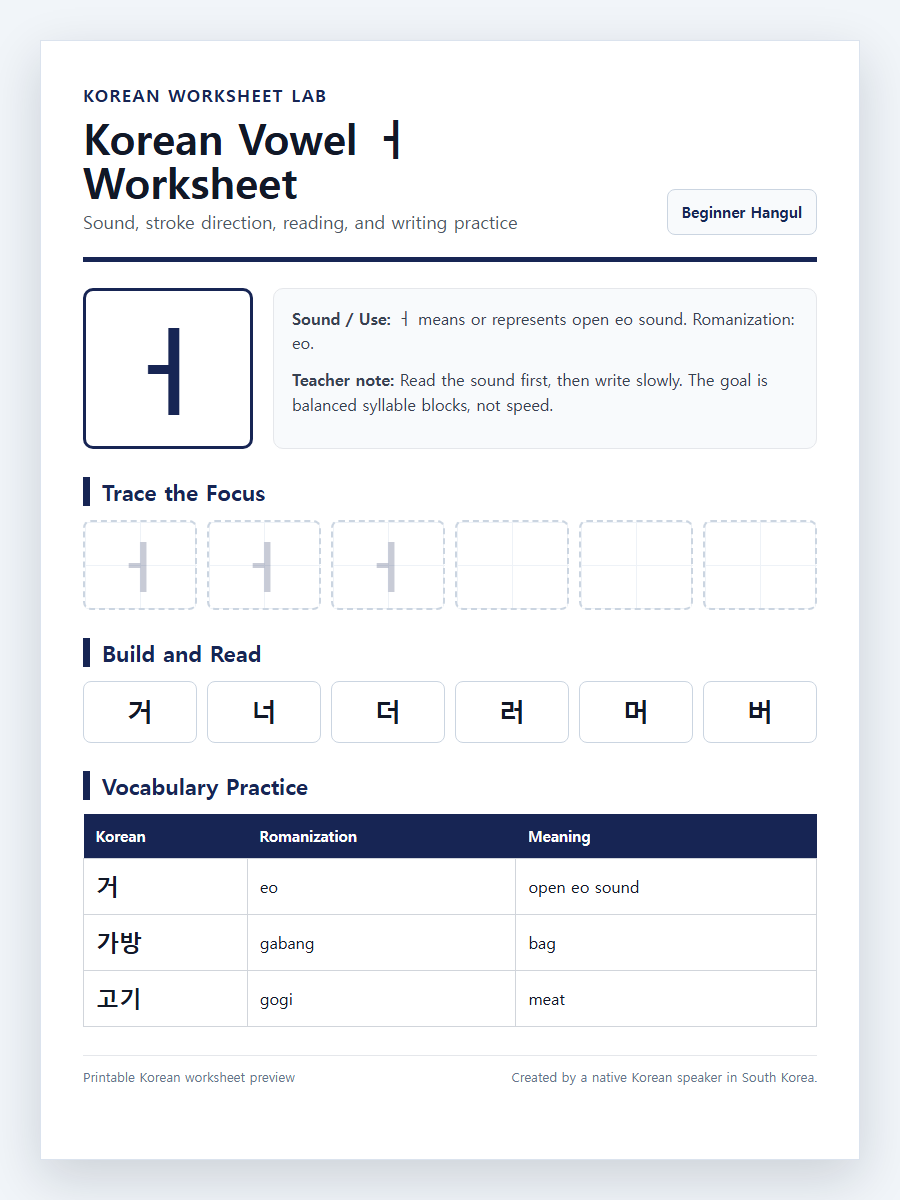
Learn ㅓ, a key Korean vowel that does not match one simple English spelling.
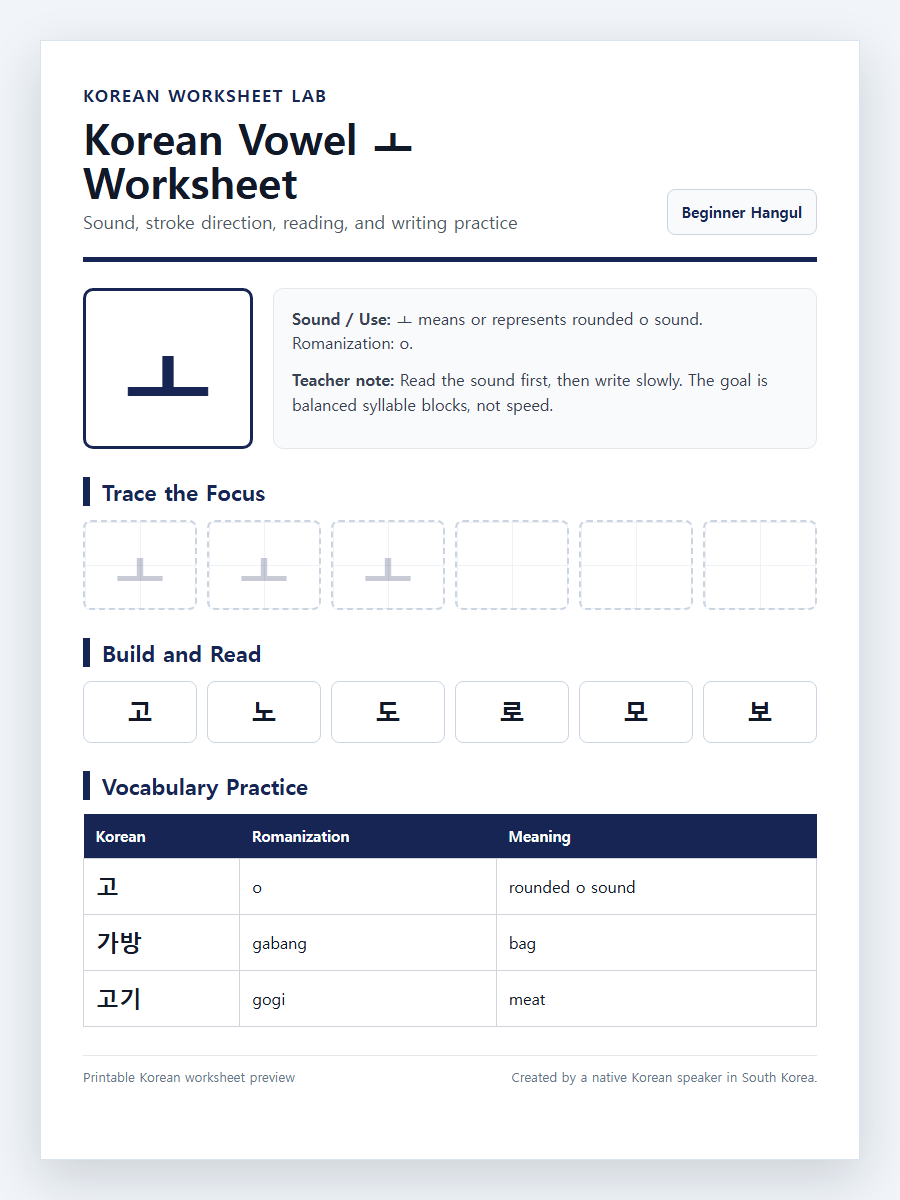
Practice ㅗ with syllables and words that help learners distinguish it from ㅓ.
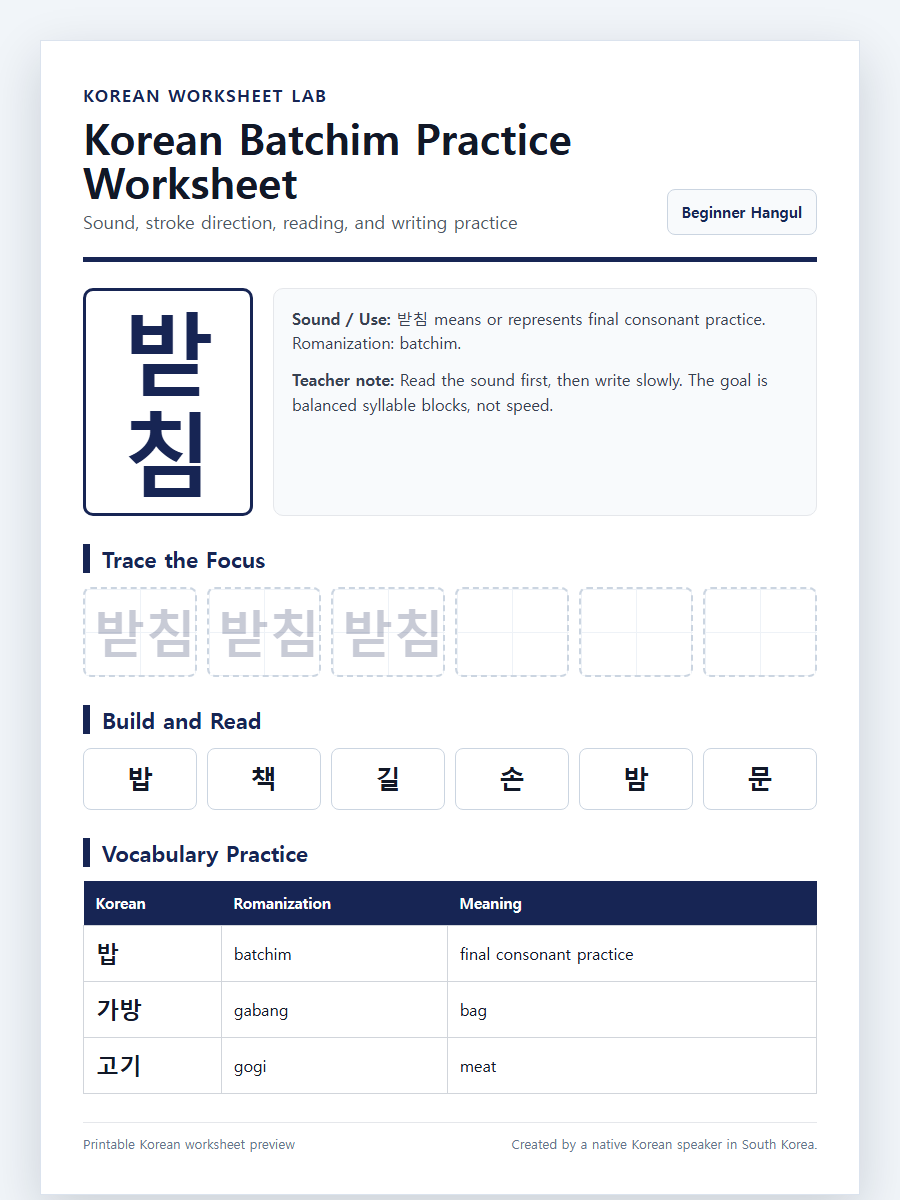
Learn final consonants in Korean syllables and practice reading words that end with a batchim.