Korean Life
Korean Age System Explained
Understand how age is discussed in Korean conversations and why age can affect speech level and relationship words.
Written and reviewed by a native Korean speaker in South Korea. Last reviewed July 2, 2026.
Introduction
Korean Age System Explained connects Korean language with the cultural setting in which it is used. The words in Korean Age System Explained may have quick English translations, but their natural use can depend on age, relationship, politeness, place, and situation. This guide adds that context so learners understand both the meaning and the conditions in which the expression sounds natural.
In Korean Age System Explained, the main focus is 한국 나이 (hanguk nai). For this korean life resource, start with the Korean form, check romanization only when pronunciation support is needed, and then apply the topic in the printable practice.
Learning Objectives
- Recognize the main korean culture focus: 한국 나이.
- Read 나이 in Hangul and use nai only as temporary pronunciation support.
- Use the Korean Age System Explained activities to move from recognizing korean life forms to producing them independently.
- Review 나이, 몇 살이에요?, 동갑 with a teacher, tutor, parent, or study partner.
Culture Overview
Age can influence relationship terms and speech choices in Korean, but legal age and conversational age are not the same question. Since June 28, 2023, international age is the standard for laws, contracts, and official documents, with specific systems still applying in some regulated areas.
Why It Matters for Korean Learners
Learners hear age questions because people may be working out relationship language and social position. That does not make every age question appropriate in every setting.
Pronunciation Tips
몇 살이에요? is pronounced smoothly as one question. The final ㅅ in 몇 changes before 살, so listening to the complete phrase is more useful than spelling it sound by sound.
Mini Dialogue
A:
몇 년생이에요?
What year were you born?
B:
1998년생이에요.
I was born in 1998.
Reading Passage
한국에서는 나이와 출생 연도를 묻는 대화를 들을 수 있어요. 하지만 처음 만난 사람에게 바로 묻는 것이 항상 자연스러운 것은 아니에요. 상황과 관계를 먼저 생각해야 해요.
In Korea, you may hear conversations asking age or birth year. But asking immediately is not always natural with every new person. Consider the situation and relationship first.
Grammar Note
이에요/예요: 1998년생이에요 identifies a person's birth year politely.
Interesting Facts
- International age became the general standard in laws and official documents on June 28, 2023.
- Birth year can be used conversationally when people establish age order.
- School year and specific regulated age rules can follow their own legal standards.
Common Misunderstandings
- Everyone uses the old counting-age system in every context.
- Knowing age automatically tells you exactly which speech level to use.
- It is always polite to ask a stranger's age immediately.
Culture Tips
- Listen for 몇 살 and 몇 년생.
- Answer only as specifically as you are comfortable.
- Use polite speech until the relationship is clear.
Etiquette
Age can be personal information. In professional, international, or first-meeting contexts, wait for a natural reason before asking.
Native Speaker Note
Many people now state 만 나이 when precision matters, while birth year remains convenient in social conversation. Actual habits vary by person and setting.
Reference: Korea.net: International age standard adopted in 2023
How to Use This Resource
- Begin with the Korean Age System Explained vocabulary table and identify the Korean form for age.
- While studying Korean Age System Explained, say 나이 and 몇 살이에요? aloud before writing so pronunciation and Hangul stay connected.
- Complete the korean life practice slowly, then repeat the item that was hardest to recall.
- After finishing Korean Age System Explained, open a related korean culture lesson and reuse at least one item from 한국 나이.
Key Vocabulary
| Korean | Romanization | Meaning / Use |
|---|---|---|
| 나이 | nai | age |
| 몇 살이에요? | myeot sarieyo | How old are you? |
| 동갑 | donggap | same age |
| 어리다 | eorida | to be young |
Examples and Study Notes
- In Korean Age System Explained, 한국 나이 carries more context than a one-word English translation can show.
- When reviewing Korean Age System Explained, pay attention to who is speaking, the relationship, and the level of politeness in the example.
- Use the Korean Age System Explained worksheet to separate dictionary meaning from natural Korean usage.
Worksheet Preview
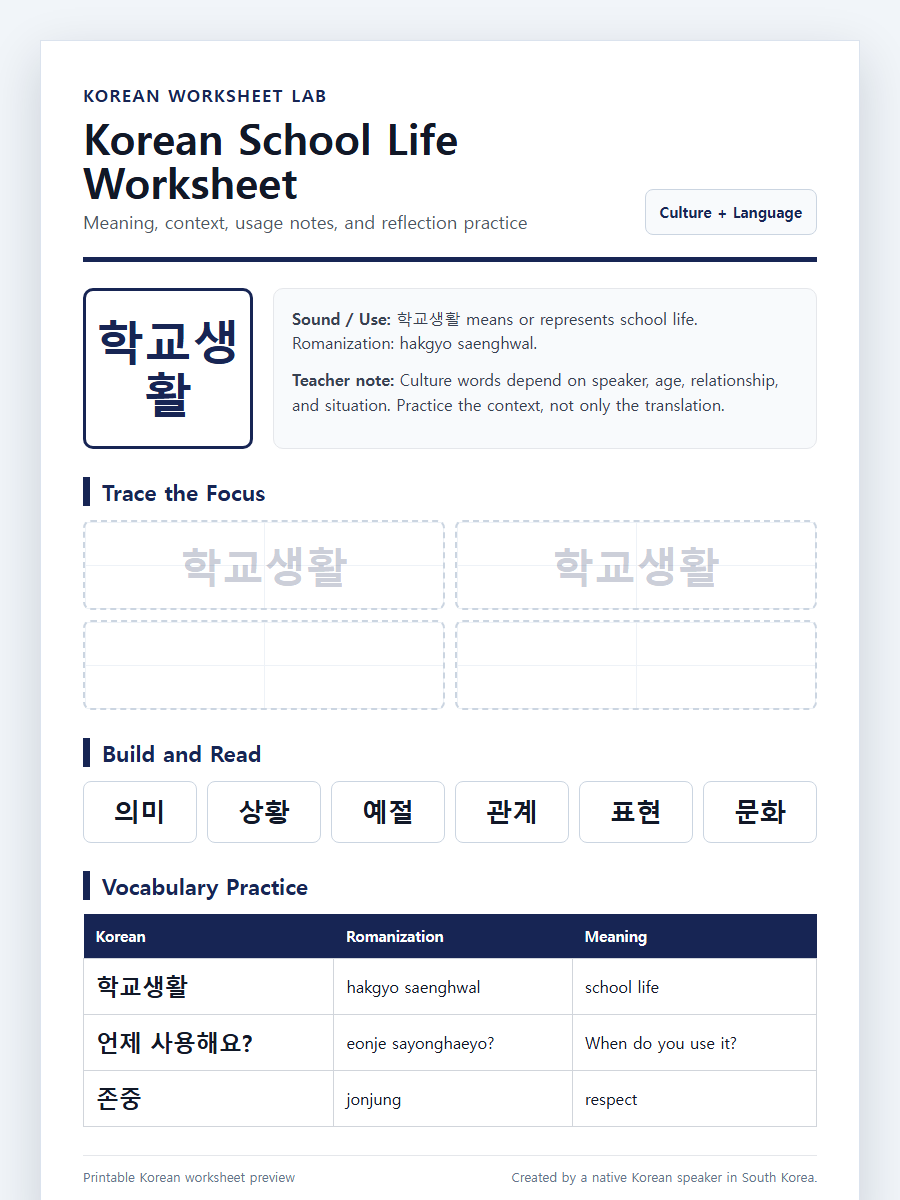
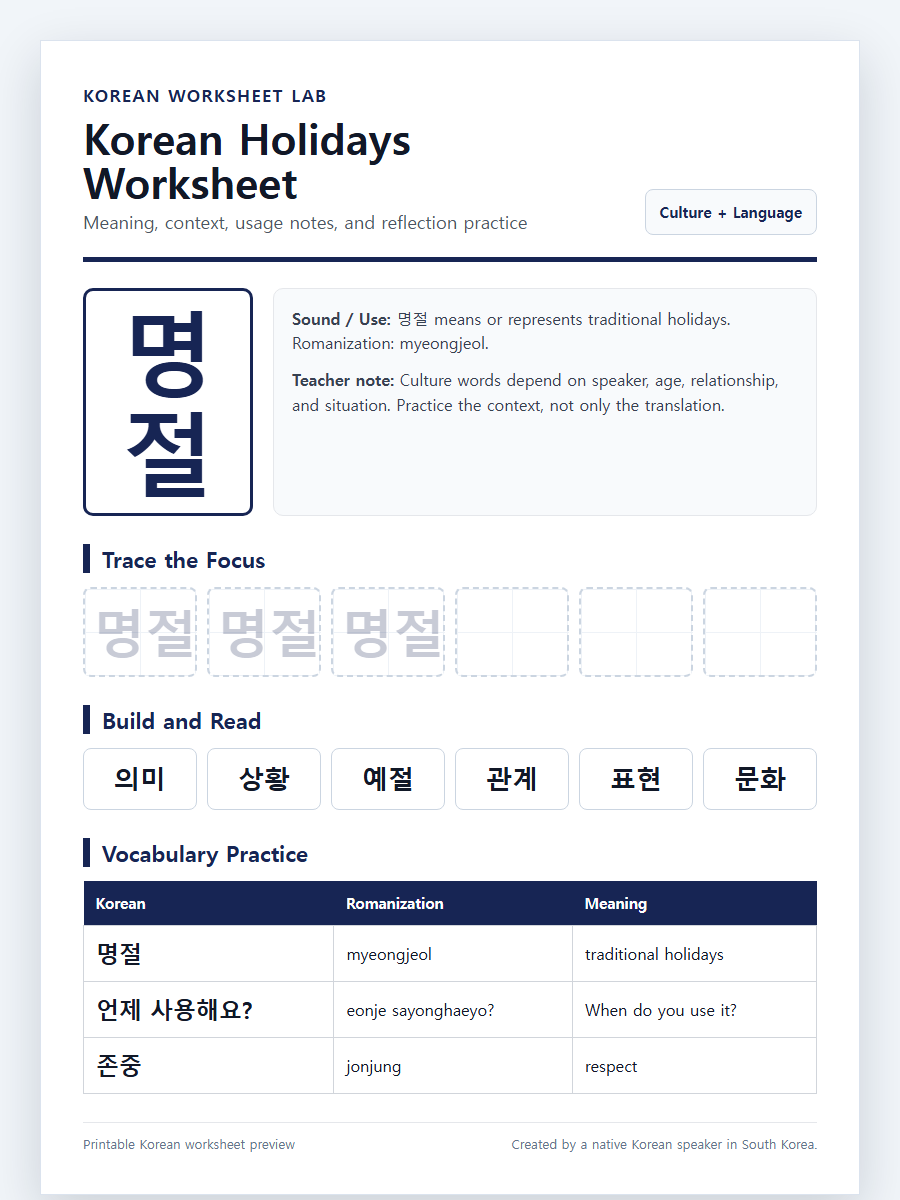
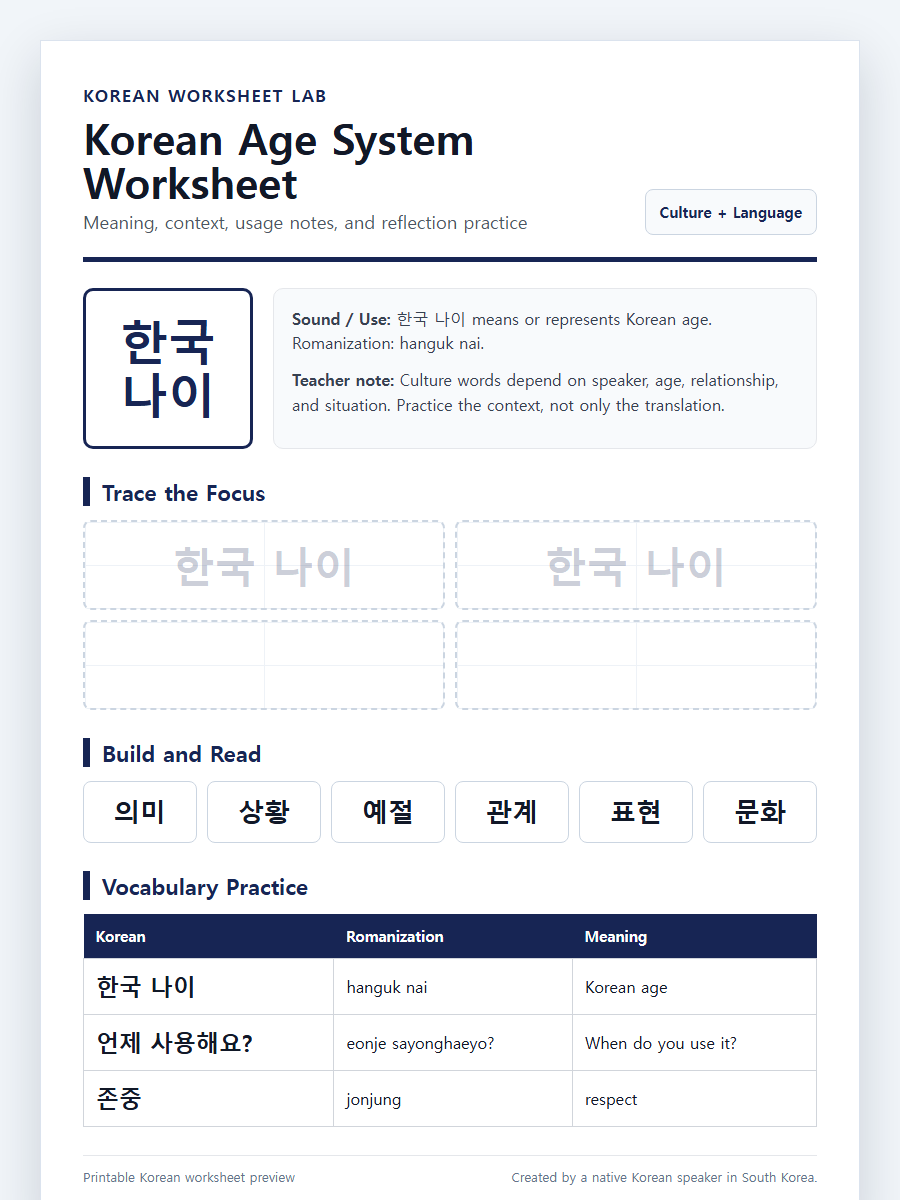
Preview every available page of Korean Age System Explained before printing. Its activities reinforce the korean life explanation through the reading, writing, recognition, or sentence work shown below.
Download PDF
Download the Korean Age System Explained PDF after reviewing the examples and key vocabulary. Complete the first attempt carefully, then revisit the hardest korean life item the next day instead of repeating only the easy rows.
Download Printable PDFPrint This WorksheetAnswer Key
Guided Practice
Complete the first Korean Age System Explained round with the vocabulary table and examples visible. The goal is accurate korean life thinking, not speed.
- Read 나이 (nai) with the meaning “age,” then cover the English and identify it again.
- Compare 나이 with 몇 살이에요?. Say what changes in sound, meaning, sentence role, or context.
- Complete the first korean life example with the lesson open, checking each step before moving on.
Independent Practice
Close or cover the Korean Age System Explained key vocabulary before starting this round. Check your work only after all three tasks are complete.
- In Korean Age System Explained, write 몇 살이에요? from memory and add its English meaning without checking the vocabulary table.
- Create one original Korean Age System Explained example using 동갑; use a complete phrase or sentence when the topic allows it.
- Finish the Korean Age System Explained printable task independently, then mark any item that required romanization or an English hint.
Review Checklist
- I can recognize 나이 without looking at the English.
- I can explain or use 몇 살이에요? in the context taught on this page.
- I can complete the korean life task with less support than on my first attempt.
- I know which item from Korean Age System Explained needs another review tomorrow.
Mini Quiz
- Which Korean form in this lesson means “age”?
- How is 몇 살이에요? romanized, and what does it mean here?
- Write the Korean form for “same age.”
Mini Quiz Answer Key
Check the Korean Age System Explained answers only after completing the mini quiz. Accept equivalent English wording when the Korean form and this lesson's meaning are accurate.
- 나이 (nai)
- myeot sarieyo; How old are you?
- 동갑 (donggap)
Teacher Notes
- Learning objective
- By the end of the lesson, learners should recognize the main focus 한국 나이 and complete one meaning, relationship, and context analysis task with reduced support.
- Recommended age
- Teens and adults; adaptable for supported younger learners
- Level
- Beginner
- Estimated time
- 20-30 minutes
- Materials needed
- Printed worksheet or lesson page, pencil, eraser, and a separate sheet for extension work
- Extension activity
- Find one realistic situation for 나이 and explain who can use it, with whom, and at what politeness level.
- Assessment idea
- For the Korean Age System Explained assessment, ask learners to identify 나이, explain 몇 살이에요?, and produce or apply 동갑 without copying. Record whether each response is independent, prompted, or not yet secure.
Tips for Self-learners
- Read the korean life explanation before printing Korean Age System Explained.
- Complete one page carefully and say 나이 aloud as you work.
- Review the hardest row containing 몇 살이에요? the next day.
- For Korean Age System Explained, cover the English meanings and test whether you can recognize the Korean forms first.
Tips for Parents and Teachers
- Introduce Korean Age System Explained in a short first round and prioritize accurate recognition of 나이 over finishing every item.
- For Korean Age System Explained, model 나이 and 몇 살이에요? aloud, then use group repetition before independent writing.
- During tutoring, ask the learner to point to the Korean form for “age” before revealing the English answer.
- Return to this korean life worksheet after one or two days and compare reading speed with the first attempt.
Common Mistakes
- Do not read only “nai.” Look back at 나이 so romanization remains a temporary bridge.
- In Korean Age System Explained, do not rush the written form of 나이; slow practice makes Korean letter shape and syllable spacing easier to notice.
- Do not assume “age” always maps word for word to Korean. Check the example and context provided in Korean Age System Explained.
FAQ
Is Korean Age System Explained good for beginners?
Yes. Korean Age System Explained introduces 한국 나이 with Hangul, romanization support, English meaning, and guided korean life practice.
Can teachers or parents use this resource?
Yes. Teachers and parents can use the Korean Age System Explained printable for a korean life warmup, tutoring task, homework review, or independent practice.
Should learners download the PDF first?
For Korean Age System Explained, read the explanation and the entries for 나이 and 몇 살이에요? first, then use the PDF for active review.