Introduction
The difference between 은/는 and 이/가 is one of the first Korean grammar problems that makes beginners feel stuck. Both can appear after a noun, and both can sometimes be translated with the same English subject. The real difference is not simply a or the, and it is not only subject versus topic.
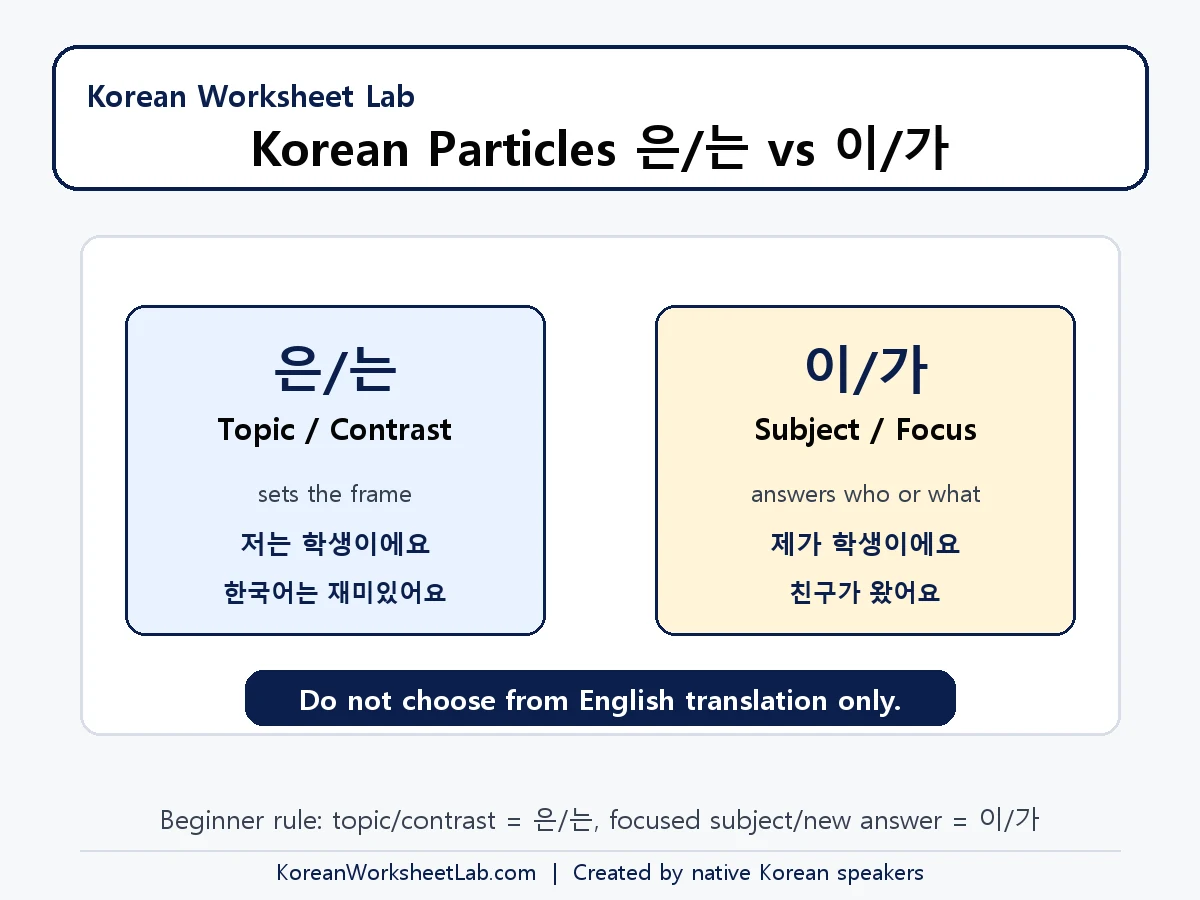
A practical beginner rule is this: 은/는 sets the topic, gives a general statement, or creates contrast. 이/가 identifies the subject, introduces new information, or answers who or what. This guide explains the difference with natural examples, common mistakes, and short practice so you can make better choices without guessing.
Learning Objectives
- Understand the main job of 은/는 as a topic or contrast marker.
- Understand the main job of 이/가 as a focused subject marker.
- Choose particles based on information focus, not English translation.
- Practice common beginner sentence pairs with clear explanations.
The Fast Difference
Use 은/는 when you want to set the frame of the sentence. It often means as for this thing or speaking of this person. Use 이/가 when you want to identify who or what fits the sentence, especially when the information is new or important.
For example, 저는 학생이에요 means as for me, I am a student. 제가 학생이에요 can answer who is the student? The English translation may look similar, but the Korean information focus is different.
- 은/는 = topic, contrast, general frame
- 이/가 = subject, identification, new information
- English translation alone cannot decide the particle
When to Use 은/는
은/는 is useful when a noun is already the topic or when you are making a general statement about it. 한국어는 재미있어요 means Korean is interesting, with Korean as the topic. 저는 미국에서 왔어요 means as for me, I came from the United States.
은/는 also creates contrast. 커피는 좋아해요 can mean I like coffee, but it may imply contrast with something else: I like coffee, but maybe not tea. This contrast feeling is one reason 은/는 appears often in comparisons.
- 저는 학생이에요 = As for me, I am a student.
- 한국어는 재미있어요 = Korean is interesting.
- 커피는 좋아해요 = I like coffee, with possible contrast.
When to Use 이/가
이/가 marks the subject that is being identified or focused. If someone asks 누가 왔어요? meaning who came?, the natural answer is 친구가 왔어요. The new important information is 친구, so 가 fits.
이/가 is also common with 있다, 없다, 좋다, 많다, and descriptions where the subject is being presented. 시간이 없어요 means there is no time. 날씨가 좋아요 means the weather is good.
- 친구가 왔어요 = A friend came.
- 시간이 없어요 = There is no time.
- 날씨가 좋아요 = The weather is good.
Consonant and Vowel Forms
The particle form changes based on the final sound of the noun. Use 은 after a consonant and 는 after a vowel. Use 이 after a consonant and 가 after a vowel. This is a sound rule, not a meaning rule.
For example, 학생 ends in a consonant, so 학생은 and 학생이 are possible forms. 저는 uses 는 because 저 ends in a vowel. 친구가 uses 가 because 친구 ends in a vowel.
- Consonant + 은: 학생은
- Vowel + 는: 저는
- Consonant + 이: 학생이
- Vowel + 가: 친구가
Topic vs New Information
A helpful question is: does the listener already know what I am talking about? If the noun is the frame of the conversation, 은/는 often works. If the noun is the new answer or the thing being identified, 이/가 often works.
Compare 이 식당은 맛있어요 and 이 식당이 맛있어요. The first sets this restaurant as the topic: as for this restaurant, it is good. The second can identify this restaurant as the good one, especially among choices.
- Known topic: 은/는
- New answer: 이/가
- Choice or identification: often 이/가
Mini Practice
Choose the better particle based on the situation. If someone asks who is Korean?, answer 제가 한국 사람이에요. If you are introducing yourself generally, say 저는 한국 사람이에요. If you contrast coffee with tea, 커피는 좋아해요 sounds natural.
Now fill in the blanks: 저는 학생이에요. 친구가 왔어요. 시간이 없어요. 한국어는 재미있어요. Read each sentence aloud and ask whether the noun is a topic, contrast, or focused subject.
- General self-introduction: 저는
- Who answer: 제가
- There is no time: 시간이
- Korean as a topic: 한국어는
Vocabulary Box
| Korean | Romanization | Meaning |
|---|---|---|
| 은/는 | eun/neun | topic or contrast marker |
| 이/가 | i/ga | subject or focus marker |
| 저 | jeo | I; me, polite |
| 제가 | jega | I, as focused subject |
| 학생 | haksaeng | student |
| 친구 | chingu | friend |
| 시간 | sigan | time |
| 한국어 | hangugeo | Korean language |
Grammar Box
- Noun ending in a consonant + 은 or 이.
- Noun ending in a vowel + 는 or 가.
- 은/는 sets a topic or contrast. 이/가 identifies or focuses the subject.
- Some sentences can use either particle, but the nuance changes.
Pronunciation Tips
- Particles attach directly to the noun without a strong pause.
- 저는 is pronounced smoothly as jeoneun, not jeo-neun with a long break.
- 제가 is pronounced jega; do not pronounce it like English jay-ga.
Example Sentences
저는 학생이에요.
jeoneun haksaengieyo
I am a student.
제가 학생이에요.
jega haksaengieyo
I am the student. / I am the one who is a student.
친구가 왔어요.
chinguga wasseoyo
A friend came.
한국어는 재미있어요.
hangugeoneun jaemiisseoyo
Korean is interesting.
Common Mistakes
Avoid
Choosing 은/는 or 이/가 from the English word is.
Try this
Choose from Korean information focus: topic, contrast, subject, or new answer.
Avoid
Using 저는 to answer 누가?
Try this
Use 제가 when answering who? with I.
Avoid
Thinking 은/는 always means the.
Try this
은/는 marks topic or contrast, not English articles.
Avoid
Ignoring final consonants.
Try this
Check the noun ending before choosing 은/는 or 이/가.
Study Tips
- Memorize sentence pairs instead of isolated rules.
- Ask whether the noun is old information or new information.
- Practice 누가? questions with 이/가 answers.
- Use the particle cheat sheet after reading this comparison.
Summary
은/는 marks topic, frame, or contrast. 이/가 marks subject, identification, or new focused information.
The same English translation can hide a different Korean nuance, so learners should practice sentence pairs.
For beginners, the safest method is to ask what job the noun has in context before choosing the particle.
Frequently Asked Questions
What is the difference between 은/는 and 이/가?
은/는 marks a topic or contrast, while 이/가 marks a focused subject, new information, or identification.
Should I say 저는 or 제가?
Use 저는 for a general self-introduction or topic. Use 제가 when answering who? or focusing I as the subject.
Can 은/는 and 이/가 both be correct?
Yes. Sometimes both are grammatical, but they usually create a different focus or nuance.
How do I choose 은 or 는?
Use 은 after a consonant-ending noun and 는 after a vowel-ending noun.
Related Learning Resources
This article follows the Korean Worksheet Lab editorial standards and is reviewed for beginner clarity and natural Korean usage.