Introduction
Batchim is the final consonant position at the bottom of a Korean syllable block. It is one of the first Hangul topics that makes learners feel that Korean spelling and Korean sound are not always identical.
The good news is that batchim pronunciation follows patterns. You do not need to memorize every word separately. If you understand the seven main final sound groups, the short unreleased final sound, and what happens before a vowel, Korean reading becomes much more predictable.
Learning Objectives
- Understand what batchim means in a Korean syllable block.
- Recognize the seven common final consonant sound groups.
- Read beginner words such as 책, 밥, 밤, 문, and 강 more accurately.
- Avoid adding extra English vowel sounds after final consonants.
What Is Batchim?
A Korean syllable block can have an initial consonant, a vowel, and sometimes a final consonant. The final consonant is called 받침. In the word 밥, the bottom ㅂ is batchim. In the word 문, the bottom ㄴ is batchim.
Batchim changes the rhythm of a word. Open syllables such as 가 and 나 end with a vowel sound. Closed syllables such as 각, 문, and 밥 end with a short final consonant sound. Beginners should practice hearing and writing that difference.
- 가 = no batchim
- 각 = ㄱ batchim
- 문 = ㄴ batchim
- 밥 = ㅂ batchim
The Seven Main Final Sounds
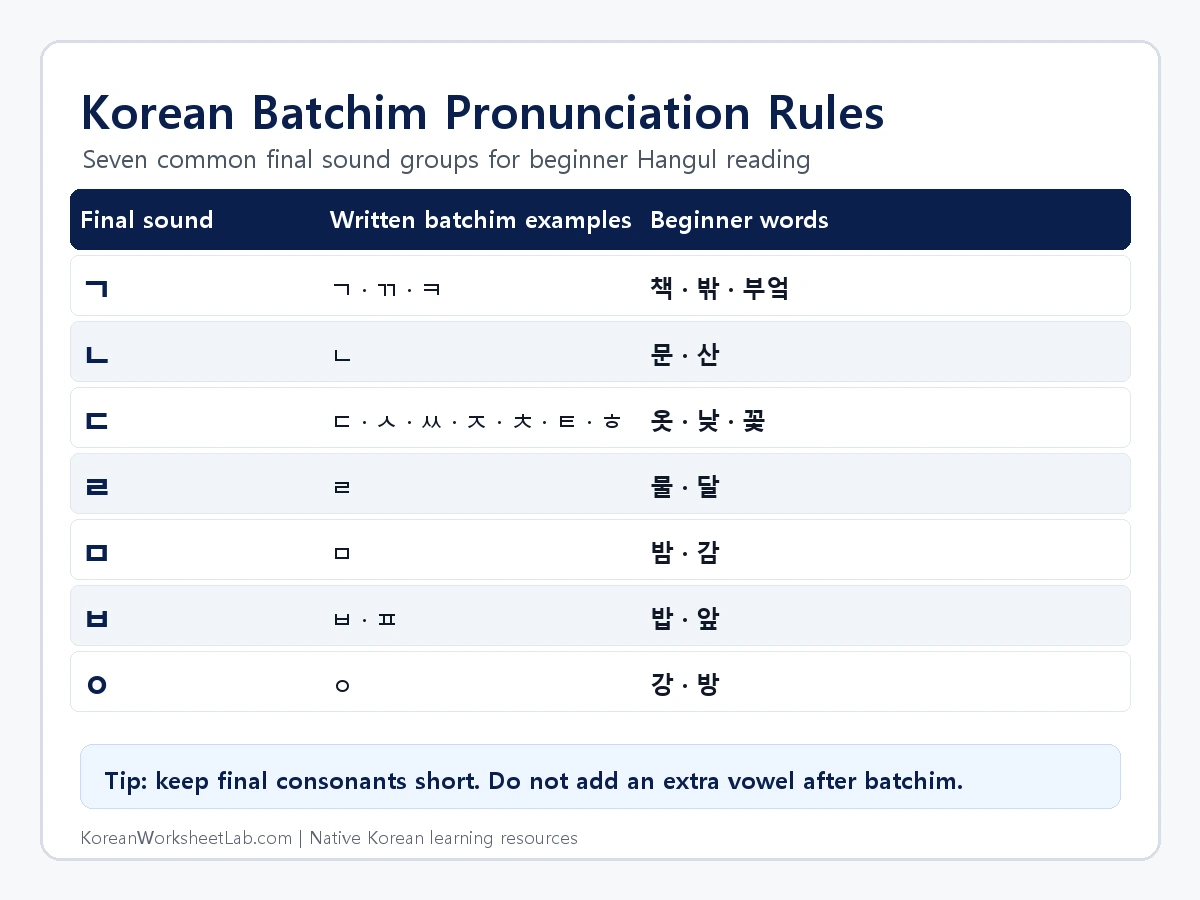
In standard Korean pronunciation, many written final consonants are pronounced as one of seven basic final sounds: ㄱ, ㄴ, ㄷ, ㄹ, ㅁ, ㅂ, or ㅇ. This is why written spelling and final sound do not always match one-to-one.
For example, ㄱ, ㄲ, and ㅋ can all sound like a short final ㄱ at the end of a syllable. ㄷ, ㅅ, ㅈ, ㅊ, ㅌ, and ㅎ often reduce to a short final ㄷ sound when nothing follows. This reduction is normal, not a mistake.
- ㄱ sound: ㄱ, ㄲ, ㅋ
- ㄴ sound: ㄴ
- ㄷ sound: ㄷ, ㅅ, ㅆ, ㅈ, ㅊ, ㅌ, ㅎ
- ㄹ sound: ㄹ
- ㅁ sound: ㅁ
- ㅂ sound: ㅂ, ㅍ
- ㅇ sound: ㅇ
Do Not Release the Final Sound Too Strongly
English speakers often pronounce final consonants with a strong release. Korean batchim is usually shorter and more contained. The final sound in 밥 is not a full English buh-puh. It is a short closed ㅂ sound.
A useful practice method is to close the sound without adding another vowel. Say 밥, stop, and do not add 으 or 어 after it. The word should remain one syllable, not become 바브 or 바버.
What Happens Before a Vowel?
When the next syllable begins with ㅇ and a vowel, the batchim sound often links forward. For example, 밥이 is pronounced closer to 바비. The written ㅂ remains in 밥, but the sound moves into the next syllable during pronunciation.
This linking is one reason learners should practice words inside short phrases, not only as isolated blocks. Reading 밥, then 밥이, then 밥을 helps you hear how the same written word changes in connected speech.
- 밥 + 이 = 밥이, pronounced like 바비
- 문 + 을 = 문을, pronounced like 무늘
- 책 + 이 = 책이, the ㄱ sound links forward
How to Practice Batchim Pronunciation
Start with clear beginner words. Read the word, identify the bottom consonant, say the word once slowly, then say it again inside a short phrase. Do not rush into difficult double batchim combinations before simple final consonants feel stable.
A practical daily drill can take five minutes: read five open syllables, read five batchim words, sort them by final sound, and write one short sentence. This gives your eyes, mouth, and hand the same pattern.
- Read the Hangul first.
- Mark the batchim.
- Name the final sound group.
- Read a phrase with a following vowel.
- Write the word once from memory.
Vocabulary Box
| Korean | Romanization | Meaning |
|---|---|---|
| 받침 | batchim | final consonant position |
| 책 | chaek | book |
| 밥 | bap | rice; meal |
| 문 | mun | door |
| 밤 | bam | night; chestnut |
| 강 | gang | river |
| 옷 | ot | clothes |
| 물 | mul | water |
Grammar Box
- Batchim is a sound and spelling topic, but it affects grammar forms because particles attach after nouns.
- A consonant-ending noun uses 은 or 이: 책은, 책이.
- A vowel-ending noun uses 는 or 가: 사과는, 사과가.
- Pronunciation can link when a particle begins with ㅇ and a vowel.
Pronunciation Tips
- Keep final consonants short and unreleased.
- Do not add an extra English vowel after batchim.
- Remember that several written consonants can share one final sound.
- Practice linked forms such as 밥이 and 문을 after isolated words.
Example Sentences
책
chaek
book; final ㄱ sound
밥
bap
rice or meal; final ㅂ sound
문
mun
door; final ㄴ sound
강
gang
river; final ㅇ sound
밥이 있어요.
babi isseoyo
There is rice / a meal.
Common Mistakes
Avoid
Pronouncing every written final consonant with a full English sound.
Try this
Use the seven final sound groups as your first guide.
Avoid
Adding an extra vowel after the batchim.
Try this
Keep 밥 as one syllable, not 바브.
Avoid
Skipping batchim until later.
Try this
Add simple batchim words after basic consonants and vowels feel comfortable.
Avoid
Only reading isolated syllables.
Try this
Practice both isolated words and linked forms such as 밥이.
Study Tips
- Group words by final sound instead of memorizing a random list.
- Record yourself reading 책, 밥, 문, 물, 밤, and 강.
- Compare a word alone with the same word plus 이 or 을.
- Use a worksheet after reading the rule so the writing practice has a clear purpose.
Summary
Batchim is the final consonant position in a Korean syllable block. It is essential for reading real Korean words.
Many final consonants reduce to seven main sounds, and those final sounds are short and contained.
The fastest beginner improvement comes from practicing final sound groups, avoiding extra vowels, and reading linked forms before particles.
Frequently Asked Questions
What is batchim in Korean?
Batchim is the final consonant position at the bottom of a Korean syllable block.
How many final batchim sounds are there?
Standard Korean pronunciation commonly groups final consonants into seven main sounds: ㄱ, ㄴ, ㄷ, ㄹ, ㅁ, ㅂ, and ㅇ.
Why does batchim pronunciation change?
Some written consonants reduce to the same final sound, and a final consonant can link forward before a following vowel.
Should beginners learn batchim right away?
Learn basic consonants and vowels first, then add simple batchim words before moving to long reading passages.
Related Learning Resources
This article follows the Korean Worksheet Lab editorial standards and is reviewed for beginner clarity and natural Korean usage.