Introduction
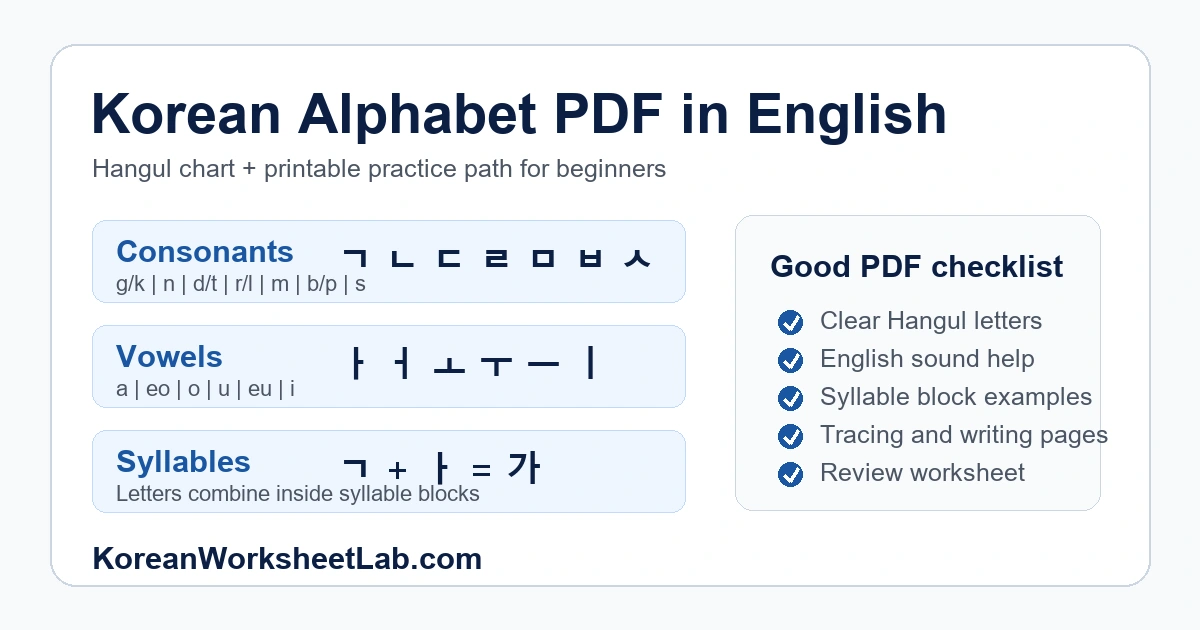
A Korean alphabet PDF in English is useful when it explains Hangul clearly, not when it only lists symbols on a page. Beginners need to see the Korean letters, hear a reasonable English sound guide, and understand how consonants and vowels combine into syllable blocks.
Hangul is often called the Korean alphabet, but it does not work exactly like the English alphabet. Korean letters are arranged inside syllable blocks such as 가, 나, and 한. A good printable PDF should help you read those blocks, trace the letters, and practice short examples in a steady order.
Learning Objectives
- Understand what a useful Korean alphabet PDF should include.
- Review the basic Hangul consonants and vowels with English support.
- Learn why syllable blocks matter more than memorizing letter names alone.
- Choose related printable worksheets for tracing, reading, and review.
What a Korean Alphabet PDF Should Include
A helpful PDF should show the 14 basic consonants, 10 basic vowels, beginner pronunciation notes, and examples of syllable blocks. It should also give enough writing space for tracing and independent practice.
If the PDF only gives romanization, it is not enough. Romanization can support the first few lessons, but learners should quickly move back to Hangul. The goal is to read ㄱ, ㄴ, ㅏ, ㅓ, 가, and 나 directly, not to depend on English spelling forever.
- Hangul consonant chart
- Hangul vowel chart
- Syllable block examples
- Stroke order or tracing space
- Short review activity
Hangul Is Not Written Like English
English letters are usually written one after another in a line. Korean letters are grouped into syllable blocks. For example, ㄱ plus ㅏ becomes 가. ㄴ plus ㅏ becomes 나. The letters are still read in order, but they are arranged visually inside a block.
This is why a Korean alphabet PDF in English should not stop at a letter chart. It should show how a consonant and vowel make a readable Korean syllable. Without block practice, beginners can recognize letters but still struggle to read real Korean words.
Basic Consonants and Vowels to Start With
Start with a small group instead of trying to memorize every chart at once. Learn ㄱ, ㄴ, ㄷ, ㄹ, ㅁ first, then add vowels such as ㅏ, ㅓ, ㅗ, ㅜ, ㅡ, and ㅣ. Build simple syllables immediately.
English sound labels are only approximate. ㄱ can sound closer to g or k depending on position. ㄹ can sound like r or l. ㅇ is silent at the beginning of a syllable but can sound like ng at the end.
- ㄱ + ㅏ = 가
- ㄴ + ㅏ = 나
- ㄷ + ㅏ = 다
- ㅁ + ㅏ = 마
How to Use the PDF for Study
Use the PDF in three rounds. First, read the chart aloud while looking at Hangul. Second, trace a small set of letters or syllables. Third, cover the English pronunciation and try to read the Korean again.
Do not print ten pages and rush through them in one sitting. Short daily practice works better. Five to fifteen minutes of accurate reading and writing is more useful than copying a full alphabet chart without checking sound or shape.
Which Printable Should You Use Next?
If you are a complete beginner, start with the general Korean alphabet guide. Then use the consonants worksheet and vowels worksheet for handwriting. After that, move to reading practice and batchim practice.
Parents and teachers can use the kids Hangul pages for larger letters and visual support, but adult beginners usually benefit from a more structured chart, explanation, and review worksheet.
Vocabulary Box
| Korean | Romanization | Meaning |
|---|---|---|
| 한글 | hangeul | the Korean writing system |
| 자음 | jaeum | consonant |
| 모음 | moeum | vowel |
| 글자 | geulja | letter or written character |
| 받침 | batchim | final consonant at the bottom of a syllable block |
Grammar Box
- Hangul letter order is not grammar, but it is the foundation for reading Korean sentences.
- A basic Korean syllable block often follows consonant + vowel, with an optional final consonant.
- Vertical vowels are usually placed to the right of the first consonant; horizontal vowels are placed below it.
Pronunciation Tips
- Romanization is an English-friendly guide, not a perfect pronunciation system.
- Read Hangul aloud before looking at English letters whenever possible.
- Pay attention to ㄱ, ㄷ, ㅂ, ㄹ, and ㅇ because their English sound labels can change by position.
Example Sentences
가
ga
ㄱ + ㅏ
나
na
ㄴ + ㅏ
다
da
ㄷ + ㅏ
한글
hangeul
Hangul; the Korean writing system
Common Mistakes
Avoid
Downloading a chart but never practicing syllables.
Try this
Use the chart with syllable-building practice such as ㄱ + ㅏ = 가.
Avoid
Treating romanization as the real alphabet.
Try this
Use romanization briefly, then read the Hangul directly.
Avoid
Learning all letters before writing anything.
Try this
Trace and write a small group as soon as you learn it.
Avoid
Skipping batchim completely.
Try this
Add simple final consonants after open syllables feel comfortable.
Study Tips
- Print one page at a time instead of the entire set if you are just starting.
- Read each Hangul example before checking romanization.
- Practice consonants and vowels separately, then combine them into syllables.
- Review with a short worksheet before moving to longer vocabulary lists.
Summary
A Korean alphabet PDF in English should explain Hangul letters, syllable blocks, pronunciation support, and printable practice.
The best use of the PDF is not passive downloading. Read, trace, write, and review in a short daily routine.
Frequently Asked Questions
Can I learn Hangul from a Korean alphabet PDF?
Yes, if the PDF includes syllable examples, pronunciation support, and practice. A chart alone is useful for review but not enough for full reading practice.
Is Hangul the same as the Korean alphabet?
Hangul is the Korean writing system. It is often called the Korean alphabet, but Korean letters are arranged into syllable blocks rather than written exactly like English letters.
Should beginners use romanization?
Romanization can help at the beginning, but learners should move toward reading Hangul directly as soon as possible.
What should I study after the Korean alphabet?
After basic consonants and vowels, practice syllable blocks, simple reading, handwriting, and then common beginner vocabulary.
Related Learning Resources
This article follows the Korean Worksheet Lab editorial standards and is reviewed for beginner clarity and natural Korean usage.