Introduction
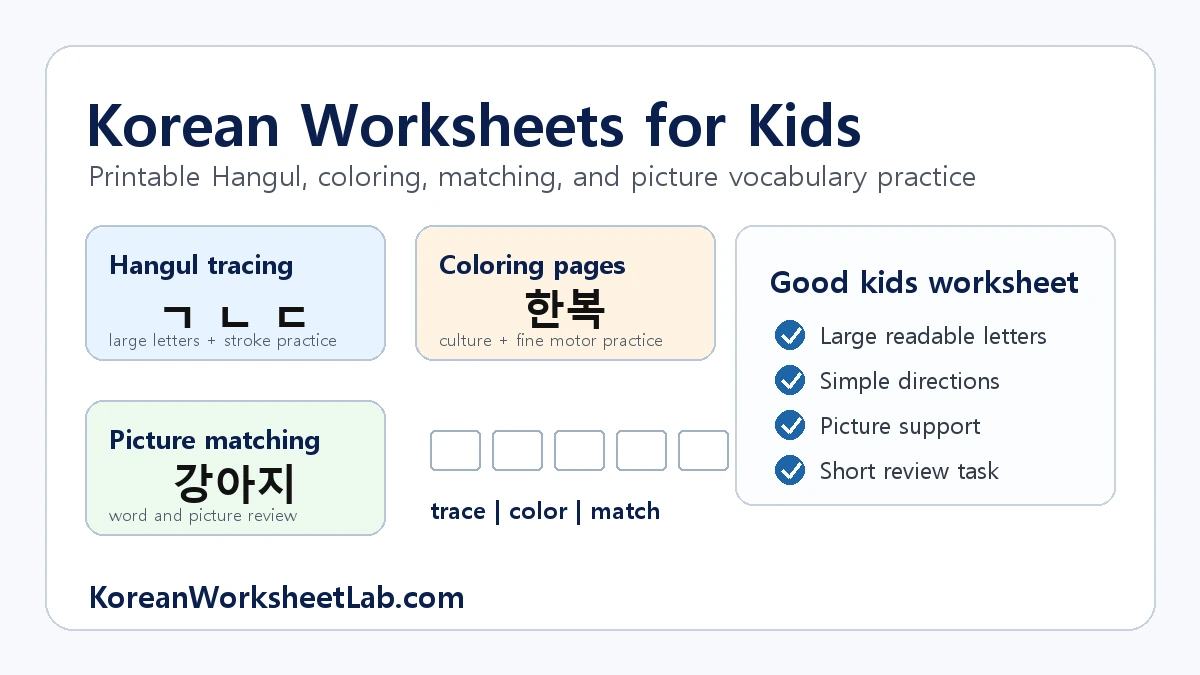
Korean worksheets for kids work best when they are simple, visual, and connected to one clear learning goal. A child should not receive a thick packet of random Korean pages. Young learners need large letters, friendly images, short instructions, and practice that feels achievable.
For Korean, the first step is usually Hangul. Children can trace letters such as ㄱ and ㄴ, color a large character, match a picture to a word, or say a short word aloud. The goal is not to finish many pages quickly. The goal is to help the child notice Korean shapes, sounds, and meanings in a calm order.
Learning Objectives
- Choose Korean worksheets that match a child's age and attention span.
- Understand when to use Hangul tracing, coloring, matching, and picture vocabulary.
- Use printable worksheets as guided learning instead of silent busy work.
- Connect kids worksheets to related Korean lessons and culture activities.
What Makes a Good Korean Worksheet for Kids?
A good kids worksheet teaches one small skill at a time. For example, a Hangul page may focus only on ㄱ, the Korean consonant giyeok. The page should show the letter clearly, give a short sound clue, offer a few tracing boxes, and leave room for independent writing or coloring.
Children also benefit from pictures because images reduce guessing. A picture of a dog beside 강아지 helps the learner connect sound, meaning, and Korean text. But the picture should support the lesson. It should not be so busy that the Korean word becomes hard to see.
- One clear target skill
- Large readable Korean text
- Picture support
- Short practice section
- A small review task
Start with Hangul Tracing
For complete beginners, start with Hangul tracing worksheets. Large consonants and vowels help children see the shape before they worry about full words. A page for ㄴ can include the letter name nieun, a simple sound clue, tracing boxes, and one easy example word.
Tracing should not be endless. One row of tracing, one row of copying, and one row of writing from memory is usually more useful than a full page of repeated dotted letters. Shorter practice keeps the child focused and gives the teacher or parent time to check shape and direction.
- Trace the letter
- Copy the letter
- Write once independently
- Say the sound aloud
Use Coloring Pages for Culture and Vocabulary
Coloring pages are useful when they connect to Korean culture or vocabulary. A hanbok coloring worksheet can introduce 한복, traditional Korean clothing. A bibimbap coloring page can introduce 비빔밥 and food vocabulary. A Taegukgi page can introduce the Korean flag in a child-friendly way.
The adult should add a short conversation while the child colors. Ask simple questions such as, What color is this? What is the Korean word? Can you point to the hat, bowl, flower, or flag? This turns coloring into language practice.
Add Matching and Picture Vocabulary
After children have seen a few Korean words, matching worksheets help them review. Matching works well for animals, fruit, food, colors, family words, and classroom objects. The child can draw a line from a picture to the Korean word or circle the correct meaning.
Keep the number of choices small. Four to six items are enough for many young learners. If the page has too many pictures or too many similar words, the worksheet becomes a test of patience rather than a Korean lesson.
How Parents and Teachers Can Use One Page
Use a kids worksheet in three short rounds. First, show the target Korean word or letter and say it aloud. Second, complete only the guided part together. Third, let the child try one small independent task, such as tracing two boxes or matching two pictures.
For classroom use, the same page can become a warm-up, center activity, or take-home review. For homeschool use, pair one printable page with a short oral review. Ask the child to point, say, trace, and color instead of only writing silently.
- Point to the Korean
- Say it aloud
- Trace or color
- Review with one question
Vocabulary Box
| Korean | Romanization | Meaning |
|---|---|---|
| 한글 | hangeul | the Korean writing system |
| 자음 | jaeum | consonant |
| 모음 | moeum | vowel |
| 강아지 | gangaji | dog |
| 한복 | hanbok | traditional Korean clothing |
| 비빔밥 | bibimbap | mixed rice dish |
Grammar Box
- Kids worksheets should introduce Korean words before heavy grammar explanations.
- Very young learners can recognize Korean nouns and letters before they form full sentences.
- Simple phrases such as 이거예요 can be added later when the child already knows several words.
Pronunciation Tips
- Say the Korean word aloud before the child traces or colors it.
- Use romanization only as adult support. Children should look at the Korean letters first.
- Repeat short words slowly, but do not add extra English vowel sounds at the end.
Example Sentences
ㄱ
giyeok
A beginner Hangul consonant for tracing practice
강아지
gangaji
dog; useful for picture vocabulary
한복
hanbok
traditional Korean clothing; useful for coloring and culture
비빔밥
bibimbap
mixed rice dish; useful for Korean food culture activities
Common Mistakes
Avoid
Giving children too many Korean words on one page.
Try this
Use a small set of words and repeat them through pictures, tracing, and matching.
Avoid
Using coloring pages without speaking practice.
Try this
Ask the child to say or point to one Korean word while coloring.
Avoid
Expecting perfect handwriting too early.
Try this
Focus first on recognition, direction, and confidence.
Avoid
Using romanization as the main text.
Try this
Make the Korean word large and use romanization only as support.
Study Tips
- Use one printable page for 10 to 15 minutes instead of rushing through a packet.
- Let children color large Hangul letters after tracing them.
- Review the same Korean word across two activities: picture matching and writing.
- Keep completed worksheets in a folder so the child can see progress.
Summary
Korean worksheets for kids should be visual, focused, and easy to complete. Hangul tracing, coloring pages, matching activities, and picture vocabulary all help when they are used with short adult guidance.
The best worksheet is not the busiest page. It is the page that helps a child notice one Korean sound, word, or idea clearly and remember it with confidence.
Frequently Asked Questions
What Korean worksheet should kids start with?
Most children should start with large Hangul tracing worksheets or picture vocabulary pages. Choose one letter or a small word set rather than a long alphabet packet.
Are coloring pages useful for learning Korean?
Yes, if the coloring page includes a clear Korean word and a short speaking or pointing activity. Coloring alone is not enough, but coloring plus language review can work well.
Should kids learn romanization?
Romanization can help adults guide pronunciation, but children should see and practice the Korean letters directly whenever possible.
How long should a kids Korean worksheet session be?
For many young learners, 10 to 15 minutes is enough. Short, repeated practice is usually better than a long worksheet session.
Related Learning Resources
This article follows the Korean Worksheet Lab editorial standards and is reviewed for beginner clarity and natural Korean usage.