Introduction
Hangul is the Korean writing system. It is often called the Korean alphabet, but its letters are not written in one long line like English letters. Korean consonants and vowels are arranged inside square-looking syllable blocks. The word 한글, for example, contains two blocks: 한 and 글.
A beginner does not need to memorize every letter in one sitting. A better approach is to learn a small group of vowels and consonants, combine them immediately, and read short syllables without romanization. This guide gives you a sequence that connects recognition, sound, reading, and handwriting.
Learning Objectives
- Understand how Hangul letters form syllable blocks.
- Follow a practical order for learning basic vowels, consonants, and batchim.
- Use tracing and reading without becoming dependent on romanization.
- Build a short daily review routine.
Start with the Shape and Sound System
Begin with a small vowel group such as ㅏ, ㅓ, ㅗ, ㅜ, and ㅣ. Notice whether the long stroke is vertical or horizontal. This matters because a vertical vowel is placed to the right of the first consonant, while a horizontal vowel is placed below it.
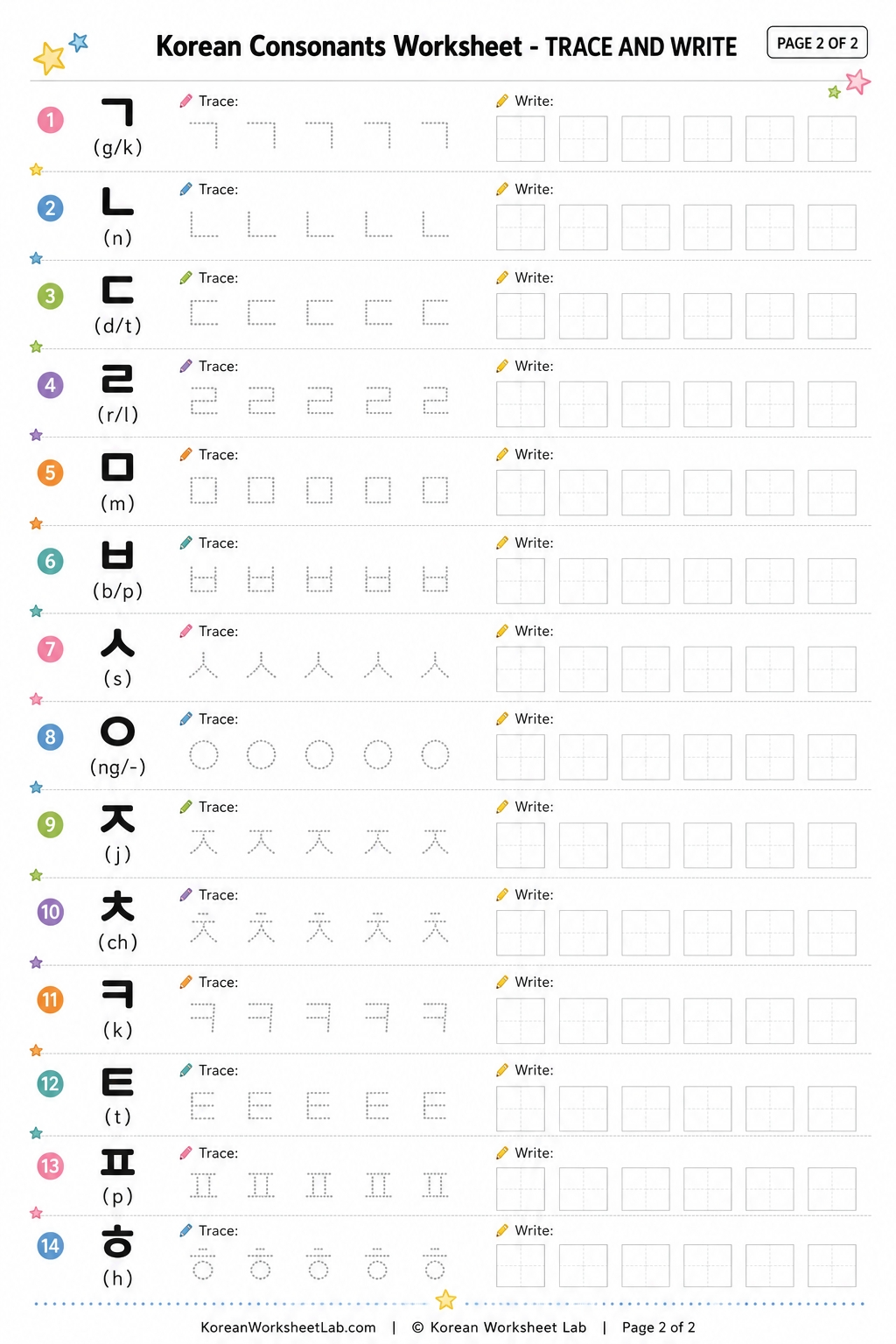
Then add a few visually distinct consonants: ㄱ, ㄴ, ㅁ, ㅅ, and ㅇ. Do not treat English sound labels as exact equivalents. ㄱ can sound closer to g or k depending on its position, and ㅇ is silent at the beginning of a block but represents an ng sound at the end.
- Learn five vowels.
- Learn five consonants.
- Build syllables on the same day.
- Read aloud before checking romanization.
Build Syllable Blocks Early
Combine one consonant and one vowel as soon as you learn them. ㄱ plus ㅏ becomes 가, and ㄴ plus ㅏ becomes 나. With a horizontal vowel, ㄱ plus ㅗ becomes 고. The letters keep their order even though their visual arrangement changes.
Practice by sorting blocks according to their vowel. Reading 가, 나, 마 together helps you notice the shared ㅏ. Reading 고, 노, 모 does the same for ㅗ. Pattern practice is more useful than copying unrelated characters.
Add Batchim After Open Syllables
Batchim is a final consonant placed at the bottom of a syllable block. Learn it after you can comfortably read simple consonant-vowel blocks. For example, 가 becomes 각 when ㄱ is added at the bottom.
Final consonants do not always keep the full sound suggested by romanization. Begin with common final sound groups and listen to whole words. Words such as 밥, 문, and 책 give batchim a meaningful context.
Use a Trace, Copy, Write Cycle
Trace a model once to notice stroke direction, copy it while looking at the model, and then write it independently. A full page of tracing can feel productive without proving recall. The independent step is where you discover what you actually remember.
Keep each syllable balanced inside a square. Large practice boxes are useful at first. As control improves, reduce the box size and write short words rather than isolated letters.
Vocabulary Box
| Korean | Romanization | Meaning |
|---|---|---|
| 한글 | hangeul | the Korean writing system |
| 자음 | jaeum | consonant |
| 모음 | moeum | vowel |
| 받침 | batchim | final consonant in a syllable block |
| 글자 | geulja | letter or written character |
Grammar Box
- Hangul structure is spelling rather than grammar: initial consonant + vowel + optional final consonant.
- A vertical vowel sits to the right of the initial consonant; a horizontal vowel sits below it.
Pronunciation Tips
- Use romanization only as a temporary sound cue. It cannot represent every Korean sound accurately.
- Record yourself reading a five-syllable row, then compare it with native audio.
- Listen for sound changes in complete words after learning the basic letter values.
Example Sentences
가
ga
ㄱ + ㅏ
고
go
ㄱ + ㅗ
한글
hangeul
Hangul
Common Mistakes
Avoid
Memorizing romanization instead of reading Hangul.
Try this
Cover the romanization and decode each block first.
Avoid
Learning every consonant before building a syllable.
Try this
Combine each small letter set immediately.
Avoid
Tracing repeatedly without independent writing.
Try this
Use trace once, copy twice, then write from memory.
Avoid
Ignoring final consonants because they look difficult.
Try this
Add common batchim after open syllables feel familiar.
Study Tips
- Study for 15 to 20 minutes daily rather than one long weekly session.
- Read labels, names, or very short words that use letters you already know.
- Mix recognition cards so you cannot depend on a memorized order.
- Review yesterday's letters before adding new ones.
Summary
Learn Hangul in small groups, build syllables immediately, and delay heavy batchim practice until basic blocks are comfortable.
Balance tracing with independent recall and spoken reading. The goal is not beautiful copying; it is accurate recognition and usable reading.
Frequently Asked Questions
How long does it take to learn Hangul?
Many learners recognize basic letters within several focused sessions, but fluent reading takes longer. Speed develops through repeated reading of real syllables and words.
Should I learn romanization first?
No. Use it briefly when a sound is unfamiliar, then return to Hangul. Long-term dependence on romanization slows direct reading.
When should I learn batchim?
Begin after you can combine basic consonants and vowels comfortably. Add common final consonants through familiar words.
Related Learning Resources
This article follows the Korean Worksheet Lab editorial standards and is reviewed for beginner clarity and natural Korean usage.