Introduction
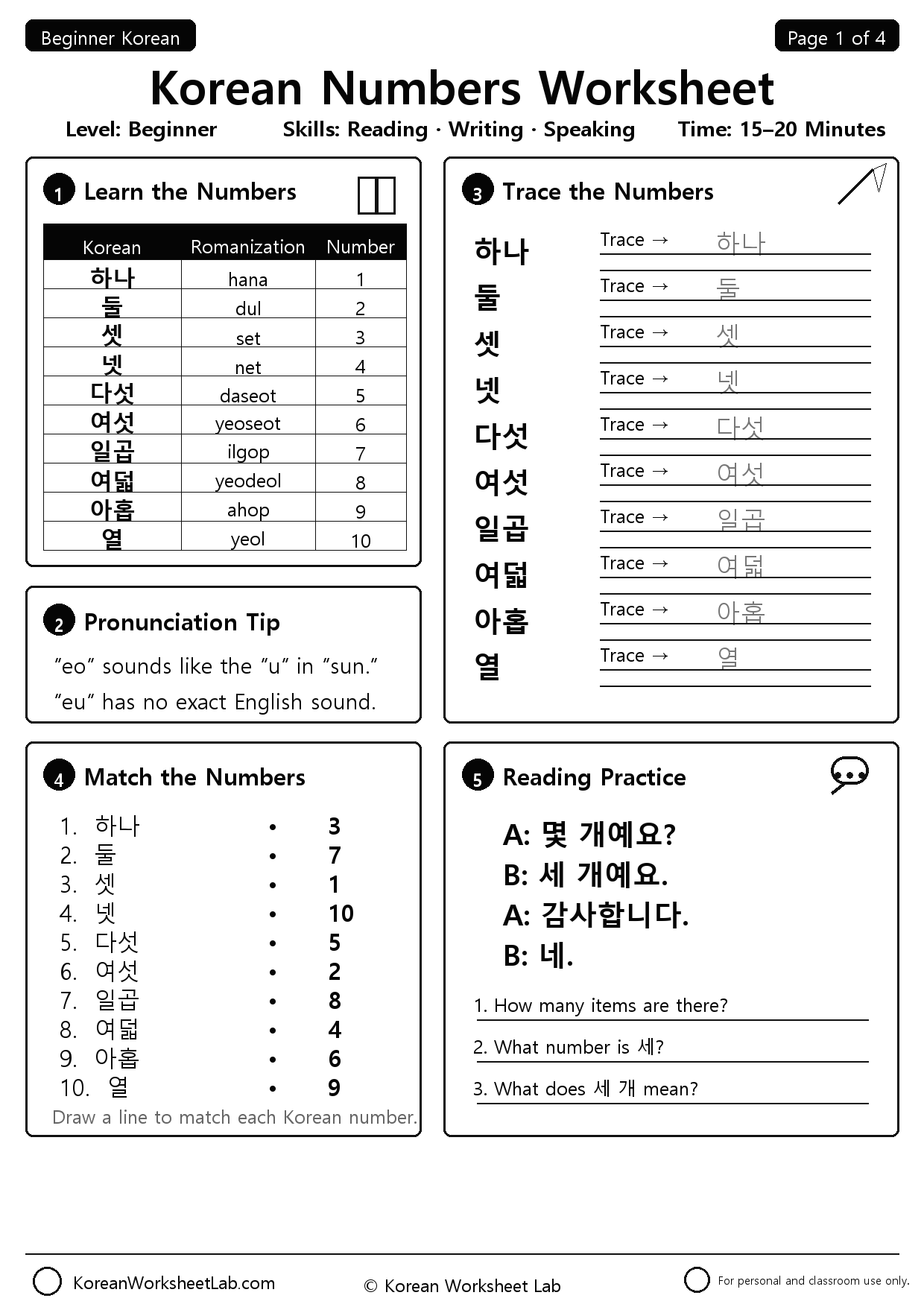
Korean uses two number systems. Native Korean numbers include 하나, 둘, 셋, and 넷. Sino-Korean numbers include 일, 이, 삼, and 사. Beginners often learn both lists but still feel unsure about which one belongs in a sentence.
The practical solution is to connect each system to a job. Native Korean numbers commonly count people and objects and express hours or age in everyday speech. Sino-Korean numbers are used for dates, minutes, money, phone numbers, addresses, and larger calculations.
Learning Objectives
- Distinguish the main everyday uses of both Korean number systems.
- Use shortened native forms before common counters.
- Read simple times, prices, dates, and quantities.
- Avoid common errors with 셋 and 세.
Use Native Korean Numbers for Counting
Use native Korean numbers with many counters for people, animals, and objects. The counter identifies what is being counted: 명 for people, 개 for general objects, 마리 for animals, and 잔 for cups or glasses.
Several native numbers change before a counter. 하나 becomes 한, 둘 becomes 두, 셋 becomes 세, 넷 becomes 네, and 스물 becomes 스무. Therefore, three people is 세 명, not 셋 명. When the number stands alone, 셋 is the normal form.
- 한 명: one person
- 두 개: two items
- 세 마리: three animals
- 네 잔: four cups
Use Sino-Korean Numbers for Dates and Money
Sino-Korean numbers form a regular place-value system. 십 is ten, 백 is one hundred, and 천 is one thousand. Twenty-three is 이십삼: two tens plus three. This system makes dates, prices, and larger numbers easier to build.
Use Sino-Korean numbers for calendar months and dates, prices in won, phone numbers, floor numbers, addresses, minutes, and seconds. A price such as 5,000 won is 오천 원. June is 유월, with a conventional pronunciation and spelling that learners should notice.
Telling Time Uses Both Systems
Korean clock time combines the systems. Hours use native Korean numbers with 시, while minutes use Sino-Korean numbers with 분. 3:20 is 세 시 이십 분.
This mixed pattern is not random once each counter has a fixed role. Practice complete clock expressions rather than memorizing isolated numbers.
Age Can Change with Context
Everyday spoken age commonly uses native Korean numbers with 살: 스무 살 means twenty years old. Formal documents, news reports, and some institutional contexts may use Sino-Korean numbers with 세.
For a beginner conversation, 몇 살이에요? and 스물두 살이에요 are useful patterns. Always shorten native forms correctly before 살.
Vocabulary Box
| Korean | Romanization | Meaning |
|---|---|---|
| 하나 / 한 | hana / han | one / one before a counter |
| 둘 / 두 | dul / du | two / two before a counter |
| 셋 / 세 | set / se | three / three before a counter |
| 시 | si | hour, o'clock |
| 분 | bun | minute |
| 원 | won | Korean currency unit |
Grammar Box
- Native number + counter: 세 명, 두 개, 네 잔.
- Sino-Korean number + unit: 삼월, 이십 분, 오천 원.
- The particle or sentence ending follows the complete number phrase: 세 명이에요.
Pronunciation Tips
- 십육 is commonly pronounced with a linking sound close to 심뉵.
- 육월 is pronounced 유월, and 시월 is used for October instead of 십월.
- Do not add an English-style pause between a number and its counter.
Example Sentences
사과 세 개 주세요.
sagwa se gae juseyo
Please give me three apples.
세 시 이십 분이에요.
se si isip bunieyo
It is 3:20.
오천 원이에요.
ocheon wonieyo
It is 5,000 won.
Common Mistakes
Avoid
Using 셋 directly before a counter.
Try this
Use the shortened form 세: 세 명, 세 개, 세 살.
Avoid
Using native numbers for prices.
Try this
Use Sino-Korean numbers with 원.
Avoid
Using one system for both hours and minutes.
Try this
Use native hours and Sino-Korean minutes.
Avoid
Reading each digit of a price separately.
Try this
Use place values: 5,000 is 오천.
Study Tips
- Sort example cards by situation instead of memorizing two disconnected lists.
- Practice prices with a menu and quantities with picture cards.
- Say five clock times aloud every day.
- Write shortened native forms beside their full standalone forms.
Summary
Use native Korean numbers mainly for counted quantities, everyday age, and hours. Use Sino-Korean numbers for dates, money, minutes, phone numbers, and calculations.
Learn the number together with its counter. Complete phrases such as 세 명 and 이십 분 are easier to retrieve than isolated rules.
Frequently Asked Questions
Does 세 mean three?
Yes, but 세 is the shortened form used before counters. The standalone native Korean number is 셋.
Which numbers are used for phone numbers?
Phone numbers use Sino-Korean digits read individually, including 공 or 영 for zero depending on context.
Why does telling time use both systems?
Korean convention assigns native numbers to hours and Sino-Korean numbers to minutes.
Related Learning Resources
This article follows the Korean Worksheet Lab editorial standards and is reviewed for beginner clarity and natural Korean usage.