Introduction
English beginners often expect Korean sentences to follow subject-verb-object order. Korean usually places the verb or adjective at the end. A basic sentence such as 저는 한국어를 공부해요 follows topic-object-verb order: as for me, Korean, study.
Word order is only part of the system. Particles show the role of a noun, and sentence endings communicate politeness, tense, and the speaker's attitude. Korean can also omit information that is already clear from context.
Learning Objectives
- Recognize the usual verb-final order of Korean sentences.
- Understand the basic jobs of 은/는, 이/가, and 을/를.
- Build polite present-tense sentences with 아요/어요.
- Avoid translating every English word directly.
Put the Main Verb or Adjective Last
The most stable beginner rule is to place the predicate at the end. In 저는 물을 마셔요, 마셔요 is the action and comes last. Time and place information usually appears before the final predicate.
Korean word order before the predicate can be flexible because particles identify noun roles. For beginners, a useful frame is topic + time + place + object + verb. You do not need every slot in every sentence.
- 저는 물을 마셔요. I drink water.
- 오늘 학교에서 공부해요. I study at school today.
- 친구가 한국 음식을 좋아해요. My friend likes Korean food.
Use Particles to Mark Noun Roles
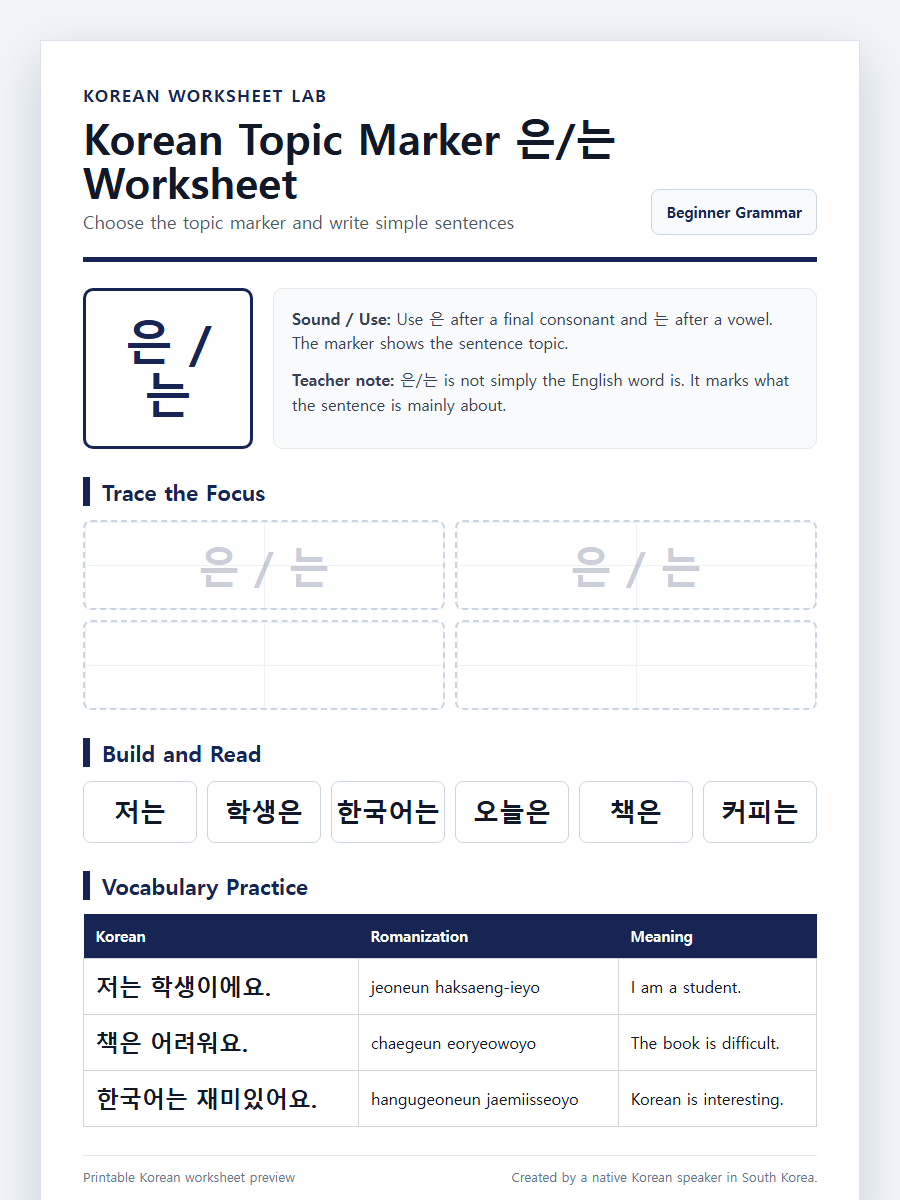
은/는 marks a topic or contrast. 이/가 marks a grammatical subject and often identifies who or what is responsible for a state or action. 을/를 marks a direct object. The form changes according to whether the noun ends in a consonant or vowel.
Particles are not one-to-one translations of English words. Learn them through sentence pairs. 저는 학생이에요 introduces me as the topic. 누가 학생이에요? 제가 학생이에요 identifies me as the answer to who.
Expect Subjects to Disappear
Natural Korean often omits a subject or topic when listeners already know it. After someone asks 뭐 먹어요? you can answer 비빔밥을 먹어요 without repeating 저는.
Beginners sometimes remove too much information because they hear native speakers omit subjects. Omit a noun only when the context makes the meaning clear. In a new topic or contrast, state it.
Treat the Ending as Part of the Message
A verb stem alone is not a complete polite sentence. The ending 아요/어요 creates a common polite present form. 먹다 becomes 먹어요, and 가다 becomes 가요.
Keep the sentence ending consistent with the social situation. The polite 요 style is a practical default for adult beginners. Dictionary forms such as 먹다 are useful for lookup but should not replace a polite ending in normal conversation.
Vocabulary Box
| Korean | Romanization | Meaning |
|---|---|---|
| 저 | jeo | I, humble or polite |
| 오늘 | oneul | today |
| 학교 | hakgyo | school |
| 공부하다 | gongbuhada | to study |
| 좋아하다 | joahada | to like |
Grammar Box
- Useful frame: Topic + time + place + object + verb.
- Consonant ending: 은, 이, 을. Vowel ending: 는, 가, 를.
- Polite present predicate: verb or adjective stem + 아요/어요.
Pronunciation Tips
- Particles attach directly to the noun without an English-style pause.
- 같이 is commonly pronounced 가치 in natural speech.
- Focus first on a clear sentence ending; speed and sound linking can develop later.
Example Sentences
저는 한국어를 공부해요.
jeoneun hangugeoreul gongbuhaeyo
I study Korean.
친구가 커피를 마셔요.
chinguga keopireul masyeoyo
My friend drinks coffee.
오늘 도서관에서 공부해요.
oneul doseogwaneseo gongbuhaeyo
I study at the library today.
Common Mistakes
Avoid
Putting the verb in the middle like English.
Try this
Move the main verb or adjective to the end.
Avoid
Using 은/는 and 이/가 as interchangeable decorations.
Try this
Choose based on topic, contrast, subject, and context.
Avoid
Ending a conversation sentence with a dictionary form.
Try this
Use an appropriate ending such as 아요/어요.
Avoid
Repeating 저는 in every sentence.
Try this
Omit it after the topic is clear, but restore it when contrast is needed.
Study Tips
- Color-code topic, object, place, and predicate when analyzing a sentence.
- Rebuild one model sentence with five different nouns.
- Read short dialogues to notice what speakers omit.
- Write Korean from a meaning prompt instead of rearranging an English sentence word by word.
Summary
Korean is usually verb-final, particles identify noun roles, and clear context allows subjects to be omitted. Sentence endings carry essential grammatical and social information.
Start with one stable frame and replace its parts. Natural flexibility becomes easier after the basic roles feel familiar.
Frequently Asked Questions
Is Korean always subject-object-verb?
The predicate normally comes last, but subjects are often omitted and other elements can move when particles keep their roles clear.
Can I leave out Korean particles?
Some particles disappear in casual speech, but beginners should learn and use them to build clear sentence structure before studying omission patterns.
What sentence ending should a beginner use?
The polite 요 style, especially 아요/어요 forms, is a practical default for everyday beginner conversation.
Related Learning Resources
This article follows the Korean Worksheet Lab editorial standards and is reviewed for beginner clarity and natural Korean usage.