Introduction
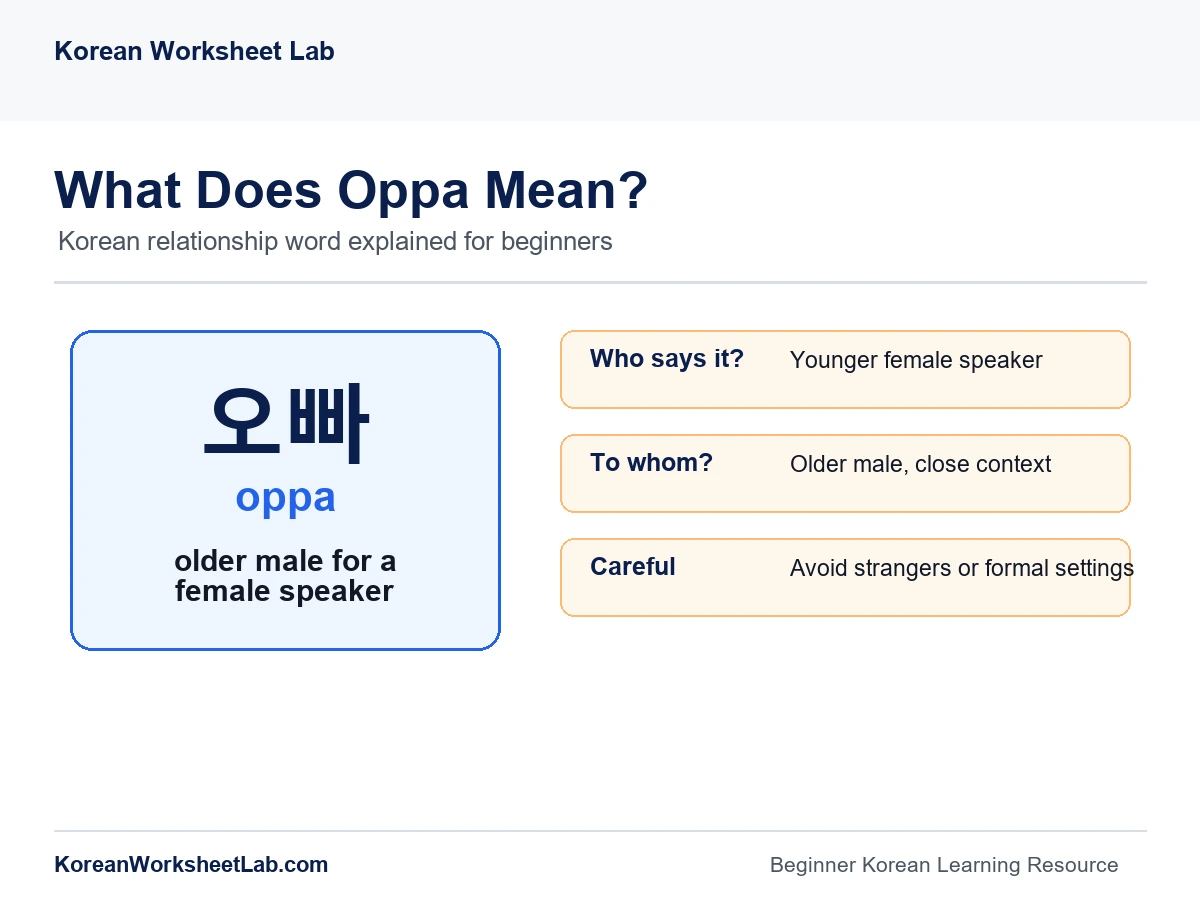
Oppa means older brother when the speaker is female. In Hangul, it is written as 오빠, and the romanization is oppa. A younger woman can use oppa for her older brother, an older male friend, an older boyfriend, or sometimes a close older male person in a familiar social relationship.
The important point is that oppa is not a general word for any Korean man. It depends on the speaker's gender, age relationship, closeness, and social context. Because the word appears often in K-dramas, K-pop, and Korean variety shows, learners sometimes copy it too quickly. This guide explains what it means and when it sounds natural.
Learning Objectives
- Read 오빠 in Hangul and recognize its romanization.
- Understand that oppa is used by female speakers for an older male.
- Separate family meaning from social or romantic usage.
- Avoid using oppa with strangers or in formal situations.
The Short Answer
Oppa means older brother from a female speaker's point of view. A girl or woman can call her actual older brother 오빠. The same word can also be used for an older male friend or boyfriend when the relationship is close enough.
If the speaker is male, he does not normally call an older man oppa. A male speaker usually uses 형 for an older brother or older male friend. This is why learning oppa together with hyung, noona, and unnie is more useful than memorizing oppa alone.
- Hangul: 오빠
- Romanization: oppa
- Basic meaning: older brother for a female speaker
- Common extended use: older male friend or boyfriend
Who Can Say Oppa?
The natural speaker is usually a younger female person speaking to or about an older male. A younger sister can say oppa to her older brother. A woman may also say oppa to an older male friend if the relationship is friendly and informal.
Adults should be careful with this word in professional or unfamiliar settings. Calling a man oppa too early can sound overly personal. In work, school, service, or first-meeting situations, use a name plus title or a neutral expression instead.
Why Oppa Appears So Often in K-Drama and K-Pop
Korean media often shows close relationships, dating situations, family scenes, and fan language. Oppa appears often because it can signal closeness, affection, seniority, or a playful tone depending on the scene.
That does not mean every real Korean conversation uses oppa the same way. Drama language can be more emotional or stylized than everyday speech. Learners should notice who is speaking, how old the speakers are, and whether the scene is family, friendship, romance, or fan culture.
Natural Examples
In a family setting, 오빠 is straightforward. A younger sister might say 오빠, 이거 봐. In a romantic setting, a woman might call her older boyfriend oppa if both people are comfortable with that style.
In English, translating oppa as only older brother can miss the social feeling. It is better to learn the relationship pattern: female speaker, older male listener, close or familiar context.
Vocabulary Box
| Korean | Romanization | Meaning |
|---|---|---|
| 오빠 | oppa | older brother or close older male, used by female speakers |
| 형 | hyeong | older brother or close older male, used by male speakers |
| 누나 | nuna | older sister or close older female, used by male speakers |
| 언니 | eonni | older sister or close older female, used by female speakers |
Grammar Box
- Oppa is a noun and address term. It can be used alone when calling someone directly.
- The polite sentence ending can still follow the sentence: 오빠, 이거 봐요.
- Relationship words in Korean depend on the speaker, not only the person being described.
Pronunciation Tips
- The double consonant 빠 is tense. It is stronger than a relaxed ba sound.
- Do not stretch the first syllable. Say op-pa clearly in two syllables.
- Romanization is only a guide. Read the Hangul 오빠 whenever possible.
Example Sentences
오빠, 이거 봐.
oppa, igeo bwa
Oppa, look at this.
우리 오빠는 학생이에요.
uri oppaneun haksaengieyo
My older brother is a student.
오빠라고 불러도 돼요?
opparago bulleodo dwaeyo
Can I call you oppa?
Common Mistakes
Avoid
Calling any Korean man oppa.
Try this
Use oppa only when the age, gender, and closeness fit.
Avoid
Using oppa in a formal workplace situation.
Try this
Use a name, title, or formal address instead.
Avoid
Thinking only girlfriends say oppa.
Try this
Younger sisters and close female friends can also use oppa.
Avoid
Ignoring the speaker's gender.
Try this
Female speakers use oppa; male speakers usually use hyeong for an older male.
Study Tips
- Watch one K-drama scene and identify who says oppa and why.
- Compare oppa with hyung, noona, and unnie in one chart.
- Practice reading the Hangul 오빠 before looking at romanization.
- Do not use oppa with real people unless the relationship clearly allows it.
Summary
Oppa means older brother for a female speaker, but it can also refer to a close older male friend or boyfriend.
The word is natural only when gender, age, relationship, and setting fit. K-drama usage is useful to observe, but real-life usage requires more care.
Frequently Asked Questions
Does oppa mean boyfriend?
Not exactly. Oppa can be used for an older boyfriend, but its basic meaning is older brother or close older male from a female speaker's point of view.
Can a man say oppa?
A male speaker usually does not call an older man oppa. He normally uses hyeong.
Is oppa romantic?
It can sound romantic in some contexts, but it can also be purely family or friendship language.
Related Learning Resources
This article follows the Korean Worksheet Lab editorial standards and is reviewed for beginner clarity and natural Korean usage.