Introduction
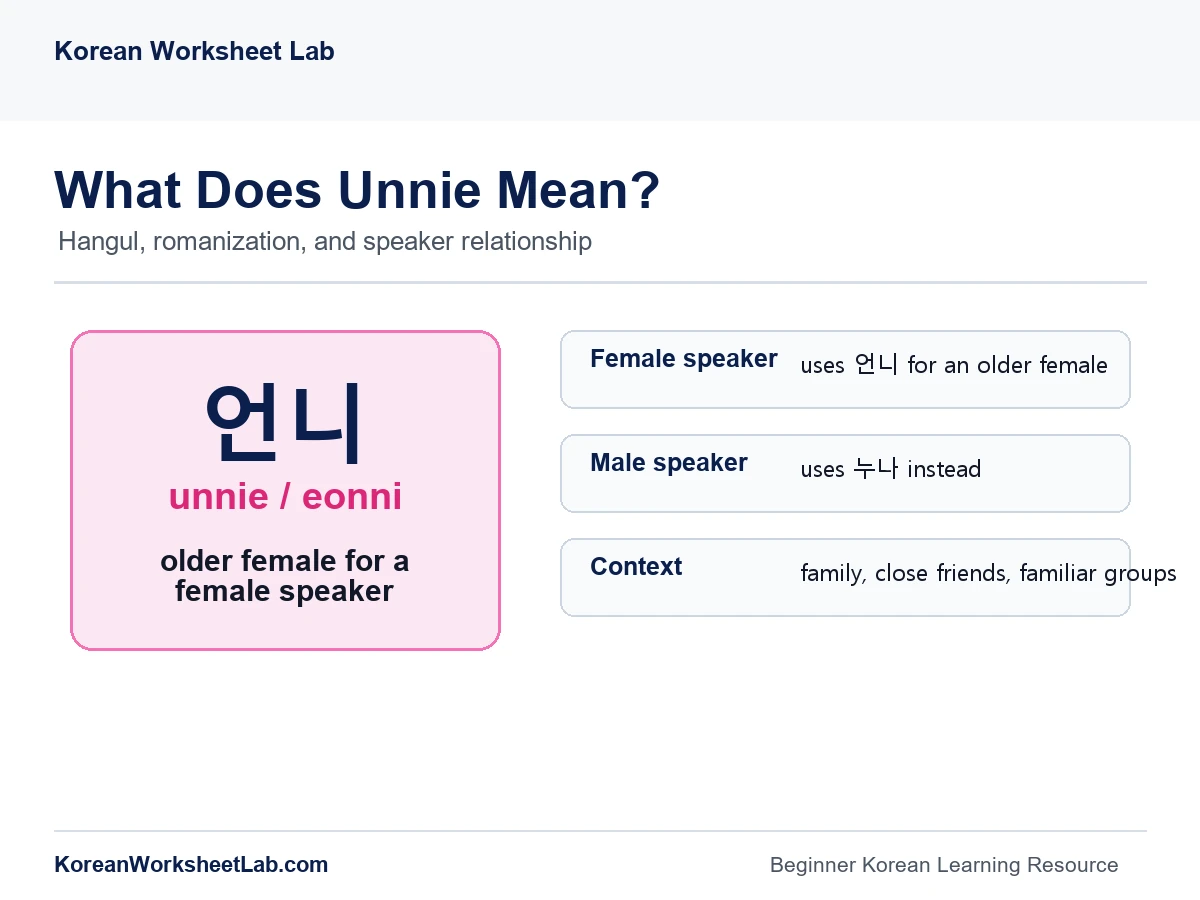
Unnie means older sister when the speaker is female. In Hangul, it is written as 언니. A younger girl or woman can use unnie for her actual older sister, an older female friend, or a close older woman in an informal relationship.
Learners often search for unnie because they hear it in K-dramas, K-pop fandom, and Korean videos. The word is common, but it is not a general word for every woman. Like oppa, hyung, and noona, it depends on the speaker's gender and relationship.
Learning Objectives
- Read 언니 in Hangul.
- Understand that female speakers use unnie for an older female.
- Compare unnie with noona.
- Use the word only in close and informal contexts.
The Short Answer
Unnie means older sister from a female speaker's point of view. A younger woman can call her older sister unnie. She can also use it for an older female friend if they have a friendly, informal relationship.
If the speaker is male, the word changes. A male speaker usually calls an older sister or older female friend 누나, romanized as noona or nuna.
- Hangul: 언니
- Romanization: unnie or eonni
- Speaker: female
- Listener/person: older female
Unnie vs Noona
Unnie and noona can both refer to an older female, but the speaker is different. A female speaker says unnie. A male speaker says noona. This speaker-based system is one of the most important details in Korean family terms.
Because English does not change older sister based on the speaker's gender, beginners often mix them up. A simple way to remember it is: girl to older girl is unnie; boy to older girl is noona.
Natural Usage
In real Korean life, unnie can sound warm and close. It may be used between sisters, friends, classmates, coworkers in a friendly setting, or people in a group where age hierarchy matters.
However, unnie is not the best choice for a stranger, customer, teacher, or formal work contact. In those situations, use a name, title, or a more neutral address.
Vocabulary Box
| Korean | Romanization | Meaning |
|---|---|---|
| 언니 | eonni / unnie | older sister or close older female, used by female speakers |
| 누나 | nuna / noona | older sister or close older female, used by male speakers |
| 여동생 | yeodongsaeng | younger sister |
| 친구 | chingu | friend |
Grammar Box
- Unnie is a relationship noun and can be used as a direct address.
- You can add particles when speaking about the person: 언니가, 언니는.
- The relationship word is chosen from the speaker's point of view.
Pronunciation Tips
- The Hangul spelling 언니 is two syllables: eon-ni.
- English spelling varies: unnie, eonni, or sometimes unni.
- The double n sound is noticeable between syllables.
Example Sentences
언니, 고마워요.
eonni, gomawoyo
Unnie, thank you.
우리 언니는 친절해요.
uri eonnineun chinjeolhaeyo
My older sister is kind.
언니라고 불러도 돼요?
eonnirago bulleodo dwaeyo
Can I call you unnie?
Common Mistakes
Avoid
Using unnie for any older woman.
Try this
Use it only when the relationship is close or socially appropriate.
Avoid
Using unnie as a male speaker.
Try this
A male speaker usually uses noona for an older female.
Avoid
Assuming unnie is always family.
Try this
It can be family, friendship, or close social language.
Study Tips
- Write a four-word chart: oppa, hyung, noona, unnie.
- Sort each word by speaker gender and older person's gender.
- Read 언니 aloud and compare it with 누나.
- Watch how Korean speakers use names and titles when they are not close.
Summary
Unnie means older sister or close older female from a female speaker's point of view.
It is natural in close, informal relationships but not a universal word for women.
Frequently Asked Questions
Is unnie the same as noona?
No. Both can refer to an older female, but female speakers use unnie and male speakers use noona.
How do you write unnie in Hangul?
Unnie is written 언니 in Hangul.
Can I call a Korean woman unnie?
Only if the relationship and context make it appropriate. It can sound too personal with strangers.
Related Learning Resources
This article follows the Korean Worksheet Lab editorial standards and is reviewed for beginner clarity and natural Korean usage.