Introduction
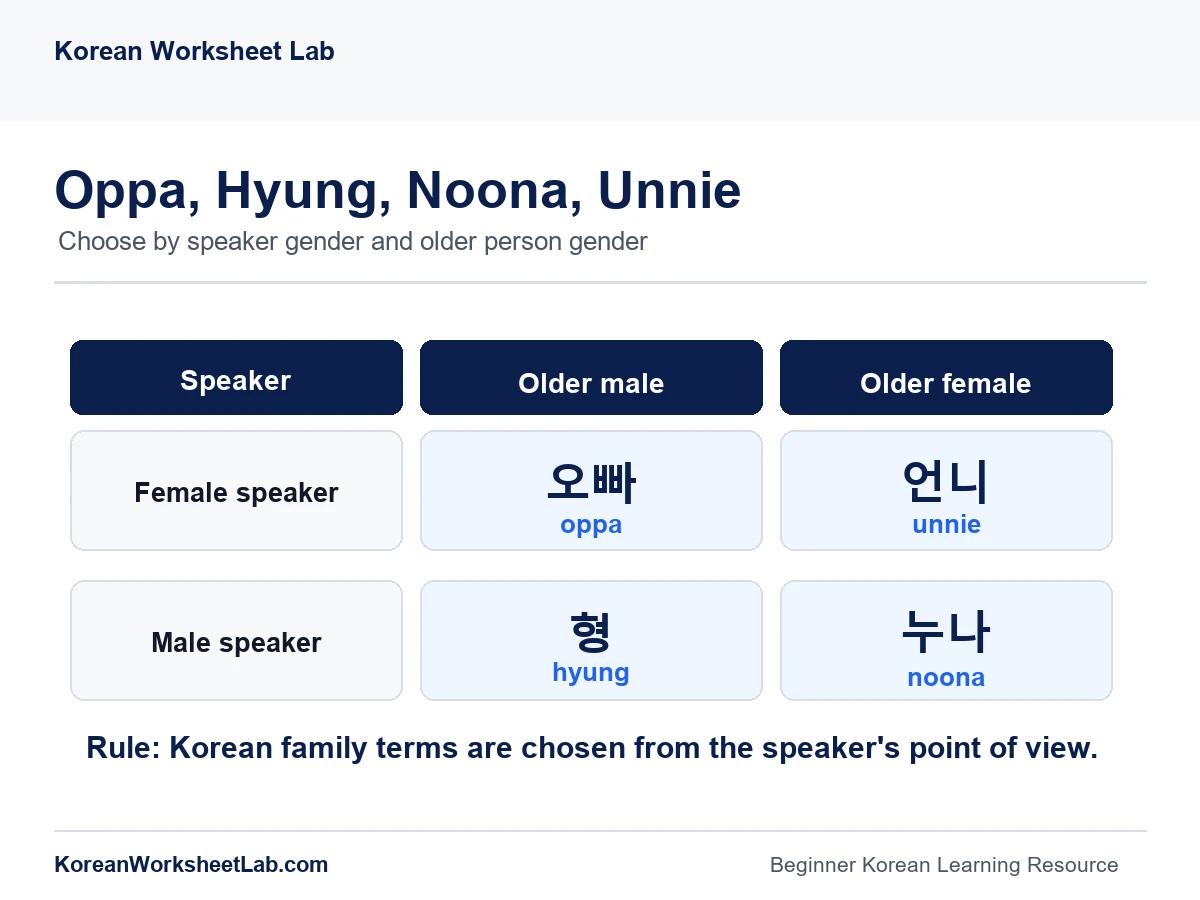
Oppa, hyung, noona, and unnie are Korean relationship words for older brothers, older sisters, and close older people. The difficult part for English speakers is that Korean chooses the word based on the speaker's gender.
The same older male can be oppa to a female speaker and hyung to a male speaker. The same older female can be unnie to a female speaker and noona to a male speaker. This chart-based guide gives beginners a reliable way to choose the right word.
Learning Objectives
- Compare four high-frequency Korean relationship words.
- Choose the correct word from the speaker's point of view.
- Understand family, friendship, and media usage.
- Avoid using intimate address terms too early.
The Core Rule
Choose the word by asking two questions: Who is speaking? Is the older person male or female? If the speaker is female and the older person is male, use oppa. If the speaker is male and the older person is male, use hyung.
For older female people, female speakers use unnie and male speakers use noona. This rule works for actual siblings and can extend to close friends or familiar social relationships.
- Female speaker + older male = oppa
- Male speaker + older male = hyung
- Female speaker + older female = unnie
- Male speaker + older female = noona
Family Meaning and Social Meaning
The family meaning is the safest starting point. Oppa and hyung can mean older brother. Noona and unnie can mean older sister. In real Korean, these words can also extend to close older friends.
That extended use depends on closeness. The words can sound friendly, affectionate, casual, or too personal depending on the relationship. A beginner should not use them automatically with every older Korean person.
Why Romanization Looks Different
You may see noona or nuna, unnie or eonni, and hyung or hyeong. Different romanization styles try to represent Korean sounds in English letters. The Hangul spelling is more reliable: 오빠, 형, 누나, 언니.
Use romanization as temporary support, but learn the Hangul forms early. Search results and subtitles may use different spellings, but Korean speakers read the Hangul.
Vocabulary Box
| Korean | Romanization | Meaning |
|---|---|---|
| 오빠 | oppa | older male for a female speaker |
| 형 | hyeong / hyung | older male for a male speaker |
| 누나 | nuna / noona | older female for a male speaker |
| 언니 | eonni / unnie | older female for a female speaker |
Grammar Box
- These words can be used as direct address terms.
- They can take particles when used inside a sentence: 오빠는, 형이, 언니가.
- The correct word depends on the speaker, not only the older person.
Pronunciation Tips
- 오빠 has a tense 빠 sound.
- 형 has a final ng-like sound in English approximation.
- 언니 is commonly romanized as eonni or unnie.
Example Sentences
오빠는 학생이에요.
oppaneun haksaengieyo
Oppa is a student.
형, 같이 가요.
hyeong, gachi gayo
Hyung, let's go together.
언니가 도와줬어요.
eonniga dowajwosseoyo
Unnie helped me.
Common Mistakes
Avoid
Choosing the word based only on the older person's gender.
Try this
Check the speaker's gender too.
Avoid
Using these terms with strangers.
Try this
Use names, titles, or neutral address in formal settings.
Avoid
Thinking romanization spellings are separate words.
Try this
Look at the Hangul spelling to identify the word.
Study Tips
- Memorize the four-word chart as a square.
- Make sample sentences with each word.
- Listen for who is speaking in K-drama scenes.
- Practice Hangul spelling instead of only romanization.
Summary
Oppa, hyung, noona, and unnie are chosen by speaker gender and the older person's gender.
They are useful Korean culture words, but they are also personal address terms that require the right relationship.
Frequently Asked Questions
What is the difference between oppa and hyung?
Both can refer to an older male. Female speakers use oppa, and male speakers use hyung.
What is the difference between noona and unnie?
Both can refer to an older female. Male speakers use noona, and female speakers use unnie.
Can these words be used for friends?
Yes, when the relationship is close and informal enough.
Related Learning Resources
This article follows the Korean Worksheet Lab editorial standards and is reviewed for beginner clarity and natural Korean usage.