Introduction
Batchim is the final consonant position at the bottom of a Korean syllable block. In Hangul, the word is written 받침. Beginners can often read open syllables such as 가, 나, and 다, but words become harder when a consonant appears under the vowel.
A good batchim practice worksheet should not only ask learners to copy words. It should show where the final consonant sits, compare open and closed syllables, provide reading examples, and give enough writing space for slow practice.
Learning Objectives
- Understand what batchim means.
- Identify final consonants inside Korean syllable blocks.
- Compare open syllables and closed syllables.
- Practice reading and writing common beginner batchim words.
What Is Batchim?
A Korean syllable block usually has an initial consonant and a vowel. Some blocks also have a final consonant at the bottom. That bottom consonant is batchim.
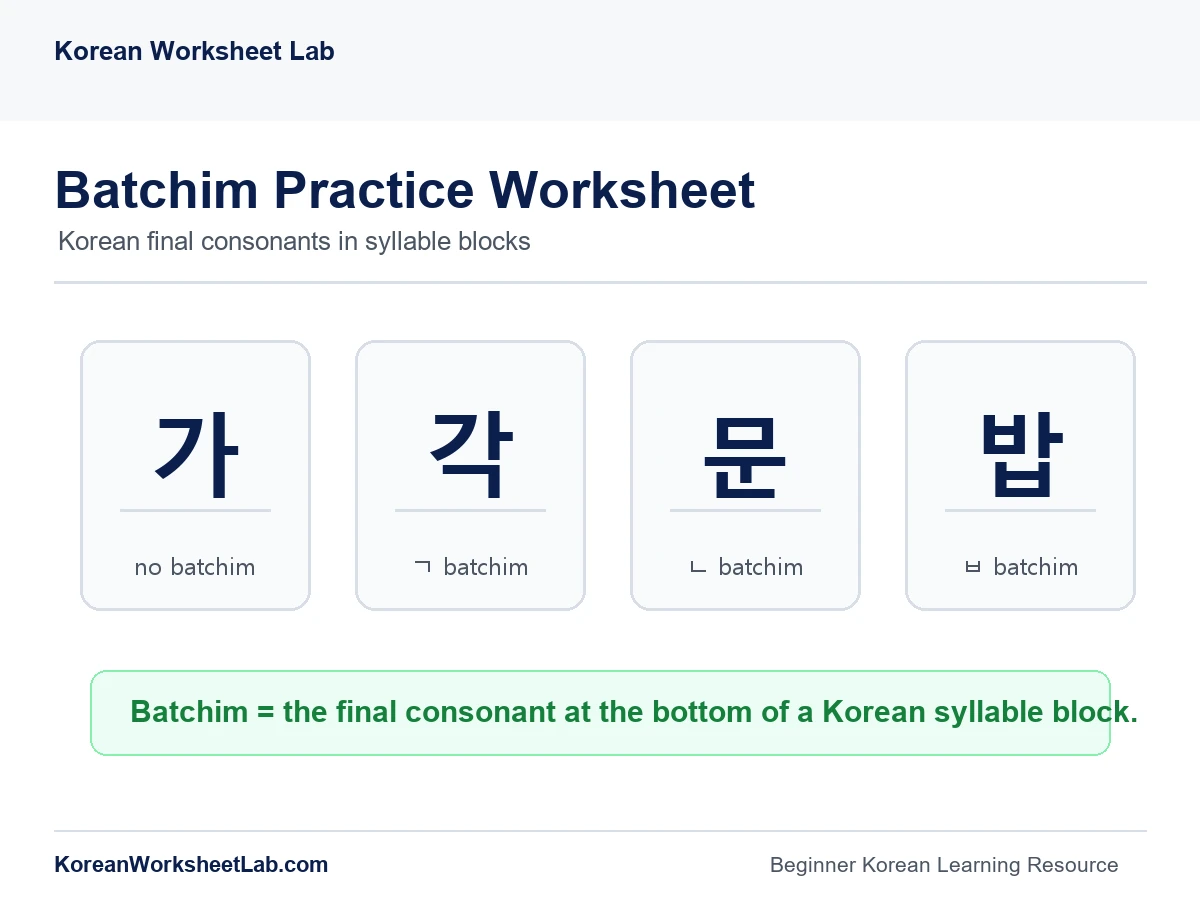
For example, 가 has no batchim. 각 has ㄱ at the bottom. 문 has ㄴ at the bottom. The visible bottom position tells the reader that the syllable is closed by a final consonant sound.
- 가 = no batchim
- 각 = ㄱ batchim
- 문 = ㄴ batchim
- 밥 = ㅂ batchim
Why Batchim Feels Difficult
English speakers may expect each written letter to have a full separate sound. Korean final consonants are shorter and more contained. Some final consonants also share the same final sound in standard pronunciation.
This is why a worksheet should combine visual recognition with listening and reading. Learners need to see the bottom position and say the whole syllable, not only name the letter.
How To Practice Batchim
Start with common words that use clear final consonants: 문, 산, 밥, 곰, 감, and 책. Read each word, identify the bottom consonant, then write the whole syllable block.
After recognition, move into contrast practice. Compare 가 and 각, 나 and 난, 바 and 밥. This helps learners notice that a small bottom consonant changes the syllable.
Vocabulary Box
| Korean | Romanization | Meaning |
|---|---|---|
| 받침 | batchim | final consonant in a Korean syllable block |
| 가 | ga | open syllable with no final consonant |
| 각 | gak | syllable with final ㄱ |
| 문 | mun | door; example word with final ㄴ |
| 밥 | bap | rice or meal; example word with final ㅂ |
Grammar Box
- Batchim is spelling and pronunciation structure, not a grammar ending.
- Particles can change depending on whether a noun ends in a consonant or vowel.
- For example, consonant-ending nouns often take 은 or 이, while vowel-ending nouns take 는 or 가.
Pronunciation Tips
- Final consonants are usually shorter than English final consonants.
- Do not add an extra vowel sound after the batchim.
- Read the whole syllable block as one unit.
Example Sentences
문이 있어요.
muni isseoyo
There is a door.
밥을 먹어요.
babeul meogeoyo
I eat rice.
산이 커요.
sani keoyo
The mountain is big.
Common Mistakes
Avoid
Adding an English-style extra vowel after final consonants.
Try this
Keep the final consonant short and contained.
Avoid
Studying batchim only as a letter list.
Try this
Practice real syllables and words.
Avoid
Ignoring the bottom position in the block.
Try this
Circle or mark the final consonant before reading.
Study Tips
- Sort words into no batchim and batchim groups.
- Underline the final consonant before reading aloud.
- Practice five common batchim words daily.
- Use the related printable worksheet after reading the explanation.
Summary
Batchim is the final consonant at the bottom of a Korean syllable block.
The best practice combines visual block recognition, short final pronunciation, real words, and writing practice.
Frequently Asked Questions
What does batchim mean?
Batchim means the final consonant position at the bottom of a Korean syllable block.
Is batchim hard for beginners?
It can feel hard at first, but contrast practice with simple words makes it much easier.
Should I learn batchim before vowels and consonants?
No. Learn basic consonants and vowels first, then add batchim practice.
Related Learning Resources
This article follows the Korean Worksheet Lab editorial standards and is reviewed for beginner clarity and natural Korean usage.