Introduction
If you search what does ayo mean in Korean, you may be hearing the polite sentence ending 아요. It is not usually a standalone word like English ayo. It is part of a verb or adjective ending, as in 가요, 좋아요, or 만나요.
Korean beginners often hear a repeated yo sound at the end of polite sentences. That final 요 marks polite style, while 아 or 어 connects to the verb or adjective stem. This guide explains the idea without heavy grammar terms.
Learning Objectives
- Understand that ayo usually points to the ending 아요.
- Compare 아요 and 어요.
- Recognize polite present-tense examples.
- Avoid treating ayo as a separate Korean word in normal sentences.
The Short Answer
Ayo by itself is not the best way to understand Korean. Learners are usually hearing 아요, a polite ending attached to verbs or adjectives. For example, 좋아요 means it is good or I like it, depending on context.
Another common ending is 어요. Together, 아요 and 어요 are basic polite present endings that beginners meet early.
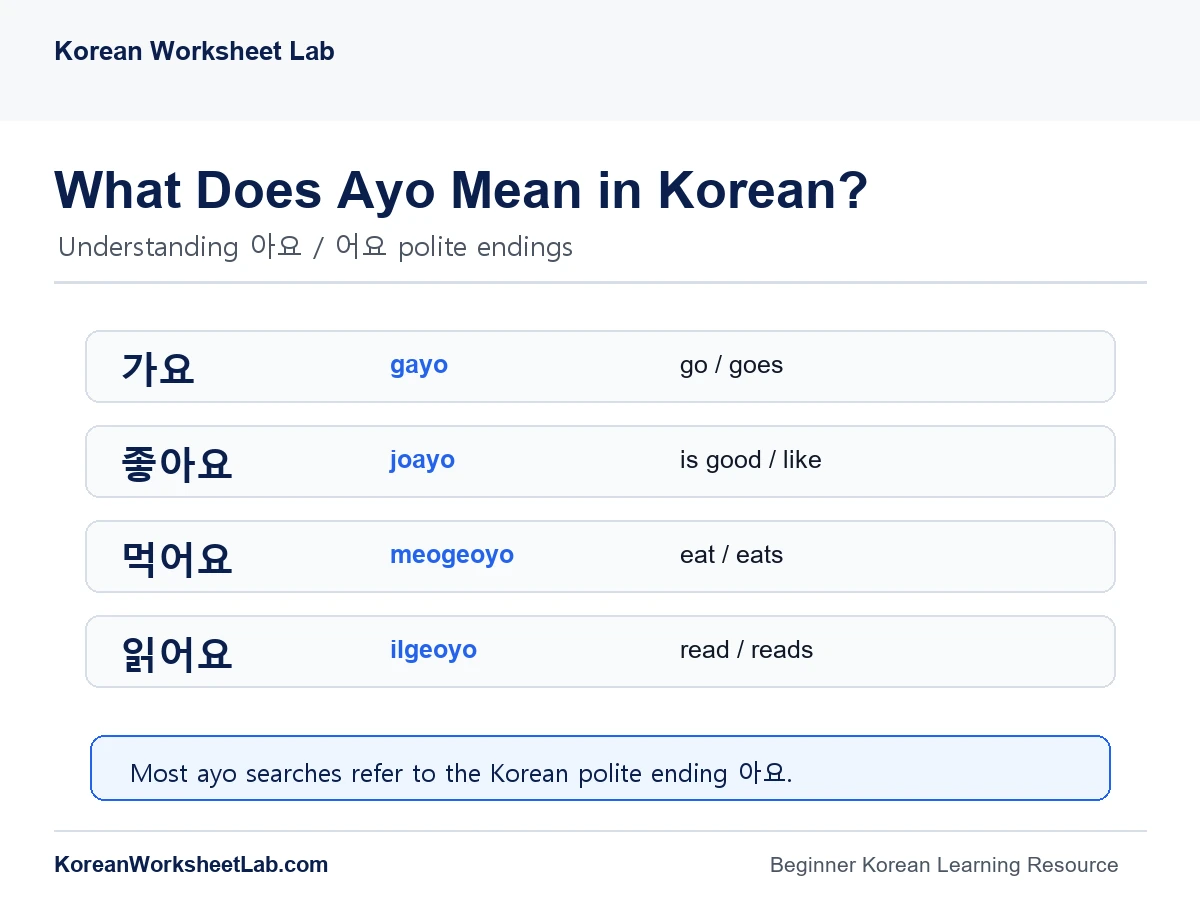
- 가요 = go / goes
- 좋아요 = is good / I like it
- 먹어요 = eat / eats
- 읽어요 = read / reads
Why You Hear Yo So Often
The 요 part makes the sentence polite in everyday conversation. Korean has different speech levels, and the polite 요 style is a useful default for adult beginners.
Because many beginner sentences end in 요, learners may hear the ending as one repeated sound. The exact form before 요 depends on the verb or adjective stem.
Ayo vs Eoyo
Many stems use 아요 when the final vowel in the stem is ㅏ or ㅗ. Other stems often use 어요. There are contractions and irregular forms, so beginners should start with common examples rather than memorize every rule at once.
가다 becomes 가요. 좋다 becomes 좋아요. 먹다 becomes 먹어요. 읽다 becomes 읽어요.
Vocabulary Box
| Korean | Romanization | Meaning |
|---|---|---|
| 아요 | ayo | polite ending pattern after some verb or adjective stems |
| 어요 | eoyo | polite ending pattern after many other stems |
| 가요 | gayo | go; goes |
| 좋아요 | joayo | is good; I like it |
| 먹어요 | meogeoyo | eat; eats |
Grammar Box
- Verb or adjective stem + 아요 / 어요 creates a common polite present form.
- 요 adds polite style in many everyday sentences.
- The English translation changes with context because Korean often omits the subject.
Pronunciation Tips
- 아요 sounds close to a-yo, but it is part of the Korean ending.
- 어요 sounds closer to eo-yo, not English oh-yo.
- Read the Hangul form instead of relying only on English spelling.
Example Sentences
한국어를 공부해요.
hangugeoreul gongbuhaeyo
I study Korean.
이거 좋아요.
igeo joayo
This is good / I like this.
커피를 마셔요.
keopireul masyeoyo
I drink coffee.
Common Mistakes
Avoid
Thinking ayo is always a standalone Korean word.
Try this
Understand it as part of the ending 아요 in most beginner searches.
Avoid
Using dictionary forms in polite conversation.
Try this
Use a polite ending such as 아요 or 어요.
Avoid
Translating every 요 sentence with the same English subject.
Try this
Use context to decide who or what the sentence is about.
Study Tips
- Collect ten verbs ending in 아요 or 어요.
- Underline only the final ending in each sentence.
- Say each sentence once slowly and once naturally.
- Review the related grammar worksheet after reading the examples.
Summary
Ayo in Korean search questions usually refers to the polite ending 아요.
It is best learned together with 어요 and real polite present-tense examples.
Frequently Asked Questions
Is ayo a Korean word?
Usually learners mean 아요, which is a polite ending pattern, not a standalone word in normal beginner sentences.
What does 요 mean?
요 is a polite sentence-ending element used in many everyday Korean sentences.
What is the difference between 아요 and 어요?
They are both polite present endings. The choice depends on the verb or adjective stem.
Related Learning Resources
This article follows the Korean Worksheet Lab editorial standards and is reviewed for beginner clarity and natural Korean usage.