Introduction
Korean topic markers and subject markers are difficult for English speakers because English does not mark nouns in the same way. The words 은, 는, 이, and 가 can all appear after nouns, but they do not do the same job. A topic marker tells the listener what the sentence is about. A subject marker points to the subject that is doing, being, existing, or being identified in that sentence.
A common beginner mistake is to ask, Which one means the? or Which one means is? That approach does not work. Korean particles are not simple English words. They are small grammar signals. This guide focuses on the practical difference between topic marker and subject marker so you can choose more naturally in short beginner sentences.
Learning Objectives
- Understand the basic job of topic markers 은/는.
- Understand the basic job of subject markers 이/가.
- Choose a marker based on sentence focus instead of English translation.
- Avoid common beginner mistakes with 저는, 제가, 사람은, and 사람이.
The Short Rule
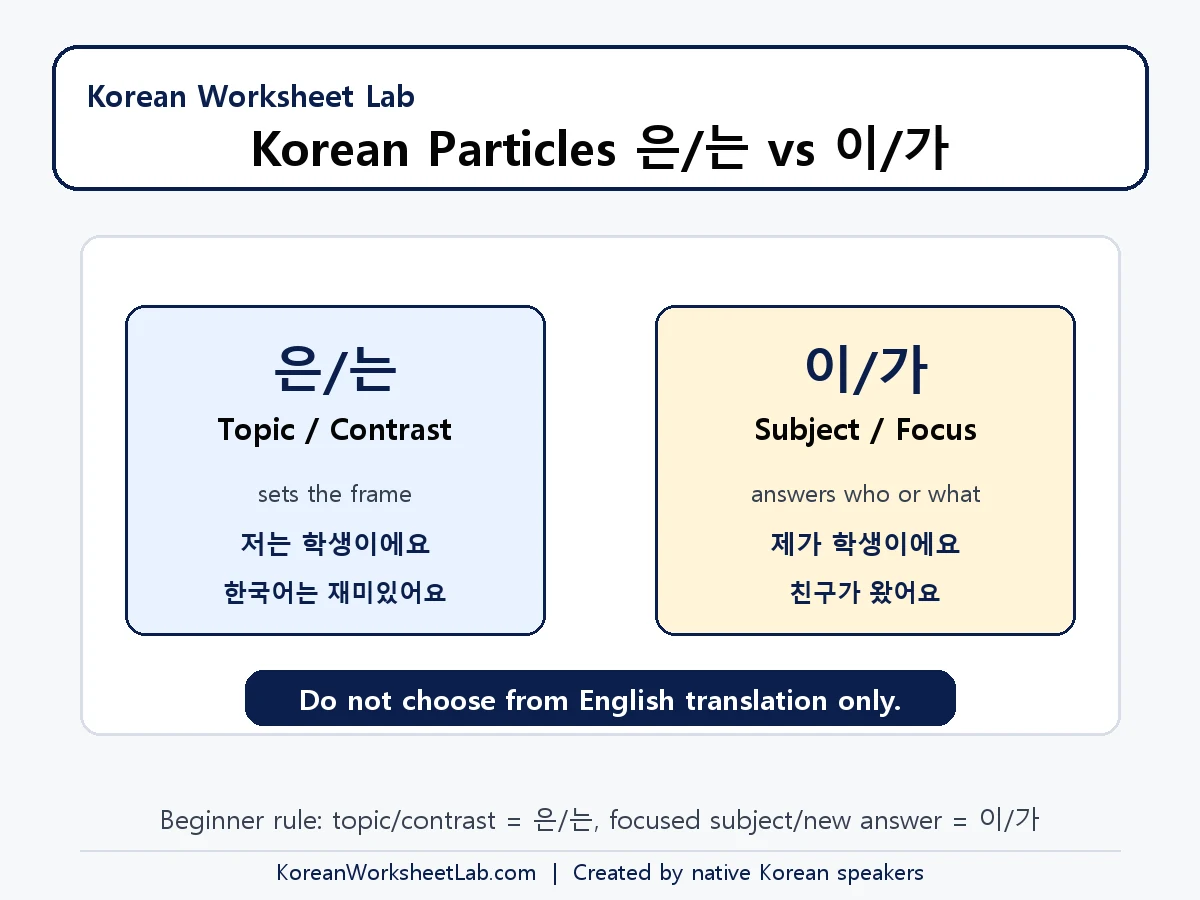
Use 은 or 는 when the noun is the topic, background, contrast, or general frame of the sentence. Use 이 or 가 when the noun is the focused subject, the newly identified person or thing, or the answer to who or what.
For example, 저는 학생이에요 introduces or frames information about me: as for me, I am a student. 제가 학생이에요 focuses on I as the person being identified: I am the student. Both can translate as I am a student, but the focus is different.
- 은/는 = topic, contrast, background, general frame
- 이/가 = subject, focus, identification, new information
- Do not choose only from the English translation
What Is a Topic Marker?
A topic marker tells the listener what area the sentence is about. In English, we might say as for me, about this book, or speaking of Korean. Korean often uses 은 or 는 for that job. The topic can be the speaker, an object, a place, a time, or an idea.
Use 은 after a noun ending in a consonant and 는 after a noun ending in a vowel. 사람 ends in the consonant ㅁ, so it becomes 사람은. 저는 ends with the vowel sound 저, so it becomes 저는.
- 사람 + 은 = 사람은
- 저 + 는 = 저는
- 한국어 + 는 = 한국어는
- 오늘 + 은 = 오늘은
What Is a Subject Marker?
A subject marker points to the noun that is the subject of the sentence. It is especially common when the subject is new, emphasized, identified, or answering a who or what question. If someone asks who did it?, the focused answer often uses 이 or 가.
Use 이 after a noun ending in a consonant and 가 after a noun ending in a vowel. 학생 ends in the consonant ㅇ, so it becomes 학생이. 제가 uses 가 because 저 becomes 제 before 가 in this common form.
- 학생 + 이 = 학생이
- 친구 + 가 = 친구가
- 누가 = who
- 제가 = I, with focused subject meaning
Minimal Pair Examples
Minimal pairs are the fastest way to feel the difference. 저는 한국 사람이에요 sounds like a general self-introduction: as for me, I am Korean. 제가 한국 사람이에요 sounds like identification: I am the Korean person, or I am the one who is Korean.
한국어는 재미있어요 means Korean is interesting as a general topic. 한국어가 재미있어요 can focus on Korean as the thing that is interesting, perhaps among several languages or choices. The English may look similar, but the Korean focus changes.
- 저는 학생이에요 = As for me, I am a student.
- 제가 학생이에요 = I am the student.
- 커피는 좋아해요 = As for coffee, I like it.
- 커피가 좋아요 = Coffee is good / coffee is what I like here.
How Native Koreans Choose
Native Koreans do not usually stop and translate particles into English. They choose based on what the listener already knows and what part of the sentence needs focus. If the noun is already the conversation frame, 은/는 often feels natural. If the noun is the new answer, 이/가 often feels natural.
This is why beginners should practice particles inside short conversations, not only isolated sentences. The same sentence can change depending on the question before it. Context is part of the grammar.
Mini Practice
Choose the more natural particle for each situation. If you are introducing yourself for the first time, 저는 학생이에요 is safer than 제가 학생이에요. If someone asks 누가 학생이에요?, the answer 제가 학생이에요 is natural because the focus is who.
Practice with question-and-answer pairs. Write the question first, then choose the particle in the answer. This trains context, not memorized translation.
- Self-introduction: 저는 학생이에요.
- Answer to who?: 제가 학생이에요.
- General topic: 한국어는 재미있어요.
- Focused subject: 이 책이 좋아요.
Vocabulary Box
| Korean | Romanization | Meaning |
|---|---|---|
| 은/는 | eun/neun | topic markers |
| 이/가 | i/ga | subject markers |
| 주제 | juje | topic |
| 주어 | jueo | subject |
| 저는 | jeoneun | as for me; I as topic |
| 제가 | jega | I as focused subject |
| 누가 | nuga | who |
| 학생 | haksaeng | student |
Grammar Box
- Use 은 after a consonant-ending noun and 는 after a vowel-ending noun.
- Use 이 after a consonant-ending noun and 가 after a vowel-ending noun.
- 은/는 often sets the sentence frame; 이/가 often identifies or focuses the subject.
- The best particle can change when the previous question changes.
Pronunciation Tips
- Particles attach directly to the noun without a long pause.
- 저는 is pronounced jeoneun, and 제가 is pronounced jega.
- 은 can sound light after a final consonant; do not add a separate English vowel before it.
- Read particle pairs aloud: 사람은, 사람이, 친구는, 친구가.
Example Sentences
저는 학생이에요.
jeoneun haksaengieyo
I am a student. / As for me, I am a student.
제가 학생이에요.
jega haksaengieyo
I am the student. / I am the one who is a student.
한국어는 재미있어요.
hangugeoneun jaemiisseoyo
Korean is interesting as a topic.
한국어가 재미있어요.
hangugeoga jaemiisseoyo
Korean is what is interesting.
누가 왔어요?
nuga wasseoyo
Who came?
친구가 왔어요.
chinguga wasseoyo
A friend came.
Common Mistakes
Avoid
Thinking 은/는 and 이/가 are interchangeable because the English translation looks the same.
Try this
Check whether the noun is the topic frame or the focused subject.
Avoid
Always using 저는 for every I sentence.
Try this
Use 제가 when you are answering who or identifying yourself as the subject.
Avoid
Choosing particles only by memorized example sentences.
Try this
Practice with the previous question included.
Avoid
Forgetting consonant and vowel forms.
Try this
Check the noun ending: 사람은, 친구는, 학생이, 친구가.
Study Tips
- Write two versions of the same sentence and explain the focus difference.
- Practice with question prompts such as 누가, 뭐가, and 무엇은.
- Read short Korean dialogues and underline the noun before each particle.
- Use the particle cheat sheet only after you understand the topic versus subject job.
Summary
The Korean topic marker 은/는 sets the frame or contrast of a sentence. The subject marker 이/가 focuses or identifies the subject.
Beginners should not translate particles as fixed English words. Instead, ask what role the noun has in the conversation.
The safest study method is to practice particles inside question-and-answer pairs, because context often decides the natural choice.
Frequently Asked Questions
What is the difference between Korean topic marker and subject marker?
A topic marker 은/는 sets what the sentence is about, while a subject marker 이/가 focuses or identifies the subject of the sentence.
Is 저는 or 제가 more natural?
저는 is common for general self-introduction. 제가 is natural when answering who or identifying yourself as the focused subject.
Can 은/는 and 이/가 both be correct?
Yes. Sometimes both are grammatical, but the nuance changes. 은/는 frames or contrasts, while 이/가 focuses or identifies.
Which particle should beginners learn first?
Learn both together with simple context. Start with 저는 for introductions and 제가 for who-answer situations.
Related Learning Resources
This article follows the Korean Worksheet Lab editorial standards and is reviewed for beginner clarity and natural Korean usage.