Introduction
A Korean final consonants chart helps learners understand why written Hangul and spoken Korean do not always match one letter at a time. In Hangul, a consonant can sit at the bottom of a syllable block. That bottom consonant is called 받침, or batchim.
The key beginner rule is simple: many written final consonants are pronounced as one of seven main final sounds. This does not mean spelling is random. It means Korean simplifies final consonant pronunciation when a syllable ends or pauses. This guide gives you a practical chart, example words, and a short practice routine.
Learning Objectives
- Identify the final consonant position in a Korean syllable block.
- Learn the seven representative batchim sound groups.
- Read beginner words such as 책, 밥, 문, 말, and 강 more accurately.
- Avoid adding extra English vowel sounds after final consonants.
What Counts as a Final Consonant?
A final consonant is the consonant at the bottom of a Korean syllable block. The syllable 가 has no final consonant. The syllable 각 has ㄱ at the bottom, so ㄱ is the final consonant. The syllable 문 has ㄴ at the bottom, and the syllable 밥 has ㅂ at the bottom.
Final consonants matter because they affect pronunciation, particle choice, and reading fluency. For example, a noun that ends in a consonant often takes 은 or 이, while a noun that ends in a vowel often takes 는 or 가.
- 가 = no final consonant
- 각 = ㄱ final consonant
- 문 = ㄴ final consonant
- 밥 = ㅂ final consonant
The 7 Korean Final Consonant Sounds
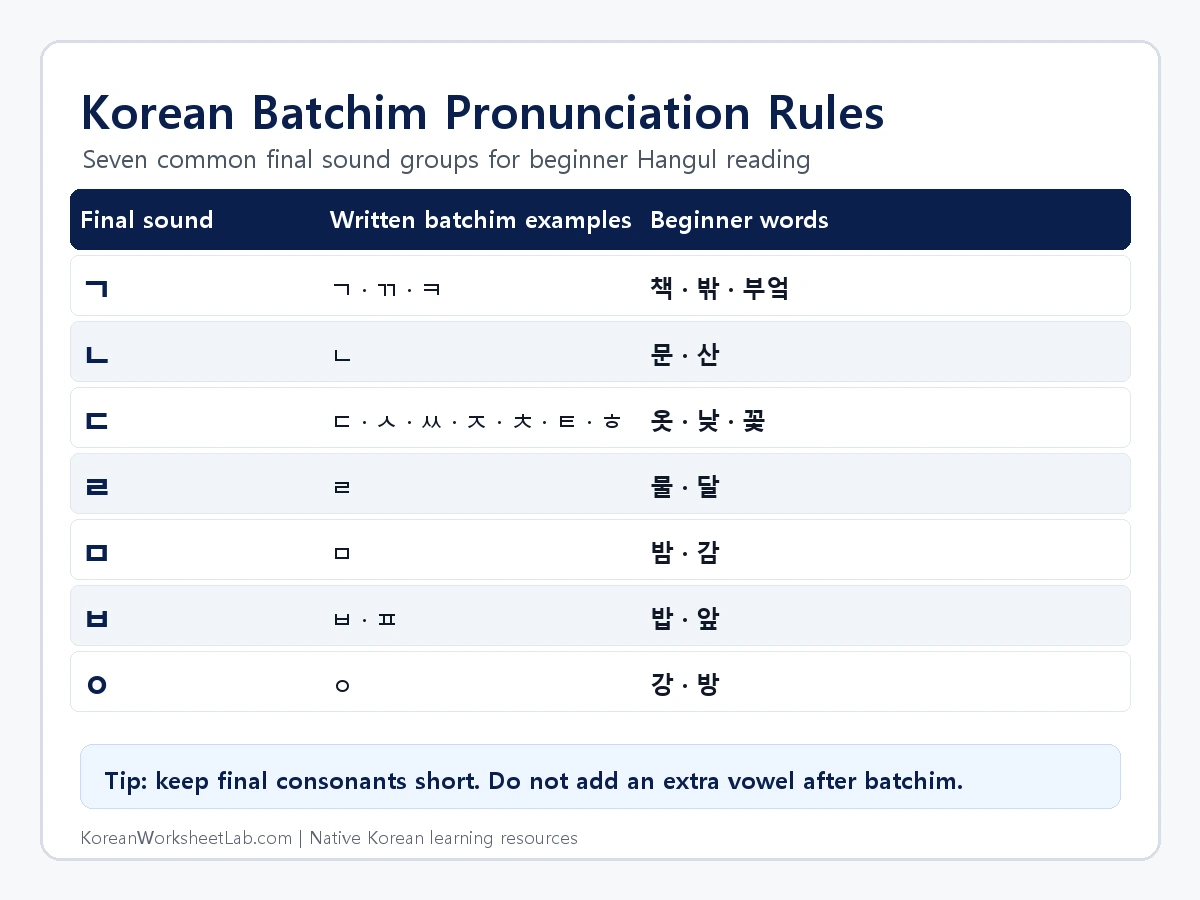
Korean has many possible written batchim letters, but in final position they are commonly grouped into seven representative sounds: ㄱ, ㄴ, ㄷ, ㄹ, ㅁ, ㅂ, and ㅇ. These are sound groups, not spelling groups.
This chart is for beginner reading before a pause or at the end of a word. Some sounds can change again when the next syllable begins with a vowel or certain consonants, but the seven-group chart is the foundation.
- ㄱ sound: ㄱ, ㅋ, ㄲ
- ㄴ sound: ㄴ
- ㄷ sound: ㄷ, ㅌ, ㅅ, ㅆ, ㅈ, ㅊ, ㅎ
- ㄹ sound: ㄹ
- ㅁ sound: ㅁ
- ㅂ sound: ㅂ, ㅍ
- ㅇ sound: ㅇ
Beginner Example Words
Use real words instead of memorizing the chart alone. 책 ends with a ㄱ sound, even though it is written with ㄱ. 밭 is written with ㅌ at the bottom, but the final sound is pronounced like ㄷ when the word is said alone. 밥 ends with a short ㅂ sound.
Do not pronounce these final sounds with a strong English-style release. In Korean, the mouth often closes into the final consonant position without adding another vowel.
- 책 = book, final ㄱ sound
- 문 = door, final ㄴ sound
- 옷 = clothes, final ㄷ sound
- 말 = horse or speech, final ㄹ sound
- 봄 = spring, final ㅁ sound
- 밥 = rice or meal, final ㅂ sound
- 강 = river, final ㅇ sound
Why Some Letters Sound the Same at the End
English speakers often expect every written consonant to keep its full sound. Korean final consonants work differently. The final position is shorter and more closed, so several written consonants reduce to the same final sound.
For example, 옷, 낮, and 꽃 have different written final consonants, but when said alone they end with a ㄷ-like final sound. This is normal Korean pronunciation, not a spelling mistake.
- 옷 ends with final ㄷ sound
- 낮 ends with final ㄷ sound
- 꽃 ends with final ㄷ sound
- 밭 ends with final ㄷ sound
What Changes Before a Vowel?
The chart above is the starting point, but Korean is spoken in connected syllables. When a word with batchim is followed by a syllable beginning with ㅇ plus a vowel, the final consonant sound often links forward.
For example, 밥 is one syllable when said alone. But 밥이 is pronounced closer to 바비 because the final ㅂ links to the next vowel sound. This is why learners should practice both isolated words and short phrases.
- 밥 + 이 = 밥이, pronounced like 바비
- 문 + 이 = 문이, pronounced like 무니
- 책 + 이 = 책이, pronounced like 채기
How to Practice with the Chart
First, cover the romanization and read only the Hangul. Second, underline the bottom consonant. Third, name the final sound group. Fourth, read the word once alone and once with a particle such as 이 or 을.
A good five-minute practice set is 책, 문, 옷, 말, 봄, 밥, and 강. Read each word slowly, sort it into the chart, then write one short phrase. This builds reading, pronunciation, and grammar awareness at the same time.
- Step 1: find the bottom consonant
- Step 2: choose the sound group
- Step 3: read the word alone
- Step 4: add a particle and read again
- Step 5: write the word once from memory
Vocabulary Box
| Korean | Romanization | Meaning |
|---|---|---|
| 받침 | batchim | final consonant position |
| 자음 | jaeum | consonant |
| 소리 | sori | sound |
| 책 | chaek | book |
| 문 | mun | door |
| 옷 | ot | clothes |
| 밥 | bap | rice; meal |
| 강 | gang | river |
Grammar Box
- Final consonants affect particle choice: consonant-ending nouns often use 은 or 이.
- Vowel-ending nouns often use 는 or 가.
- Batchim pronunciation can link forward before a syllable beginning with ㅇ and a vowel.
- The chart is a reading foundation; connected speech adds more pronunciation rules.
Pronunciation Tips
- Keep final ㄱ, ㄷ, and ㅂ sounds short and unreleased.
- Do not add extra vowels such as eu or uh after batchim.
- Practice both isolated words and linked forms.
- Use Hangul first; romanization is only a temporary support.
Example Sentences
책이 있어요.
chaegi isseoyo
There is a book.
문이 열려요.
muni yeollyeoyo
The door opens.
밥을 먹어요.
babeul meogeoyo
I eat rice / a meal.
강이 보여요.
gangi boyeoyo
I can see the river.
옷이 예뻐요.
osi yeppeoyo
The clothes are pretty.
Common Mistakes
Avoid
Reading every final consonant exactly like its initial sound.
Try this
Use the seven final sound groups first.
Avoid
Adding an extra vowel after final consonants.
Try this
Close the sound briefly and stop without adding another syllable.
Avoid
Memorizing only romanization.
Try this
Read the Hangul block and identify the batchim visually.
Avoid
Practicing only isolated words.
Try this
Add particles such as 이, 은, or 을 to hear linking and grammar patterns.
Study Tips
- Print or save the seven-sound chart and review it before reading new words.
- Sort ten beginner words by final sound group.
- Record yourself reading 책, 문, 옷, 말, 봄, 밥, and 강.
- After isolated practice, read linked forms such as 책이, 문이, and 밥을.
Summary
Korean final consonants are called batchim. They sit at the bottom of a Hangul syllable block.
Many written final consonants reduce to seven representative final sounds: ㄱ, ㄴ, ㄷ, ㄹ, ㅁ, ㅂ, and ㅇ.
A chart is useful, but real progress comes from reading words, adding particles, and avoiding extra English-style vowel sounds.
Frequently Asked Questions
How many Korean final consonant sounds are there?
For beginner pronunciation, Korean final consonants are commonly grouped into seven representative sounds: ㄱ, ㄴ, ㄷ, ㄹ, ㅁ, ㅂ, and ㅇ.
Is batchim the same as final consonant?
Yes. Batchim is the Korean term for the final consonant position at the bottom of a syllable block.
Why does ㅅ sometimes sound like ㄷ at the end?
In final position, ㅅ belongs to the ㄷ final sound group when pronounced alone or before a pause.
Should beginners memorize all double batchim first?
No. Start with the seven basic final sound groups, then learn double batchim after simple words feel stable.
Related Learning Resources
This article follows the Korean Worksheet Lab editorial standards and is reviewed for beginner clarity and natural Korean usage.