Introduction
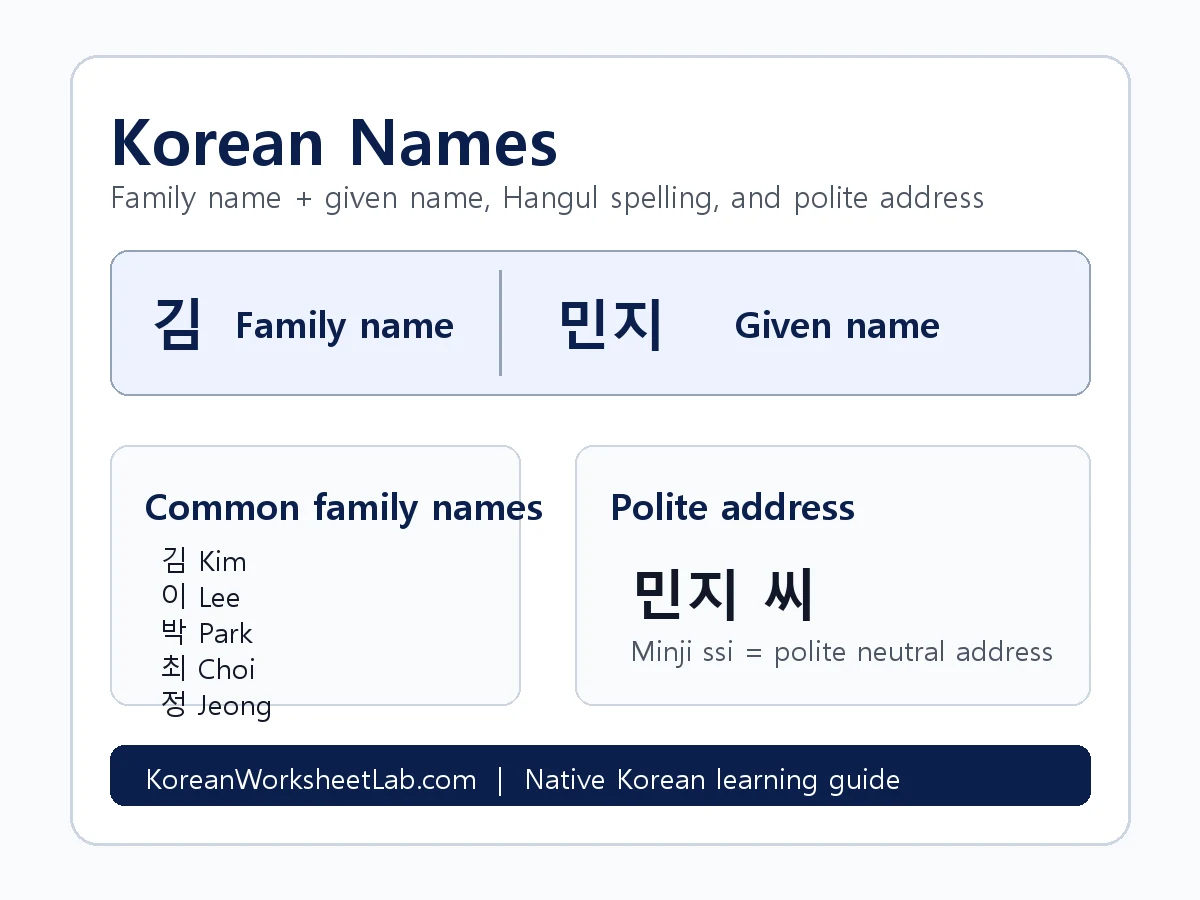
Korean names can look short, but they carry a lot of cultural information. A typical Korean full name has a family name first and a given name second. For example, in 김민지, 김 is the family name and 민지 is the given name. This order is different from the usual English order, so beginners often misunderstand which part is personal.
Names also connect to politeness. In Korean, you usually do not call an adult by only their given name unless you are very close or the person is younger and the relationship allows it. Understanding Korean name structure helps learners read forms, understand introductions, follow subtitles more accurately, and avoid sounding too casual.
Learning Objectives
- Understand the basic order of Korean names: family name first, given name second.
- Recognize the difference between Hangul spelling and hanja meaning.
- Learn common Korean family names and how given names are usually built.
- Use respectful forms of address such as name + 씨 in beginner situations.
How Korean Name Order Works
Most Korean names are written with the family name first. In the name 박지훈, 박 is the family name and 지훈 is the given name. In 이서연, 이 is the family name and 서연 is the given name. When Koreans introduce themselves in Korean, this order usually stays the same.
English-language articles sometimes reverse Korean names for readers, but Korean learners should learn the Korean order early. It helps you understand school rosters, office name tags, forms, subtitles, and polite introductions. If you see three syllables, the first syllable is often the family name, but there are exceptions.
- 김민지 = 김 family name + 민지 given name
- 박지훈 = 박 family name + 지훈 given name
- 이서연 = 이 family name + 서연 given name
Family Names Are Usually One Syllable
Many Korean family names are one Hangul syllable. Very common examples include 김, 이, 박, 최, 정, 강, 조, 윤, 장, and 임. Because these names appear often, learners may hear the same family name many times in classrooms, shows, and real Korean introductions.
There are also two-syllable family names, such as 남궁 and 황보, but they are much less common. A beginner does not need to memorize every rare family name first. Start by recognizing that the family name normally comes first and is often one syllable.
- 김 = Kim
- 이 = Lee / Yi / Rhee
- 박 = Park / Bak
- 최 = Choi
- 정 = Jeong / Jung
Given Names Are Often Two Syllables
A Korean given name is often two syllables, such as 민지, 서연, 지훈, 하준, or 도윤. Each syllable is written as a Hangul block. Some given names are one syllable, and some are longer, but two syllables are very common.
Korean given names are chosen for sound, family preference, generation traditions, and sometimes hanja meaning. Hanja are Chinese characters that can be used to represent meaning behind a Korean name. Not every Korean uses hanja actively in daily life, but hanja can still matter on official documents or when explaining the meaning of a name.
Hangul Spelling vs Hanja Meaning
Hangul shows how a Korean name is written in Korean letters. Hanja can show the meaning behind some names. For example, two people may both be named 지민 in Hangul, but their hanja may be different, so the intended meaning can also be different.
This is why you should be careful with automatic name-meaning lists online. A Hangul name does not always have one fixed meaning. To know the exact hanja meaning, you usually need the person's chosen hanja or a family explanation. If you do not have that information, it is safer to say that the name is written a certain way rather than claiming one exact meaning.
- Hangul tells you the Korean spelling.
- Hanja may explain meaning.
- The same Hangul name can have different hanja meanings.
- Some modern names may not use hanja.
How to Address Someone Politely
For beginners, name + 씨 is a useful polite pattern. For example, 민지 씨 means Ms. Minji or Minji in a polite neutral way. You can also use a full name plus 씨, such as 김민지 씨. In many adult situations, this is safer than using only a given name.
Do not attach 씨 to your own name when introducing yourself. You can say 저는 김민지예요 or 저는 김민지입니다. Also avoid calling a teacher, customer, manager, or older person by given name only unless they have clearly invited you to do so.
- 김민지 씨 = polite address
- 민지 씨 = polite but a little more personal
- 저는 김민지예요 = I am Kim Minji
- Do not say 저는 김민지 씨예요
Romanization Can Vary
Korean names often have more than one English spelling. 이 may appear as Lee, Yi, or Rhee. 정 may appear as Jeong, Jung, or Chung. 박 may appear as Park or Bak. These differences can come from family preference, older systems, passports, or personal choice.
For language learning, Hangul is more reliable than romanization. If you know the Hangul spelling, you can pronounce and recognize the name more accurately. Romanization is useful for English documents, but it should not replace reading Korean names in Hangul.
Vocabulary Box
| Korean | Romanization | Meaning |
|---|---|---|
| 이름 | ireum | name |
| 성 | seong | family name |
| 개인 이름 | gaein ireum | given name; personal name |
| 한국 이름 | hanguk ireum | Korean name |
| 한글 | hangeul | Korean writing system |
| 한자 | hanja | Chinese characters used for meaning in some Korean names |
| 씨 | ssi | polite title after a name |
Grammar Box
- The basic self-introduction pattern is 저는 + name + 예요/이에요 or 입니다.
- Use 예요 after a vowel-ending name and 이에요 after a consonant-ending name in polite speech.
- Name + 씨 is used to address another person politely; it is not used after your own name.
- Korean name order is family name + given name.
Pronunciation Tips
- Read the Hangul spelling first instead of relying only on English spelling.
- 김 is pronounced closer to gim/kim depending on context, but Kim is the common English spelling.
- 이 is pronounced like a short ee sound in Korean, even though it is often written Lee in English.
- 씨 is pronounced with a tense ss sound, not like the English word see.
Example Sentences
저는 김민지예요.
jeoneun Gim Minji-yeyo.
I am Kim Minji.
민지 씨, 안녕하세요.
Minji ssi, annyeonghaseyo.
Hello, Minji.
이름이 뭐예요?
ireumi mwoyeyo?
What is your name?
제 이름은 박지훈입니다.
je ireumeun Bak Jihun-imnida.
My name is Park Jihun.
성은 김이에요.
seongeun Gim-ieyo.
My family name is Kim.
Common Mistakes
Avoid
Assuming the last part of a Korean name is always the family name.
Try this
In Korean order, the family name usually comes first.
Avoid
Calling adults by given name only.
Try this
Use name + 씨 or an appropriate title unless the relationship is close.
Avoid
Believing every Hangul name has one fixed meaning.
Try this
Check the hanja or family explanation before stating a precise meaning.
Avoid
Using 씨 after your own name.
Try this
Introduce yourself with 저는 + name + 예요/이에요 or 입니다.
Study Tips
- Write five Korean names and underline the family name in each one.
- Practice introducing yourself with 저는 ___예요 and 저는 ___입니다.
- Read Korean names in Hangul before checking English spelling.
- Make a small chart of common family names such as 김, 이, 박, 최, and 정.
- Practice polite address with name + 씨 using both full names and given names.
Summary
Korean names usually follow the order family name first and given name second. Many family names are one syllable, and many given names are two syllables.
Hangul gives the spelling, while hanja may explain the meaning behind some names. Because hanja can differ, the same Hangul name does not always have one exact meaning.
For beginner politeness, name + 씨 is useful when addressing another person, but do not use 씨 after your own name when introducing yourself.
Frequently Asked Questions
Do Korean names put the family name first?
Yes. In Korean, the family name usually comes first, followed by the given name. 김민지 is 김 plus 민지.
Are Korean given names always two syllables?
No, but two-syllable given names are very common. One-syllable and longer names also exist.
Can I know a Korean name meaning from Hangul only?
Not always. Hangul shows spelling. Exact meaning often depends on hanja or family choice.
What does 씨 mean after a Korean name?
씨 is a polite title used after another person's name. It is useful in many neutral adult situations.
Related Learning Resources
This article follows the Korean Worksheet Lab editorial standards and is reviewed for beginner clarity and natural Korean usage.