Introduction
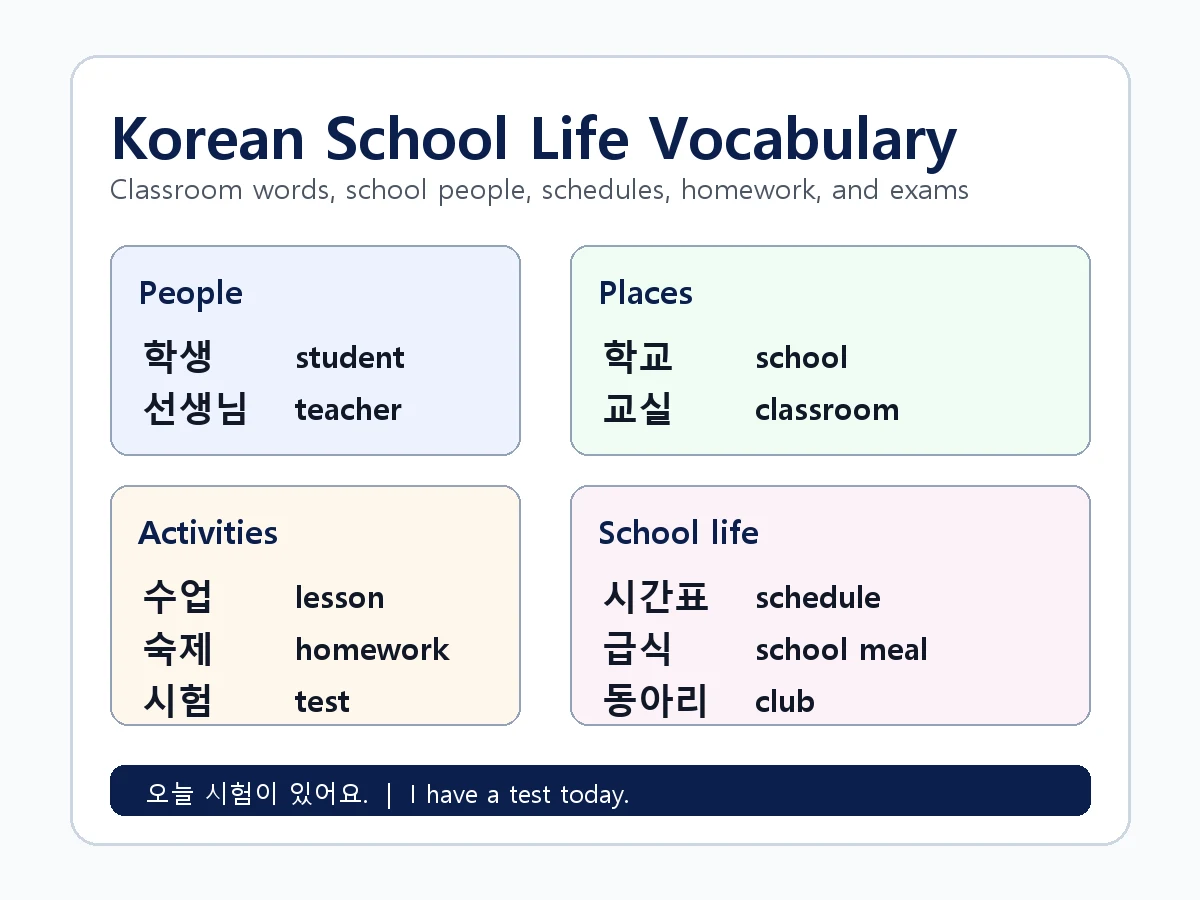
Korean school life vocabulary is useful even if you are not studying in a Korean school. Words such as 학교, 학생, 선생님, 교실, 수업, 시험, and 숙제 appear in textbooks, dramas, language classes, and everyday conversations. These words also help you understand how Korean learners talk about age, grade, teachers, school lunch, clubs, and exams.
A good beginner list should not only translate school words. It should explain where each word is used, how it sounds in natural sentences, and which words are easy to confuse. This guide organizes Korean school vocabulary into practical groups so learners can read the Hangul, check romanization when needed, and practice with short classroom-style examples.
Learning Objectives
- Learn core Korean school life words in Hangul with romanization and English meanings.
- Understand the difference between school places, people, supplies, schedule words, and activities.
- Use beginner sentence patterns to talk about class, homework, exams, and school life.
- Avoid common vocabulary mistakes such as confusing 수업, 반, 학년, and 학교.
Core School Words
Start with the words that appear in almost every school-related conversation. 학교 means school. 학생 means student. 선생님 means teacher. 교실 means classroom. 수업 means class or lesson. These words are more useful than memorizing a long list of supplies first because they help you understand basic sentences immediately.
Notice that 선생님 includes 님, a respectful ending. Beginners should normally say 선생님, not just 선생, when talking to or about a teacher. In Korean, school vocabulary often carries respect and relationship information, so word choice matters.
- 학교 = school
- 학생 = student
- 선생님 = teacher
- 교실 = classroom
- 수업 = class or lesson
Classroom Objects
After core school words, learn the classroom objects you can see and touch. 책 is book, 공책 is notebook, 연필 is pencil, 지우개 is eraser, 책상 is desk, 의자 is chair, and 칠판 is board. These are good beginner words because they are concrete and easy to review with pictures.
For self-study, point to an object and say the Korean word aloud. For teaching, ask students to match a picture to the Hangul word before asking them to write the word. This keeps the activity from becoming blind copying.
- 책 = book
- 공책 = notebook
- 연필 = pencil
- 지우개 = eraser
- 칠판 = board
Schedule and School Life Words
School life includes more than objects. 시간표 means timetable or class schedule. 숙제 means homework. 시험 means exam or test. 점심 means lunch, and 급식 means a school meal provided by the school. 동아리 means club or school club activity.
These words help learners understand short Korean passages about daily routines. For example, 오늘 시험이 있어요 means There is a test today. 숙제를 해요 means I do homework. 점심에 급식을 먹어요 means I eat school lunch at lunchtime.
Grade, Class, and Homeroom
Three words often confuse beginners: 학년, 반, and 수업. 학년 means grade or school year. 반 means class group or homeroom group. 수업 means a class lesson. For example, 중학교 2학년 means second year of middle school, while 3반 means class group 3.
A student can be in one 반 but take many 수업. This distinction matters when reading Korean school stories or watching scenes set in school. It also helps you understand introductions such as 저는 2학년 3반이에요.
- 학년 = grade / school year
- 반 = class group / homeroom
- 수업 = lesson / class session
- 담임 선생님 = homeroom teacher
Useful Beginner Sentences
Use school vocabulary with simple sentence patterns. 있어요 means there is or I have. 해요 means do. 먹어요 means eat. 좋아해요 means like. With these patterns, you can make practical sentences before learning advanced grammar.
For example, 숙제가 있어요 means I have homework. 시험이 있어요 means I have a test. 수업을 들어요 means I attend a class. 학교에 가요 means I go to school. These are short, natural sentences that match beginner grammar.
- 숙제가 있어요 = I have homework.
- 시험이 있어요 = I have a test.
- 학교에 가요 = I go to school.
- 수업을 들어요 = I attend class.
How to Practice This Vocabulary
Do not memorize all school words in one sitting. Divide them into three groups: people and places, classroom objects, and school activities. Review one group at a time, then combine the words in short sentences.
A strong five-minute practice routine is simple. Read each Hangul word aloud, cover the English meaning, say one example sentence, and write the word once from memory. If you are teaching, finish with one speaking question such as 오늘 수업이 있어요? or 숙제가 있어요?
Vocabulary Box
| Korean | Romanization | Meaning |
|---|---|---|
| 학교 | hakgyo | school |
| 학생 | haksaeng | student |
| 선생님 | seonsaengnim | teacher |
| 교실 | gyosil | classroom |
| 수업 | sueop | class; lesson |
| 숙제 | sukje | homework |
| 시험 | siheom | exam; test |
| 시간표 | siganpyo | timetable; class schedule |
| 급식 | geupsik | school meal |
| 동아리 | dongari | club; school club |
| 학년 | hangnyeon | grade; school year |
| 반 | ban | class group; homeroom |
Grammar Box
- Use 에 with school as a destination: 학교에 가요.
- Use 에서 for the place where an action happens: 교실에서 공부해요.
- Use 이/가 with existence: 숙제가 있어요, 시험이 있어요.
- Use 을/를 with actions such as 수업을 들어요 and 숙제를 해요.
Pronunciation Tips
- 학교 is often pronounced 학꾜 because ㄱ becomes tense after final ㄱ.
- 학년 is pronounced 항년 in natural speech because ㄱ changes before ㄴ.
- 수업 has two syllables: 수-업. Do not pronounce it like one English-style word.
- 선생님 should be pronounced as three clear syllables: 선-생-님.
Example Sentences
학교에 가요.
hakgyoe gayo.
I go to school.
교실에서 공부해요.
gyosireseo gongbuhaeyo.
I study in the classroom.
오늘 시험이 있어요.
oneul siheomi isseoyo.
I have a test today.
숙제를 해요.
sukjereul haeyo.
I do homework.
저는 2학년이에요.
jeoneun i-hangnyeonieyo.
I am in second grade / year two.
Common Mistakes
Avoid
Using 학교 for every school-related word.
Try this
Use 교실 for classroom, 수업 for lesson, and 반 for class group.
Avoid
Calling a teacher 선생 in normal beginner speech.
Try this
Use 선생님 because it is respectful and natural.
Avoid
Confusing 학년 and 반.
Try this
학년 is grade or year; 반 is class group or homeroom.
Avoid
Memorizing romanization before Hangul.
Try this
Read the Hangul first and use romanization only as temporary pronunciation support.
Study Tips
- Make three lists: school people, classroom objects, and school activities.
- Write one sentence with 학교, one with 교실, and one with 숙제.
- Practice saying 오늘 시험이 있어요 and 숙제가 있어요 aloud.
- Use a picture worksheet or flashcards for concrete objects such as 책, 연필, and 지우개.
- Review pronunciation changes in 학교 and 학년 after you can recognize the words.
Summary
Korean school life vocabulary is useful for classes, dramas, Korean reading passages, and beginner conversations.
Start with core words such as 학교, 학생, 선생님, 교실, 수업, 숙제, and 시험 before memorizing longer lists.
The most important distinction is meaning in context: 학교 is school, 교실 is classroom, 수업 is lesson, 학년 is grade, and 반 is class group.
Frequently Asked Questions
What is school in Korean?
School in Korean is 학교, romanized as hakgyo. In natural pronunciation, it often sounds like 학꾜.
What is teacher in Korean?
Teacher is 선생님, romanized as seonsaengnim. Beginners should use 선생님 because it is respectful.
What is homework in Korean?
Homework is 숙제, romanized as sukje. You can say 숙제를 해요, meaning I do homework.
What is the difference between 학년 and 반?
학년 means grade or school year. 반 means class group or homeroom group.
Related Learning Resources
This article follows the Korean Worksheet Lab editorial standards and is reviewed for beginner clarity and natural Korean usage.