Introduction
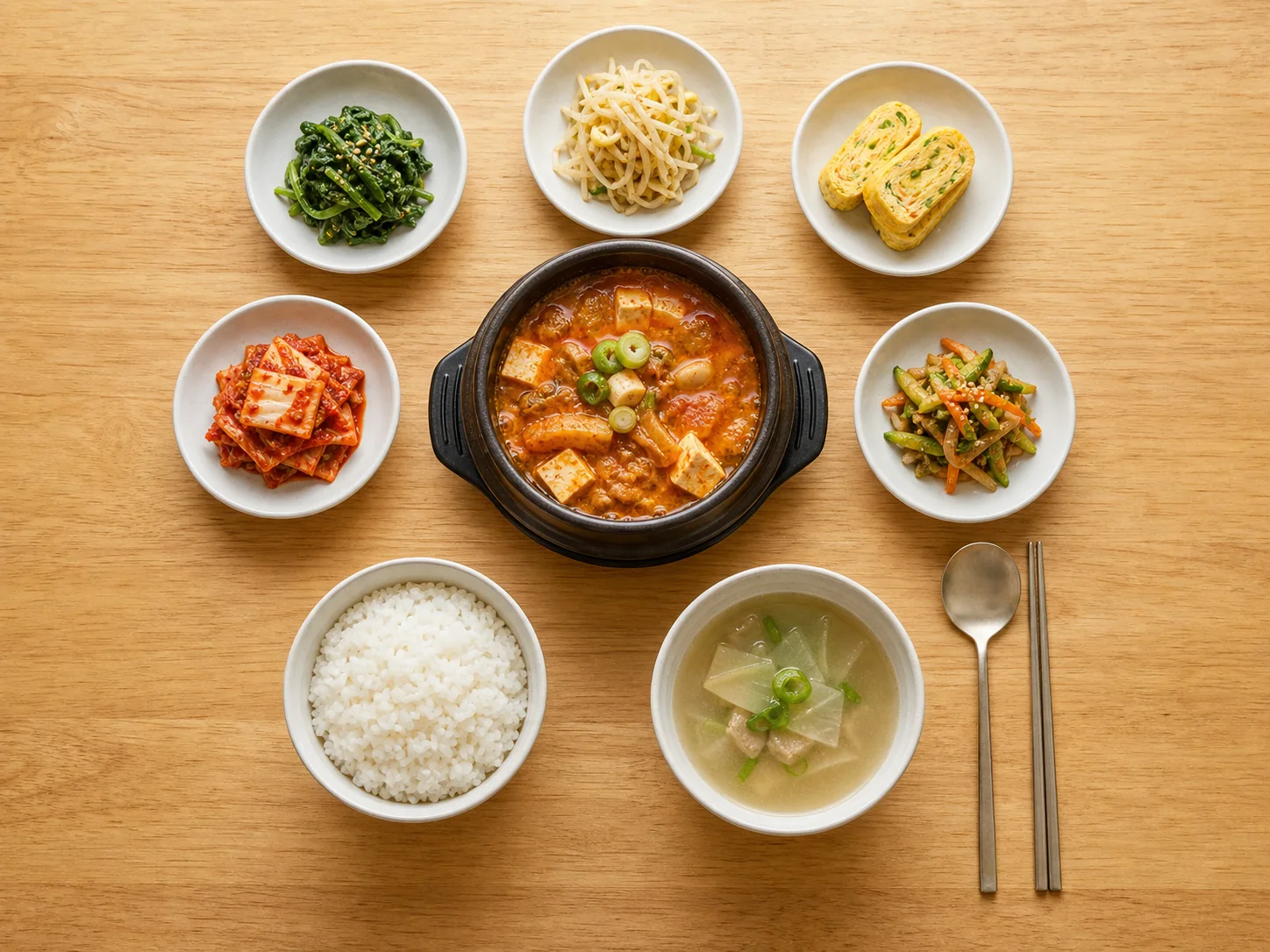
Korean food vocabulary becomes easier when you learn how a meal is organized. On a typical home-style table, 밥 is the individual bowl of cooked rice, 국 may be an individual bowl of soup, and several 반찬 can sit in the middle for people to share. A 찌개 may also be shared, although serving styles differ by household and restaurant. These words describe both food and the relationships around the table.
This guide does not ask you to memorize dozens of famous dish names. It teaches the small group of words that helps you read a Korean table, describe taste, and respond politely before and after eating. You will also learn where broad cultural claims can mislead: not every Korean meal is spicy, not every dish is shared, and etiquette changes with the setting.
Learning Objectives
- Identify the main parts of a Korean table setting: 밥, 국, 찌개, and 반찬.
- Distinguish 음식, 요리, 밥, 식사, and 한식 in beginner conversation.
- Use natural expressions for sharing, serving, tasting, and thanking someone for a meal.
- Describe common flavors without assuming that all Korean food is spicy.
- Check your understanding with a short context-based practice and answer key.
Read a Korean Meal from the Outside In
Start with the bowl closest to one person. 밥 (bap) literally means cooked rice, but it can also mean a meal in everyday speech. The phrase 밥 먹었어요? literally asks whether someone has eaten, yet depending on context it can function as a warm check-in rather than a request for a detailed menu report. 식사 (siksa) is the more formal word for a meal.
국 (guk) is soup, usually with more broth than solid ingredients. 찌개 (jjigae) is a stew with a stronger, denser broth and more ingredients. The boundary is a culinary category rather than an exact liquid measurement, so learners should remember familiar names such as 미역국 and 된장찌개 as complete units.
반찬 (banchan) means the dishes eaten alongside rice. Kimchi can be a 반찬, but 반찬 is not another word for kimchi. A table may have vegetables, eggs, fish, tofu, or other side dishes. The number and style vary with the home, budget, season, region, and occasion.
- 밥: cooked rice; also an everyday word for a meal
- 국: soup, generally broth-forward
- 찌개: stew, generally concentrated and ingredient-heavy
- 반찬: side dishes eaten with rice
- 수저: the spoon-and-chopsticks set
Food, Dish, Meal, and Korean Cuisine Are Not the Same Word
음식 (eumsik) is the broad, neutral word for food. It works in 한국 음식, Korean food, and 매운 음식, spicy food. 요리 (yori) can mean a prepared dish or cooking as an activity. 요리하다 means to cook, while 이 요리는 맛있어요 means this dish is delicious.
밥 is more personal and conversational. 밥을 먹어요 can mean eat rice or eat a meal, according to context. 식사 is more formal and appears in polite invitations or service language, such as 식사하셨어요? 한식 (hansik) means Korean cuisine as a category, especially when contrasting it with 중식, Chinese cuisine, or 일식, Japanese cuisine.
A useful rule is to learn the noun with one natural partner. Use 음식을 먹다 for eating food, 요리하다 for cooking, 밥을 먹다 for having a meal, 식사하다 for dining in a more formal register, and 한식을 좋아하다 for liking Korean cuisine.
Shared Dishes and Individual Portions
Many Korean tables place 반찬 in the center, but sharing is not an instruction to reach into every dish without noticing the setting. Some homes use personal plates, serving chopsticks, or separate portions. Restaurants may serve refillable side dishes, but policies differ and unlimited refills should never be assumed.
같이 먹어요 means we eat together or let us eat together, depending on context. 덜어 먹어요 means to take a portion onto another plate before eating. 개인 접시 is an individual plate. These expressions are more useful than a rigid claim that Koreans always share everything.
The verb 드시다 is the honorific form of 먹다, to eat. You use it when the eater deserves respectful language: 할머니, 많이 드세요 means Grandma, please eat plenty. Do not use 드시다 merely because the food is Korean; the choice depends on the person you are describing or addressing.
- 같이 먹어요. — Let’s eat together / We eat together.
- 개인 접시에 덜어 먹어요. — Take some onto an individual plate before eating.
- 이 반찬 드셔 보세요. — Please try this side dish. (honorific)
- 반찬을 더 주실 수 있어요? — Could you give us more side dishes?
What to Say Before and After a Meal
잘 먹겠습니다 (jal meokgetseumnida) is commonly said before eating when someone prepared, provided, or paid for the food. A natural English sense is I will enjoy the meal, with appreciation built in. It is not a mechanical phrase that every person must announce before every snack or solitary meal.
잘 먹었습니다 (jal meogeotseumnida) is said after eating to show appreciation: I ate well or thank you for the meal. When a host serves food, 맛있게 드세요 means please enjoy your meal, using the honorific verb 드시다. Diners do not normally say 맛있게 드세요 to describe their own eating.
Among close friends, 잘 먹을게 can be a casual thank-you before eating something a friend bought or gave you. Because speech level carries social meaning, beginners should keep 잘 먹겠습니다 and 잘 먹었습니다 as safe polite forms until the relationship is clearly casual.
Describe Taste without Translating Word for Word
맛있어요 means it is delicious. To be more specific, use 매워요 for spicy, 달아요 for sweet, 짜요 for salty, 시어요 for sour, and 써요 for bitter. 싱거워요 means the seasoning is weak or the food is not salty enough; it is not the same as 맛없어요, which means it tastes bad.
고소해요 describes a savory, nutty, roasted richness found in foods such as sesame, toasted grains, or some bean dishes. English has no single perfect match, so examples teach it better than a one-word translation. 담백해요 describes a clean, mild, not overly greasy taste. Neither word simply means bland.
Korean predicates such as 맵다 and 달다 change form in polite present speech: 맵다 becomes 매워요, and 달다 becomes 달아요. Learn the dictionary form for lookup and the polite form for conversation.
- 이 찌개는 조금 매워요. — This stew is a little spicy.
- 나물은 고소하고 담백해요. — The seasoned vegetables are nutty-savory and light.
- 국이 제 입맛에는 조금 짜요. — The soup is a little salty for my taste.
- 맵지 않게 해 주세요. — Please make it not spicy, if possible.
Mini Practice
Choose the best Korean word or expression for each context. Try without looking back at the vocabulary box, then explain why the other choices do not fit.
1. You mean Korean cuisine as a category: 밥 / 한식 / 반찬. 2. A host says please enjoy your meal to an older guest: 잘 먹겠습니다 / 맛있게 드세요 / 밥 먹었어요? 3. You take kimchi from a shared dish onto your own small plate: 개인 접시에 덜어 먹어요 / 국을 마셔요 / 요리해요. 4. The food needs more seasoning but is not necessarily bad: 맛없어요 / 싱거워요 / 달아요. 5. Complete the polite sentence: 이 찌개는 조금 ___ (맵다).
Now translate two short lines into natural English: 6. 밥 먹었어요? 7. 잘 먹었습니다. Finally, write one Korean sentence that describes a 반찬 using 맛있어요, 짜요, 고소해요, or 담백해요.
Answer Key
1. 한식, because the question asks for Korean cuisine as a category. 2. 맛있게 드세요, because a host is respectfully inviting the guest to enjoy the meal. 3. 개인 접시에 덜어 먹어요, meaning take a portion onto an individual plate. 4. 싱거워요, meaning weakly seasoned or not salty enough. 5. 매워요: 이 찌개는 조금 매워요.
6. 밥 먹었어요? literally means Did you eat? or Have you eaten? In a friendly check-in, Have you eaten? is natural. 7. 잘 먹었습니다 means I ate well and expresses thanks for the meal. For the writing item, answers vary. One correct model is 이 나물은 고소하고 맛있어요, This seasoned vegetable dish is nutty-savory and delicious.
Vocabulary Box
| Korean | Romanization | Meaning |
|---|---|---|
| 음식 | eumsik | food; the broad neutral term |
| 요리 | yori | a prepared dish; cooking |
| 밥 | bap | cooked rice; an everyday meal |
| 식사 | siksa | meal; dining (more formal) |
| 한식 | hansik | Korean cuisine |
| 국 | guk | soup |
| 찌개 | jjigae | Korean-style stew |
| 반찬 | banchan | side dish eaten with rice |
| 수저 | sujeo | spoon and chopsticks as a set |
| 개인 접시 | gaein jeopsi | individual plate |
| 덜다 | deolda | to take or serve out a portion |
| 먹다 | meokda | to eat |
| 드시다 | deusida | to eat (honorific) |
| 고소하다 | gosohada | to taste nutty, roasted, and savory |
| 담백하다 | dambaekada | to taste clean, mild, and not greasy |
Grammar Box
- Noun + 을/를 먹어요 marks what is eaten: 밥을 먹어요, I eat a meal; 반찬을 먹어요, I eat side dishes.
- Noun + 은/는 introduces or contrasts a topic: 이 찌개는 매워요, This stew is spicy.
- Adjective stem + 지 않게 해 주세요 requests that something be made not a certain way: 맵지 않게 해 주세요, Please make it not spicy.
- Verb stem + 아/어 보세요 invites someone to try an action: 먹어 보세요, Please try it; 드셔 보세요 is honorific.
- 고 connects two descriptions: 고소하고 담백해요, It is nutty-savory and light.
Pronunciation Tips
- 밥 ends with a short unreleased ㅂ sound when said alone; do not add an extra English-style vowel after bap.
- 국 is pronounced with a closed final ㄱ when it ends the phrase, but the sound can link before a following vowel.
- 먹었- in 잘 먹었습니다 is commonly heard with connected pronunciation close to [머걷씀니다]; learn the written form first and then listen for the sound change.
- Romanization cannot show every Korean sound reliably. Use it as a temporary cue while keeping your eyes on Hangul.
Example Sentences
오늘은 한식을 먹고 싶어요.
oneureun hansigeul meokgo sipeoyo.
I want to eat Korean food today.
밥하고 국은 따로 나와요.
bapago gugeun ttaro nawayo.
The rice and soup are served separately.
이 반찬은 뭐예요?
i banchaneun mwoyeyo?
What is this side dish?
개인 접시에 덜어 먹어요.
gaein jeopsie deoreo meogeoyo.
We take portions onto individual plates before eating.
할머니, 이 나물 드셔 보세요.
halmeoni, i namul deusyeo boseyo.
Grandma, please try this seasoned vegetable dish.
이 찌개는 맵지만 맛있어요.
i jjigaeneun maepjiman masisseoyo.
This stew is spicy, but it is delicious.
잘 먹겠습니다.
jal meokgetseumnida.
Thank you for the meal; I will enjoy it.
잘 먹었습니다.
jal meogeotseumnida.
Thank you for the meal; I ate well.
Common Mistakes
Avoid
Translating 밥 only as rice in every sentence.
Try this
Check the context. 밥 can mean cooked rice or an everyday meal.
Avoid
Calling every dish 반찬.
Try this
Use 반찬 for side dishes eaten with rice; 국, 찌개, and 밥 have different roles.
Avoid
Assuming that all Korean food is spicy.
Try this
Describe the actual dish. Many soups, vegetable dishes, grilled foods, and rice dishes are mild.
Avoid
Saying that every Korean table always shares every dish.
Try this
Notice personal bowls, serving utensils, individual plates, and the rules of that home or restaurant.
Avoid
Using 잘 먹겠습니다 as a literal future-tense statement only.
Try this
Understand it as a conventional expression of appreciation before a provided meal.
Avoid
Using 드시다 to sound polite about yourself.
Try this
Use 먹다 for your own eating; use the honorific 드시다 for a respected person's action.
Study Tips
- Draw one table and label only five roles: 밥, 국, 찌개, 반찬, and 수저.
- Learn dish names as category pairs: 미역국, 된장찌개, 김치 반찬, and 밥.
- Describe one real meal with two taste words instead of memorizing ten isolated adjectives.
- Practice 잘 먹겠습니다 before a hosted meal and 잘 먹었습니다 after it, while remembering why you are thanking the provider.
- Cover the romanization and read each Korean example aloud before checking the English.
Summary
A Korean meal is easier to understand when you see a system rather than a list. 밥 is the rice or everyday meal, 국 is soup, 찌개 is stew, and 반찬 are the dishes eaten alongside rice. Serving and sharing patterns vary, so observe the setting instead of treating one custom as universal.
Use 음식 for food in general, 요리 for a dish or cooking, 식사 for a more formal meal, and 한식 for Korean cuisine. Expressions such as 잘 먹겠습니다, 잘 먹었습니다, 덜어 먹어요, and 드셔 보세요 connect vocabulary with real relationships at the table.
Frequently Asked Questions
What does 밥 mean besides rice?
밥 literally means cooked rice, but in everyday Korean it often means a meal. 밥 먹었어요? can mean Have you eaten? rather than Did you eat rice?
What is the difference between 국 and 찌개?
국 is generally a broth-forward soup, while 찌개 is generally a denser, more strongly seasoned stew. Learn common dish names because the boundary is a culinary convention, not an exact formula.
Are Korean side dishes always shared?
Many 반찬 are placed in the center, but practices vary. Homes and restaurants may use personal plates, serving utensils, or individual portions, so follow the setting.
When should I say 잘 먹겠습니다?
Say it before a meal to show appreciation when someone has prepared, provided, or paid for the food. It is common and polite, but it is not mandatory before every snack or solitary meal.
How do I say Korean cuisine in Korean?
Korean cuisine is 한식, romanized as hansik. 한국 음식 also means Korean food and is natural in general conversation.
Related Learning Resources
This article follows the Korean Worksheet Lab editorial standards and is reviewed for beginner clarity and natural Korean usage.