Introduction
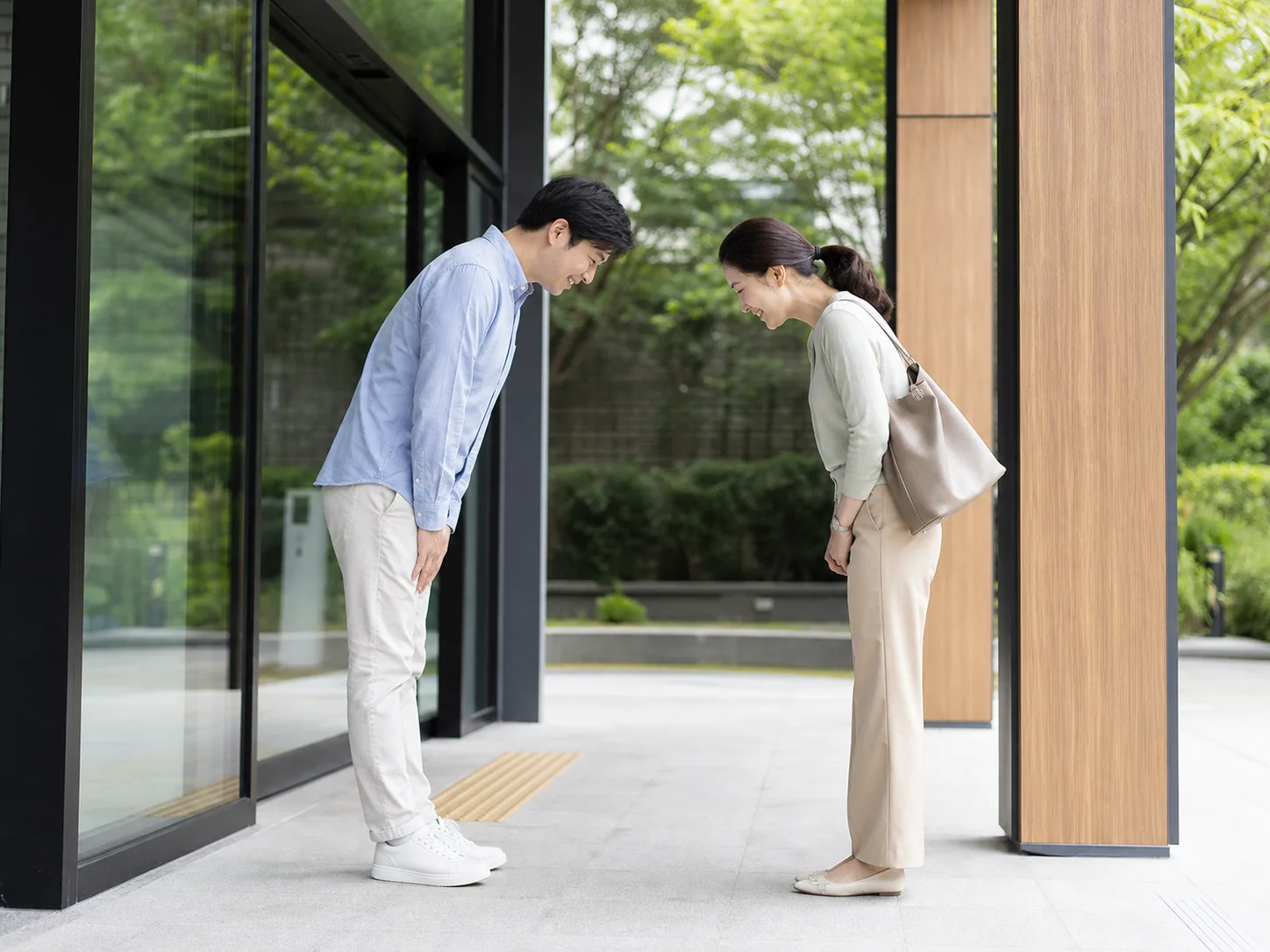
Korean etiquette is not a secret list of rules that foreigners must perform perfectly. It is a way of showing that you notice the relationship, the setting, and the people around you. A small bow with 안녕하세요, using polite speech with a new acquaintance, or receiving a gift with two hands can communicate care before your Korean is fluent.
The most useful beginner habit is not memorizing dozens of taboos. Start with a polite default, observe what people in that particular setting do, and adjust. Age and professional rank can matter, but so can familiarity, the formality of the event, regional habits, and individual preference. This guide teaches practical Korean phrases together with the behavior they accompany.
Learning Objectives
- Use a safe polite default when greeting or speaking to someone new.
- Recognize when a slight bow, two-handed gesture, or shoes-off custom is relevant.
- Use simple Korean expressions before and after meals and in public situations.
- Avoid treating context-dependent Korean manners as universal rules.
- Choose an appropriate response in a short etiquette practice.
The Best Beginner Rule: Start Polite and Observe
With strangers, teachers, service workers, older acquaintances, and people you have just met, begin with 존댓말 (jondaenmal), polite speech. The everyday 해요체 style often ends in 요, as in 안녕하세요, 괜찮아요, and 감사해요. It is warm and respectful without sounding like a formal announcement.
In official settings you may hear 합니다-style endings such as 감사합니다 and 죄송합니다. You do not need to force every sentence into the most formal style. A natural beginner combination is 안녕하세요 for hello, 감사합니다 for thanks, 죄송합니다 for a sincere apology, and ordinary 요-style sentences for conversation.
반말 (banmal), casual speech without polite endings, is not simply bad language. Friends, family members, and people who have agreed to speak casually use it naturally. The mistake is assuming that similar age automatically gives permission. Continue with polite speech until the relationship and preference are clear.
- New relationship: use polite speech.
- Uncertain setting: watch and follow the local pattern.
- Close relationship: change speech level only when it is mutually comfortable.
Greetings: Words, Eye Contact, and a Small Bow
안녕하세요 (annyeonghaseyo) is the safest everyday greeting. In many ordinary meetings, a light bow or nod accompanies it. The bow is usually brief, not a dramatic right angle. Business, ceremonial, and family occasions can be more formal, while close friends may simply wave or speak.
A handshake may appear in professional or international settings. Let the other person lead if you are unsure. You can shake with the right hand while the left hand lightly supports the right wrist or forearm. This supported gesture signals attentiveness, but the exact gesture varies by person and situation.
Titles are often safer than first names alone. 선생님 can address a teacher, and workplace titles may be followed by 님. Do not call every older Korean person 아저씨 or 아줌마; those words are context-sensitive and can sound too familiar or unwelcome when used as direct address.
Giving and Receiving with Two Hands
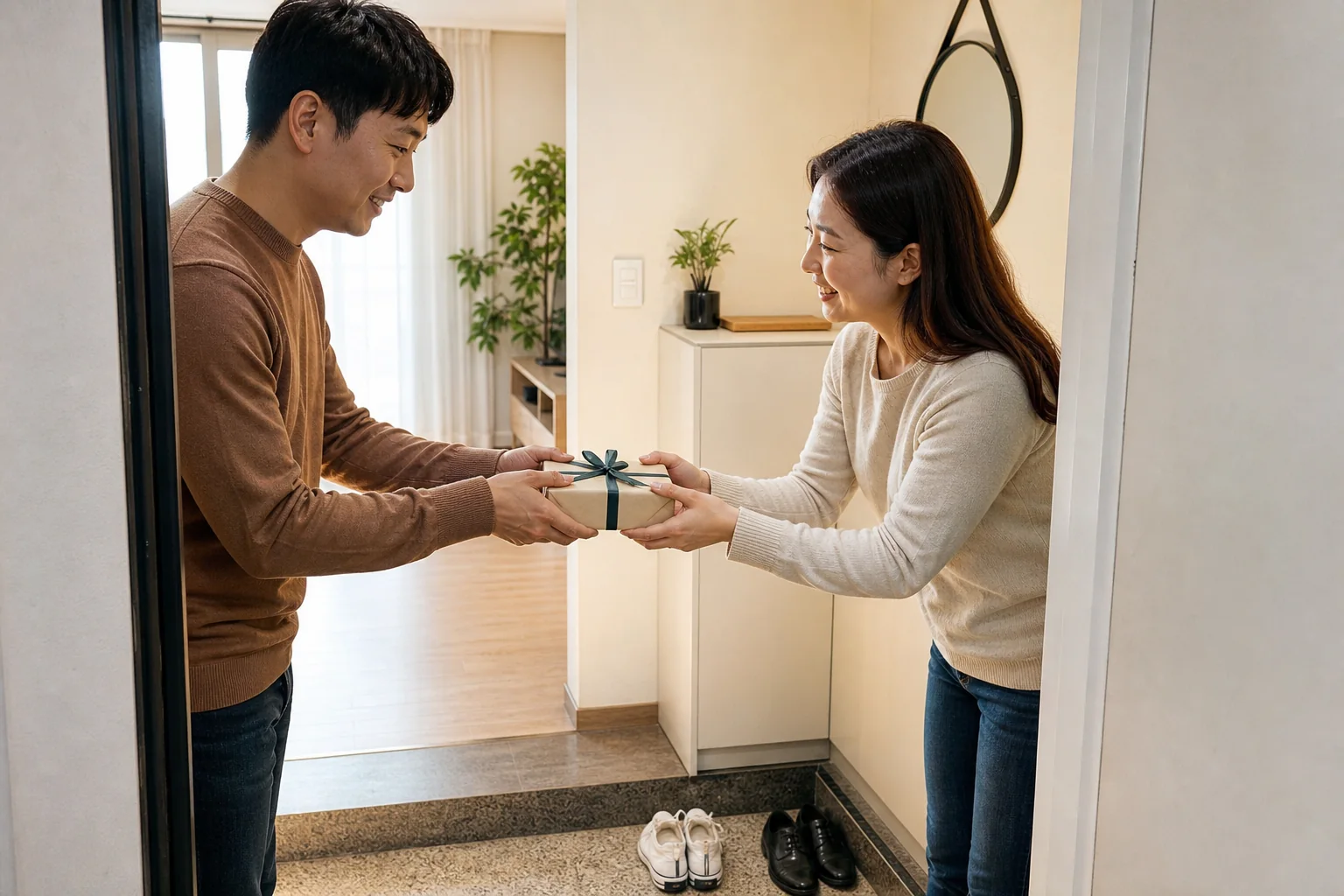
When giving or receiving a business card, gift, payment card, document, or drink in a respectful situation, use both hands. Another common form is to use the right hand while the left supports the wrist or forearm. Pause long enough to receive the item carefully instead of grabbing it while looking away.
Two hands are especially useful with an older person, a host, a customer, a teacher, or during a first formal meeting. Between close friends, one hand may be completely normal. The point is not that one-handed movement is always rude; the gesture becomes more careful when respect is socially relevant.
Pair the action with a short phrase. 감사합니다 means thank you. 여기 있습니다 means here it is. 잘 받았습니다 expresses that you received something with appreciation, especially a gift or delivered item.
Shoes, Homes, and Indoor Spaces
Remove your shoes before stepping into the living area of a Korean home. The entry zone, 현관 (hyeongwan), usually makes the boundary visible through a lower floor, shoe cabinet, or row of shoes. Keep outdoor shoes in that entrance area and use indoor slippers if the host provides them.
Some guesthouses, temples, studios, clinics, and restaurants with floor seating also require shoes off. Many ordinary restaurants and shops do not. Look for a raised floor, shoe rack, slippers, or a sign, and follow the host rather than removing shoes everywhere.
Bathroom slippers, when provided, stay in the bathroom. Accidentally walking into the living room in them is a familiar mistake. If you are unsure, ask 신발 벗어요? (sinbal beoseoyo?), meaning ‘Do I take off my shoes?’
Korean Dining Etiquette Without Rigid Myths
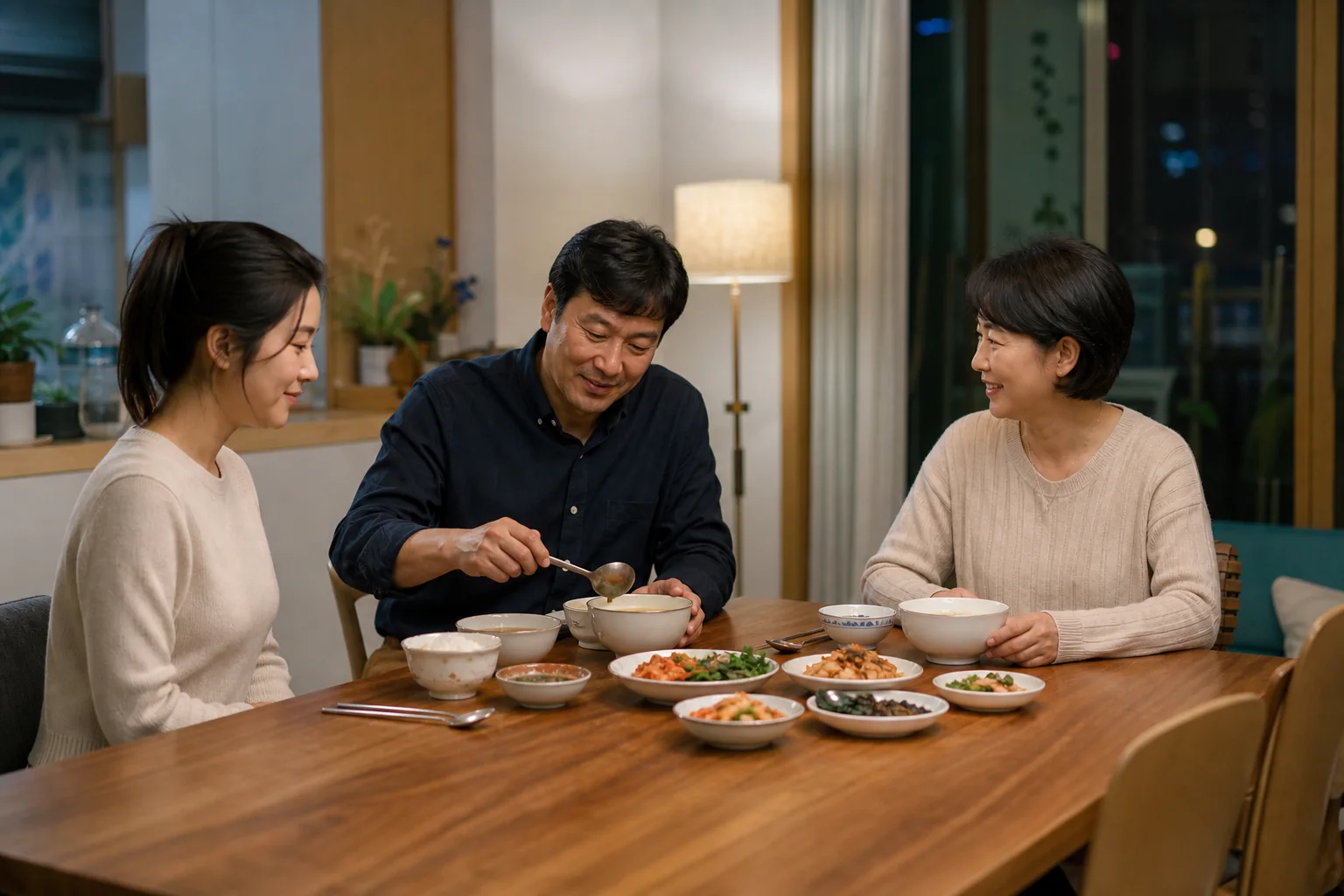
At a hosted or formal meal, waiting until the senior person or host begins is a considerate default. In a casual café lunch with friends, the group may simply start together. Say 잘 먹겠습니다 (jal meokgetseumnida) before a meal someone has prepared or provided. It literally looks like ‘I will eat well,’ but functionally expresses appreciation for the meal.
After eating, 잘 먹었습니다 (jal meogeotseumnida) thanks the provider and means that you ate well. These phrases are natural at hosted meals, company meals, and when someone treats you. You do not need to announce them dramatically before every snack you buy for yourself.
Rice and soup bowls commonly stay on the table rather than being lifted to the mouth. Use the spoon for rice and soup and chopsticks for side dishes, while following the actual table setting. Shared dishes are common, but not every dish is shared in every home or restaurant. Use serving utensils or an individual plate when provided.
Alcohol etiquette is relationship-sensitive and unnecessary for anyone who does not drink. In formal groups, people may pour for one another and use two hands when giving or receiving a glass. You may decline: 술을 못 마셔요 means ‘I cannot drink alcohol,’ and 괜찮습니다 means ‘No, thank you / I’m okay.’ Respectful refusal is better than treating drinking as mandatory.
Public Transport, Queues, and Shared Space
On buses and subways, keep conversations and phone audio at a considerate volume. Priority seats are intended for passengers who need them, including older adults, pregnant passengers, and people with disabilities or injuries. Do not assume that every need is visible, and follow posted signs.
Queue at marked lines and let passengers exit before entering a train or elevator. Keep doorways and escalator exits clear. Rules and local campaigns about escalator standing can change, so current station signs are more reliable than an old travel tip.
Waste sorting can be detailed, and public trash bins are not always easy to find. Use the labeled bins available in the building or ask where an item belongs. In a café, return trays only when the store uses a return station. Observation is part of etiquette.
Age, Titles, and Personal Boundaries
Korean speakers sometimes ask age or birth year because it can help establish forms of address and speech level. That does not mean every stranger is entitled to personal information. In international workplaces, professional events, or casual first meetings, age may not be relevant at all.
If you are comfortable answering, 저는 2000년생이에요 means ‘I was born in 2000.’ If you prefer not to, you can redirect politely: 나이는 조금 나중에 말씀드릴게요, ‘I’ll tell you my age a little later.’ Beginners should avoid calculating hierarchy from age alone; role, closeness, and institutional culture also matter.
Relationship words such as 오빠, 언니, 누나, 형, 선배, and 후배 are not universal substitutes for names. They encode the speaker’s position and relationship. Use a person’s preferred name or title until you know that a relationship term is welcome.
A Five-Second Etiquette Decision Check
Before acting, ask three quiet questions: Is this a new or formal relationship? Is there a visible local pattern? Would a slightly more careful action inconvenience anyone? If the relationship is new, begin politely. If shoes, trays, seats, or lines have clear signals, follow them. If no signal exists, a simple question is more natural than anxious guessing.
Useful repair language matters more than perfection. 실례합니다 means ‘Excuse me.’ 몰랐어요 means ‘I didn’t know.’ 죄송합니다 means ‘I’m sorry.’ A brief apology and correction usually communicates respect better than a long defense.
- Relationship: close, new, or formal?
- Setting: home, workplace, restaurant, or public space?
- Signal: what are the host, signs, and other people showing?
- Repair: can you ask or apologize briefly?
Mini Practice
Choose the best response for each situation before checking the answer key. 1) You meet your Korean teacher for the first time: 안녕 or 안녕하세요? 2) A host gives you a wrapped gift: take it quickly with one hand, or receive it carefully with both hands? 3) You enter a restaurant with no raised floor, shoe rack, or sign: remove your shoes automatically, or look for instructions? 4) A colleague offers alcohol but you do not drink: accept because refusal is rude, or say 술을 못 마셔요? 5) You accidentally step forward before passengers leave the subway: argue that you are a visitor, or say 죄송합니다 and move aside?
For an extra speaking task, say these three lines aloud without looking at the romanization: 안녕하세요. 감사합니다. 죄송합니다. Then create one polite question with 요 for a situation where you need help.
Answer Key
1) 안녕하세요 is the safe polite greeting for a teacher you have just met. 2) Receive the gift with both hands and say 감사합니다. 3) Look for instructions; shoes are not removed in every restaurant. 4) Say 술을 못 마셔요 or 괜찮습니다; drinking is not mandatory. 5) Say 죄송합니다, move aside, and let passengers exit.
The extra question can vary. 화장실이 어디예요? (‘Where is the restroom?’) and 신발 벗어요? (‘Do I take off my shoes?’) are both suitable because they use a polite 요 ending and solve a real uncertainty.
Vocabulary Box
| Korean | Romanization | Meaning |
|---|---|---|
| 예절 | yejeol | etiquette; manners |
| 존댓말 | jondaenmal | polite or honorific speech |
| 반말 | banmal | casual speech |
| 인사 | insa | greeting |
| 현관 | hyeongwan | entrance area of a home or building |
| 신발 | sinbal | shoes |
| 두 손 | du son | two hands |
| 실례합니다 | sillyehamnida | excuse me |
| 괜찮습니다 | gwaenchanseumnida | I am okay; no, thank you |
| 죄송합니다 | joesonghamnida | I am sorry |
Grammar Box
- Use 요-style endings as an everyday polite default: 괜찮아요, 어디예요?, and 벗어요?
- The formal polite -ㅂ니다/-습니다 style appears in 감사합니다, 죄송합니다, and 잘 먹겠습니다.
- Noun + (이)세요? asks politely about identity: 선생님이세요? means ‘Are you a teacher?’
- Verb stem + 지 마세요 makes a polite negative request: 여기에서 사진 찍지 마세요 means ‘Please do not take photos here.’
- 못 + verb can express inability: 술을 못 마셔요 means ‘I cannot drink alcohol.’
Pronunciation Tips
- In 감사합니다, the written ㅂ before ㄴ is pronounced like ㅁ: [감사함니다], not a separate English-style b sound.
- In 죄송합니다, 죄 is commonly pronounced close to [줴] or [죄] in natural speech; avoid forcing an English j-plus-oy sequence.
- The ㄹㄹ sequence in 실례합니다 is linked smoothly, approximately sillyehamnida.
- Romanization is only a reminder. Listen to whole phrases and gradually read the Hangul directly.
Example Sentences
안녕하세요. 처음 뵙겠습니다.
annyeonghaseyo. cheoeum boepgetseumnida.
Hello. It is nice to meet you for the first time.
선생님, 감사합니다.
seonsaengnim, gamsahamnida.
Teacher, thank you.
신발 벗어요?
sinbal beoseoyo?
Do I take off my shoes?
여기 있습니다.
yeogi itsseumnida.
Here it is.
잘 먹겠습니다.
jal meokgetseumnida.
Thank you for the meal; I will enjoy it.
잘 먹었습니다.
jal meogeotseumnida.
Thank you for the meal; I ate well.
술을 못 마셔요.
sureul mot masyeoyo.
I cannot drink alcohol.
실례합니다. 화장실이 어디예요?
sillyehamnida. hwajangsiri eodiyeyo?
Excuse me. Where is the restroom?
Common Mistakes
Avoid
Using 반말 with everyone who looks close to your age.
Try this
Use polite speech until both people are comfortable changing levels.
Avoid
Bowing deeply in every casual interaction.
Try this
A brief nod or small bow is enough for many everyday greetings; follow the setting.
Avoid
Removing shoes in every restaurant or shop.
Try this
Look for a raised floor, shoe rack, slippers, sign, or host instruction.
Avoid
Believing one-handed gestures are always rude.
Try this
Use two hands when respect or formality is relevant; close friends may act casually.
Avoid
Assuming alcohol must be accepted to be polite.
Try this
Decline clearly with 술을 못 마셔요 or 괜찮습니다. Personal boundaries matter.
Avoid
Calling an unfamiliar person 오빠, 언니, 아저씨, or 아줌마 immediately.
Try this
Use the person’s preferred name or title until the relationship term is appropriate.
Avoid
Treating a drama scene as a universal etiquette lesson.
Try this
Drama behavior serves a story. Compare it with the real relationship, place, and purpose.
Study Tips
- Practice one behavior and one phrase together: a small bow with 안녕하세요, or two hands with 감사합니다.
- Sort situations into three columns: close and casual, everyday polite, and formal.
- During a Korean video, identify who uses 요-style, who uses casual speech, and why.
- Learn repair phrases early so a small mistake does not stop the conversation.
- Review customs as flexible defaults, then observe the actual home, school, workplace, or restaurant.
Summary
For a beginner, Korean etiquette can be reduced to a useful pattern: begin with polite speech, greet attentively, use two hands when a situation calls for extra respect, follow visible indoor and dining signals, and protect other people’s space in public. These habits are more reliable than a long list of dramatic taboos.
Etiquette changes with relationship and setting. Asking a short polite question, declining something respectfully, or repairing a mistake with 죄송합니다 is culturally competent behavior. You do not need to imitate every gesture or surrender a personal boundary to show respect.
Frequently Asked Questions
What are the most important Korean etiquette rules for beginners?
Start with polite speech, greet with 안녕하세요 and a small bow when appropriate, use two hands in respectful exchanges, remove shoes where the space indicates it, and observe the host or posted signs.
Do I always need to bow in Korea?
No. A brief bow or nod is common in greetings, but friends may wave and professional settings may include a handshake. Match the relationship and occasion.
Should I use both hands for everything in Korea?
Use both hands, or support your right wrist with your left hand, when giving or receiving something in a respectful or formal situation. One hand is normal in many casual situations.
Do Koreans remove shoes in restaurants?
Only in restaurants or areas that require it, often where there is raised floor seating. Look for a shoe rack, slippers, signs, or instructions rather than removing shoes automatically.
Is it rude to refuse alcohol in Korea?
No. You can decline politely with 술을 못 마셔요 or 괜찮습니다. Health, religion, recovery, medication, preference, and safety are valid reasons, and an explanation is not always necessary.
Can I use casual Korean with someone my age?
Do not assume so. Similar age can make a switch to casual speech easier, but use polite speech until the other person suggests or agrees to the change.
What should I do if I make an etiquette mistake?
Correct the action and give a short apology such as 죄송합니다. Most minor mistakes are resolved more naturally by calm repair than by a long explanation.
Related Learning Resources
This article follows the Korean Worksheet Lab editorial standards and is reviewed for beginner clarity and natural Korean usage.