Introduction
The Korean age system can confuse learners because Korea has used more than one way to talk about age. You may hear that Korean age disappeared, but you may also hear Koreans still ask about birth year, school year, or age order. Both can be true depending on the situation.
In official legal and administrative contexts, South Korea moved to the international age system in 2023. In everyday conversation, however, age still matters socially because it affects honorifics, school relationships, seniority, and how people decide whether to speak politely or casually. This guide explains what changed, what remains, and how learners should talk about age in 2026.
Learning Objectives
- Understand the difference between international age, traditional Korean age, and year age.
- Learn what changed in South Korea after the 2023 age law.
- Know when Koreans still ask about age or birth year in conversation.
- Practice safe beginner sentences for talking about age politely.
The Short Answer for 2026
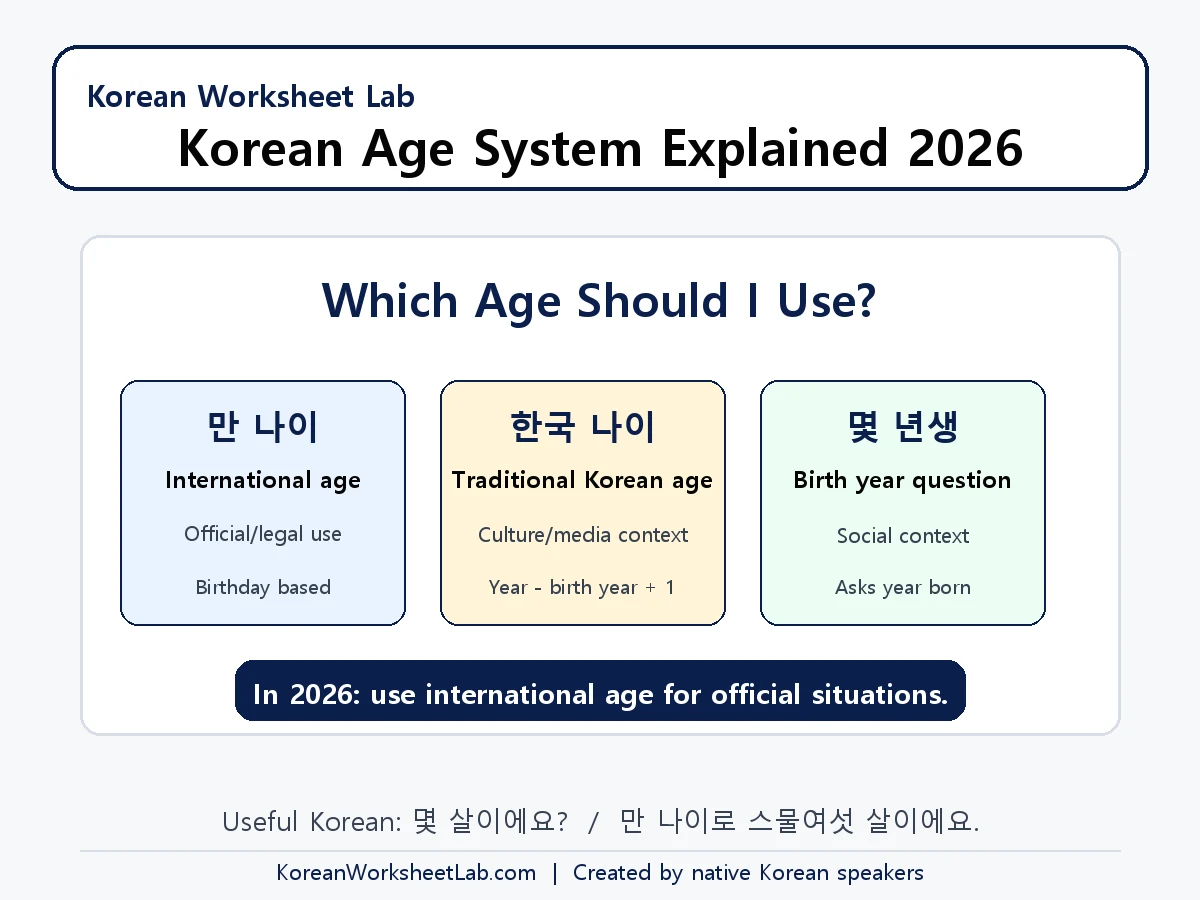
For official purposes in South Korea, use international age. International age starts at zero when a person is born and increases on the birthday. This is the same basic system used in many countries.
Traditional Korean age is the older counting style where a baby is considered one at birth and everyone becomes one year older on January 1. This system is no longer the default for official documents in South Korea, but learners may still hear people mention it when explaining culture or older habits.
- Official age in South Korea: international age
- Traditional Korean age: older cultural counting style
- Daily conversation: age and birth year still matter socially
International Age
International age is based on your birthday. You are zero at birth, one after your first birthday, and one year older on each birthday. If a person was born on May 1, 2000, they are 25 before May 1, 2026 and 26 on May 1, 2026.
This is the age system learners should use for official forms, medical information, contracts, legal documents, and most practical situations in modern South Korea.
- Starts at zero
- Changes on your birthday
- Used for official and legal purposes
Traditional Korean Age
Traditional Korean age is often explained with a simple formula: current year minus birth year plus one. Under this system, a person is one year old at birth and everyone gains a year on January 1.
For example, someone born in 2000 would be 27 in traditional Korean age during 2026: 2026 minus 2000 plus one. This is not usually the age you should give on official documents, but it is useful for understanding older explanations, variety shows, dramas, and cultural discussions.
- Formula: current year - birth year + 1
- Everyone gets older on January 1
- Useful for culture, not official paperwork
Year Age
Korea has also used a system often called year age. It is calculated as current year minus birth year. It starts at zero at birth but changes for everyone on January 1 instead of on each birthday.
This matters because some rules in Korea have historically used year-based age. For learners, the main point is simple: do not assume one English phrase, Korean age, covers every situation. Ask which age system is being used if accuracy matters.
- Formula: current year - birth year
- Changes on January 1
- Different from both birthday age and traditional Korean age
Why Koreans Still Ask About Age
Even after the legal change, age can still affect Korean social language. Korean has honorifics, polite speech, casual speech, and relationship words such as 선배, 후배, 형, 누나, 오빠, and 언니. People often use age or birth year to understand the relationship.
This does not mean every Korean conversation begins with age. In many modern or professional settings, people may avoid direct age questions. But in school, friend groups, entertainment, and some casual contexts, birth year and age order can still appear.
How Beginners Should Answer Age Questions
If someone asks your age in Korean, the safest beginner answer is to use international age unless the person specifically asks for Korean age. You can also say your birth year if that is what the conversation is about.
Use polite speech when answering someone you do not know well. 저는 스물여섯 살이에요 means I am twenty-six years old. If you want to be extra clear, you can say 만 나이로 스물여섯 살이에요, meaning I am twenty-six by international age.
- 저는 스물여섯 살이에요 = I am twenty-six years old
- 만 나이로 스물여섯 살이에요 = I am twenty-six by international age
- 몇 년생이에요? = What year were you born?
Mini Practice
Practice reading these situations. If a form asks for age in South Korea in 2026, use international age. If a Korean friend explains old Korean age culture, they may use the traditional formula. If someone asks 몇 년생이에요, they are asking your birth year, not your exact birthday age.
Now write three answers: your international age, your birth year, and one sentence explaining that you are using 만 나이. This helps you avoid confusion when Koreans compare age, school year, and speech level.
- Official form: international age
- Culture explanation: traditional Korean age may appear
- Birth year question: answer with the year you were born
Vocabulary Box
| Korean | Romanization | Meaning |
|---|---|---|
| 나이 | nai | age |
| 만 나이 | man nai | international age; full age |
| 한국 나이 | hanguk nai | Korean age |
| 세는 나이 | seneun nai | traditional counted age |
| 몇 살이에요? | myeot sarieyo? | How old are you? |
| 몇 년생이에요? | myeot nyeonsaengieyo? | What year were you born? |
| 생일 | saengil | birthday |
| 법 | beop | law |
Grammar Box
- 살 is the native Korean counter commonly used for age in everyday speech.
- 세 is a Sino-Korean counter often used in formal, written, or official age expressions.
- 만 나이로 means by international age or by full age.
- 몇 년생이에요 asks for birth year, not exact age.
Pronunciation Tips
- 몇 살이에요 is pronounced smoothly; the final consonant in 몇 connects to 살.
- 만 나이 keeps two clear words: man nai.
- 년생 has a ㄴ sound followed by ㅅ; keep both syllables short and clear.
Example Sentences
저는 스물여섯 살이에요.
jeoneun seumullyeoseot sarieyo
I am twenty-six years old.
만 나이로 스물여섯 살이에요.
man nairo seumullyeoseot sarieyo
I am twenty-six by international age.
몇 년생이에요?
myeot nyeonsaengieyo?
What year were you born?
생일이 지났어요.
saengiri jinasseoyo
My birthday has passed.
Common Mistakes
Avoid
Thinking Korean age is still the official default everywhere.
Try this
South Korea uses international age for official legal and administrative purposes.
Avoid
Thinking Korean age no longer matters culturally at all.
Try this
Age order and birth year still appear in social language, relationships, and culture.
Avoid
Using 세 and 살 randomly.
Try this
Use 살 for most everyday spoken age sentences and 세 for more formal or written contexts.
Avoid
Answering 몇 년생이에요 with your age.
Try this
This question asks for the year you were born.
Study Tips
- Memorize 만 나이 before studying traditional Korean age.
- Practice your own age sentence with 살.
- Learn your birth year answer for 몇 년생이에요.
- Review honorifics after age, because age often affects speech level.
Summary
In 2026, South Korea uses international age for official purposes.
Traditional Korean age is still useful for understanding culture, older explanations, and media references.
Learners should know 만 나이, 한국 나이, 살, 세, and 몇 년생이에요 to avoid common confusion.
Frequently Asked Questions
Does South Korea still use Korean age in 2026?
Officially, South Korea uses international age for legal and administrative purposes, but traditional Korean age can still appear in cultural explanations and casual discussions.
What is Korean age?
Traditional Korean age counts a baby as one at birth and adds one year for everyone on January 1.
How do I say my age in Korean?
For everyday speech, use 저는 [number] 살이에요. To be clear, you can say 만 나이로 [number] 살이에요.
What does 몇 년생이에요 mean?
It means what year were you born? It asks for birth year, not exact age.
Related Learning Resources
This article follows the Korean Worksheet Lab editorial standards and is reviewed for beginner clarity and natural Korean usage.