Introduction
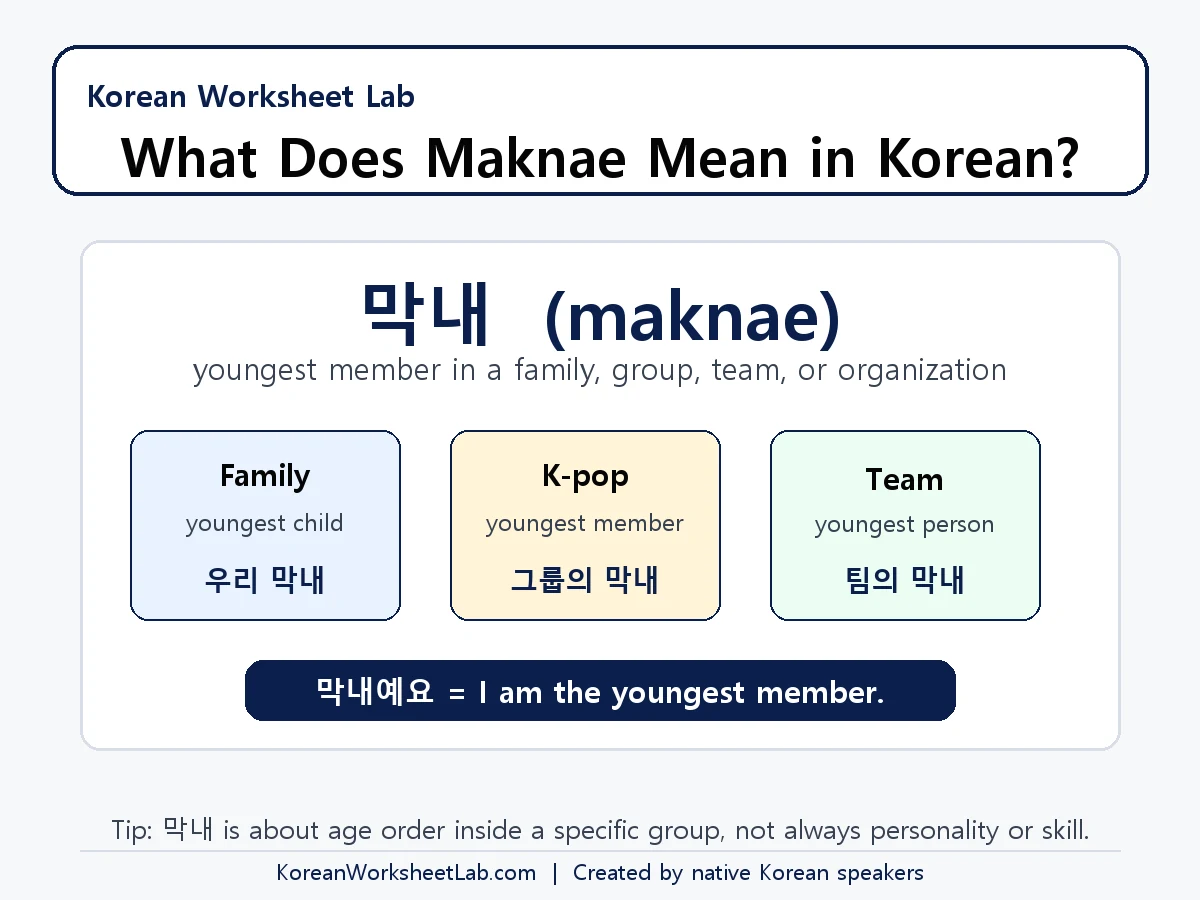
Maknae, written 막내 in Korean, means the youngest person in a family, group, team, or organization. English speakers often meet the word through K-pop, where the youngest idol in a group is called the maknae. In real Korean, the word is broader than entertainment vocabulary.
A maknae can be the youngest child in a family, the youngest employee on a team, the youngest member of a club, or the youngest performer in a group. The word is about age position inside a specific group. This guide explains what 막내 means, when Koreans use it, what it does not mean, and how beginners can use it naturally.
Learning Objectives
- Understand the basic meaning of 막내.
- Learn how maknae is used in families, K-pop, teams, and daily Korean.
- Compare 막내 with older sibling words and seniority words.
- Avoid common mistakes about age, respect, and romantic meaning.
The Short Meaning of Maknae
막내 means the youngest member of a group. The group can be a family, class, team, idol group, company department, club, or friend group. If three siblings are in a family, the youngest sibling is the 막내. If five members are in a music group, the youngest member is the 막내.
The important point is comparison. A person is not a maknae in every situation. Someone may be the youngest in their family but not the youngest at work. Someone may be the youngest in a K-pop group but older than many fans. 막내 describes a position inside one group.
- 막내 = youngest member
- It depends on the group
- It is not the same as child, baby, or beginner
Maknae in Families
In Korean families, 막내 often means the youngest child. Parents, grandparents, and siblings may say 우리 막내, meaning our youngest. It can sound affectionate, especially inside a family.
However, 막내 is not the same as 아기, which means baby. A person can still be called the family maknae even as an adult because the word refers to family order, not current age.
- 우리 막내 = our youngest
- 막내딸 = youngest daughter
- 막내아들 = youngest son
Maknae in K-pop
In K-pop, maknae usually means the youngest member of an idol group. Fans may talk about a group's maknae, a maknae line, or a golden maknae. These expressions are fandom language, but they are based on the ordinary Korean word 막내.
A K-pop maknae is not automatically shy, cute, childish, or less skilled. Some maknaes are strong performers, leaders in practice, or very mature. The word only identifies the youngest member by age.
- Group maknae = youngest idol member
- Maknae line = younger members of a group
- Golden maknae = a very talented youngest member
Maknae at Work or School
Koreans can also use 막내 in workplaces, clubs, and teams. If a new team member is the youngest person in the office, coworkers may call them the team maknae in a light or friendly way. The tone depends on the relationship and workplace culture.
Learners should be careful with this word in real workplaces. It can sound warm among close people, but it may sound too personal if you use it with someone you do not know well. In formal settings, a name plus 님 or a job title is usually safer.
Maknae vs Sunbae and Hoobae
막내 is about being the youngest by age inside a group. 선배 and 후배 are about who entered a school, company, group, or field earlier or later. These ideas can overlap, but they are not the same.
For example, a person can be the youngest member of a team but still be a 선배 to someone who joined later. Another person can be older in age but a 후배 if they joined the company later. Korean age words and seniority words often need context.
- 막내 = youngest by age in a group
- 선배 = senior who came before
- 후배 = junior who came after
Mini Practice
Read each situation and choose whether 막내 fits. In a family with three children, the youngest child is the 막내. In an idol group, the youngest member is the 막내. In a company, the newest employee is not automatically the 막내 unless that person is also the youngest by age.
Now practice one sentence: 저는 우리 가족의 막내예요. This means I am the youngest in my family. If you are not the youngest, change the sentence to 제 동생은 우리 가족의 막내예요, meaning my younger sibling is the youngest in our family.
- 저는 막내예요 = I am the youngest
- 우리 막내는 귀여워요 = Our youngest is cute
- 그룹의 막내예요 = They are the youngest member of the group
Vocabulary Box
| Korean | Romanization | Meaning |
|---|---|---|
| 막내 | maknae | youngest member |
| 우리 막내 | uri maknae | our youngest |
| 막내딸 | maknaettal | youngest daughter |
| 막내아들 | maknaeadeul | youngest son |
| 가족 | gajok | family |
| 그룹 | geurup | group |
| 선배 | seonbae | senior in the same group or field |
| 후배 | hubae | junior in the same group or field |
Grammar Box
- 막내 is a noun, so it can be used with 이에요 or 예요: 막내예요.
- Use 의 to show possession or group relationship: 가족의 막내 means the youngest in the family.
- 우리 often means our, but in Korean it can also sound natural where English would say my, as in 우리 가족.
Pronunciation Tips
- 막내 is commonly romanized as maknae, but the Korean pronunciation is closer to mang-nae because ㄱ before ㄴ is nasalized.
- Do not pronounce maknae as two strong English syllables. Keep it smooth: mang-nae.
- 막내딸 has a tense ㄸ sound in 딸, so say it clearly and shortly.
Example Sentences
저는 우리 가족의 막내예요.
jeoneun uri gajogui mangnaeyeyo
I am the youngest in my family.
그는 그룹의 막내예요.
geuneun geurubui mangnaeyeyo
He is the youngest member of the group.
우리 막내는 대학생이에요.
uri mangnaeneun daehaksaengieyo
Our youngest is a university student.
막내라고 항상 어린 것은 아니에요.
mangnaerago hangsang eorin geoseun anieyo
Being the maknae does not always mean being childish.
Common Mistakes
Avoid
Thinking maknae means baby.
Try this
막내 means youngest member. The person can be an adult.
Avoid
Using maknae for the newest person.
Try this
Use 막내 for the youngest by age, not automatically the newest by entry date.
Avoid
Assuming every K-pop maknae is childish.
Try this
The word only means youngest member. Personality and role are separate.
Avoid
Using 막내 too casually with strangers.
Try this
Use it when the group context is clear and the tone is appropriate.
Study Tips
- Write your family order in English first, then identify whether 막내 applies.
- Practice 막내예요 with family, group, and team examples.
- Review 선배 and 후배 to separate age order from entry order.
- Listen for the nasalized pronunciation: 막내 sounds closer to 망내.
Summary
Maknae means the youngest member of a family, group, team, or organization.
In K-pop, maknae means the youngest idol member, but the word is used in ordinary Korean too.
막내 is about age position inside a group, while 선배 and 후배 are about seniority or entry order.
Frequently Asked Questions
What does maknae mean in Korean?
Maknae means the youngest member of a family, group, team, or organization.
Is maknae only a K-pop word?
No. K-pop fans use it often, but 막내 is a normal Korean word used in families, groups, teams, and workplaces.
How do you pronounce maknae?
막내 is often romanized as maknae, but it sounds closer to mang-nae because ㄱ changes before ㄴ.
Does maknae mean beginner?
No. Maknae means youngest by age in a group. A beginner or newcomer is a different idea.
Related Learning Resources
This article follows the Korean Worksheet Lab editorial standards and is reviewed for beginner clarity and natural Korean usage.