Introduction
Sunbae, written 선배 in Korean, means someone who entered the same school, company, team, field, or organization before you. It is often translated as senior, but it does not simply mean older person. The main idea is earlier experience within the same group.
Learners often meet sunbae through K-dramas, K-pop, school stories, and workplace scenes. The word can sound friendly, respectful, or awkward depending on context. This guide explains what 선배 means, how it differs from 후배, and when 선배님 is more appropriate.
Learning Objectives
- Understand the real meaning of 선배 beyond drama subtitles.
- Compare 선배, 후배, and 동기.
- Learn when to say 선배 and when to say 선배님.
- Avoid common mistakes with age, romance, and workplace usage.
The Short Meaning of Sunbae
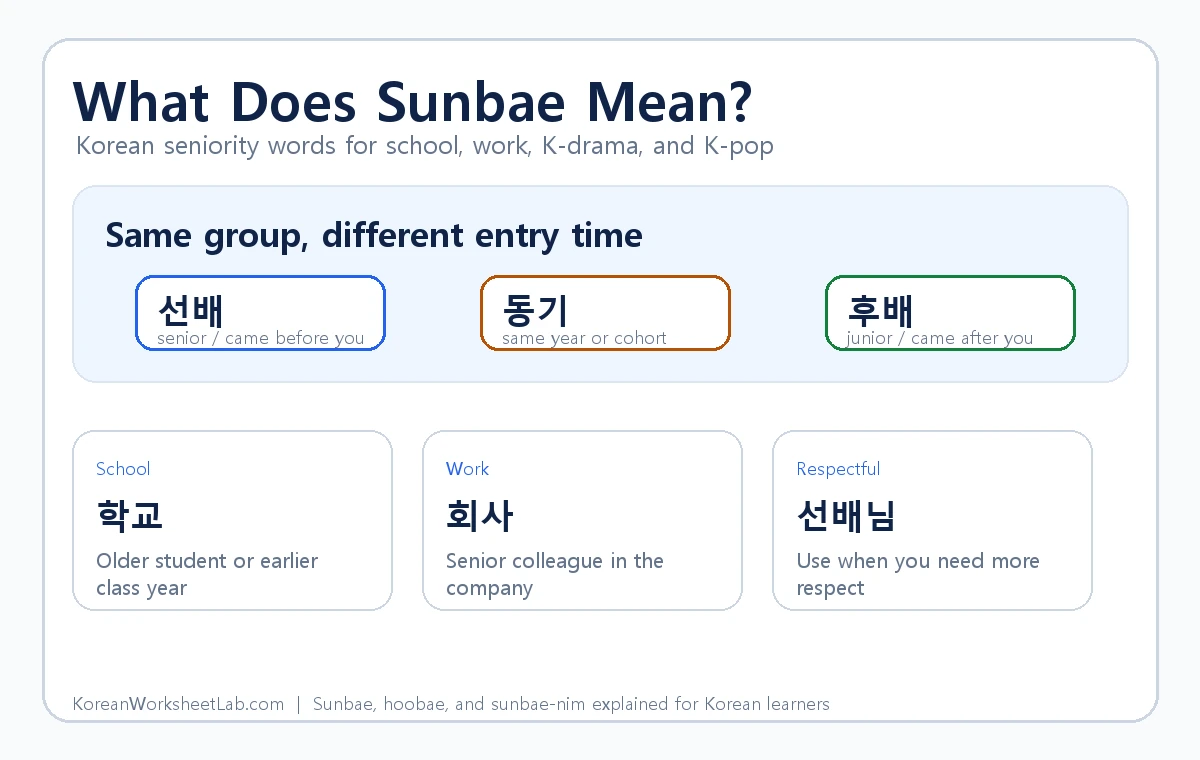
선배 means a person who came before you in the same group or path. A student in a higher school year can be your sunbae. A coworker who joined the company before you can also be your sunbae. A person who started in the same profession earlier can sometimes be called sunbae too.
The word is about social position inside a shared context. It does not automatically mean old, boss, teacher, boyfriend, girlfriend, or celebrity. In English, senior is the closest simple translation, but Korean 선배 carries cultural expectations about guidance, respect, and experience.
- 선배 = senior in the same group or field
- 후배 = junior who came after
- 동기 = same class year, cohort, or entry group
Sunbae vs Hoobae
후배 is the opposite of 선배. If someone is your sunbae because they entered before you, you are their hoobae because you entered after them. This pair is common in schools, universities, companies, clubs, entertainment agencies, sports teams, and professional fields.
The relationship does not always mean close friendship. A sunbae may help a hoobae, give advice, or explain how things work. A hoobae may show respect or ask questions politely. But the exact relationship depends on personality, organization culture, and how close the people are.
- Sunbae came before you.
- Hoobae came after you.
- Donggi entered at the same time.
When Should You Use Sunbae-nim?
선배님 adds 님, a respectful title marker. It sounds more polite than 선배 alone. Beginners should use 선배님 when speaking to or about someone they do not know well, someone in a formal setting, or someone they want to address respectfully.
Using 선배 alone can be acceptable among people who are close or in a casual setting, but it can sound too direct if the relationship is not close. If you are unsure, 선배님 is safer.
- Respectful: 선배님
- More casual: 선배
- Do not use it for every older person you meet.
Is Sunbae Romantic?
Sunbae is not a romantic word by itself. It can appear in romantic dramas because many stories happen at school, university, work, or entertainment companies. A character may like their sunbae, but the word itself only marks a senior relationship.
This is similar to how teacher, classmate, or coworker can appear in romance stories without being romantic words. Do not assume someone is flirting just because they say sunbae.
How Native Koreans Use It in Real Life
In school, students may talk about an older student as 선배. At work, people may refer to someone who joined earlier as 선배 or 선배님, especially if they are in a similar role or field. In entertainment, idols may call more experienced artists 선배님.
However, Korean workplaces also use job titles, names plus 님, or position titles such as 팀장님. Sunbae is useful, but it is not the only respectful word in Korean.
- School: older or earlier student
- Work: senior colleague in the same field
- Entertainment: more experienced artist
- Formal settings: often 선배님
Mini Practice
Choose the best word for each situation. If someone entered your school one year before you, they are your 선배. If someone entered after you, they are your 후배. If someone entered at the same time, they are your 동기.
Now read the short sentences aloud and notice the relationship: 선배님, 안녕하세요. 저는 새 후배입니다. 동기와 같이 공부해요.
- A person who came before you: 선배
- A person who came after you: 후배
- A person in the same entry group: 동기
Vocabulary Box
| Korean | Romanization | Meaning |
|---|---|---|
| 선배 | seonbae | senior; someone who came before you in the same group |
| 선배님 | seonbaenim | respectful form of sunbae |
| 후배 | hubae | junior; someone who came after you |
| 동기 | donggi | same class year, cohort, or entry group |
| 학교 | hakgyo | school |
| 회사 | hoesa | company |
| 직장 | jikjang | workplace |
Grammar Box
- 선배 and 후배 are nouns, not sentence endings.
- 님 can attach to titles or roles to show respect, as in 선배님.
- You can use particles with 선배: 선배가, 선배는, 선배를, or 선배에게 depending on the sentence.
Pronunciation Tips
- 선배 is romanized as seonbae, but the first vowel is Korean ㅓ, not English sun.
- 후배 is hubae; keep the first syllable short and clear.
- 선배님 is pronounced smoothly as seon-bae-nim, not as three separate English words.
Example Sentences
선배님, 안녕하세요.
seonbaenim, annyeonghaseyo
Hello, sunbae / senior.
저는 새 후배입니다.
jeoneun sae hubaeimnida
I am a new junior.
동기와 같이 공부해요.
donggiwa gachi gongbuhaeyo
I study with a classmate from the same cohort.
우리 선배가 도와줬어요.
uri seonbaega dowajwosseoyo
Our sunbae helped us.
Common Mistakes
Avoid
Thinking sunbae means any older person.
Try this
Use it for someone who came before you in the same school, workplace, group, or field.
Avoid
Assuming sunbae is romantic.
Try this
It is a seniority word. Romance depends on context, not the word itself.
Avoid
Using sunbae alone in a formal setting.
Try this
Use 선배님 when you need a respectful form.
Avoid
Calling a boss sunbae when a job title is expected.
Try this
In workplaces, titles such as 팀장님 or role titles may be more natural.
Study Tips
- Create a three-column chart: sunbae, donggi, hoobae.
- Practice one sentence with 선배님 and one with 후배.
- Watch a K-drama school or workplace scene and identify who entered first.
- Review Korean honorifics before using seniority words in real conversations.
Summary
Sunbae means someone who came before you in the same school, workplace, group, or field.
Hoobae is the opposite, and donggi means someone in the same entry group.
Use sunbae-nim when you need a more respectful form, especially in formal or unfamiliar situations.
Frequently Asked Questions
What does sunbae mean in Korean?
Sunbae means a senior person who came before you in the same school, workplace, organization, field, or group.
Is sunbae only used at school?
No. It is common at school, but it can also be used in workplaces, clubs, entertainment, sports, and professional fields.
What is the difference between sunbae and hoobae?
Sunbae came before you in the same group. Hoobae came after you.
Should I say sunbae or sunbae-nim?
Use sunbae-nim when you want to be respectful or when the relationship is not close. Sunbae alone is more casual.
Related Learning Resources
This article follows the Korean Worksheet Lab editorial standards and is reviewed for beginner clarity and natural Korean usage.