Introduction
Korean honorifics can feel confusing because they are not just one grammar rule. They include polite endings, formal endings, respectful titles, name suffixes, and word choices that show your relationship with the listener.
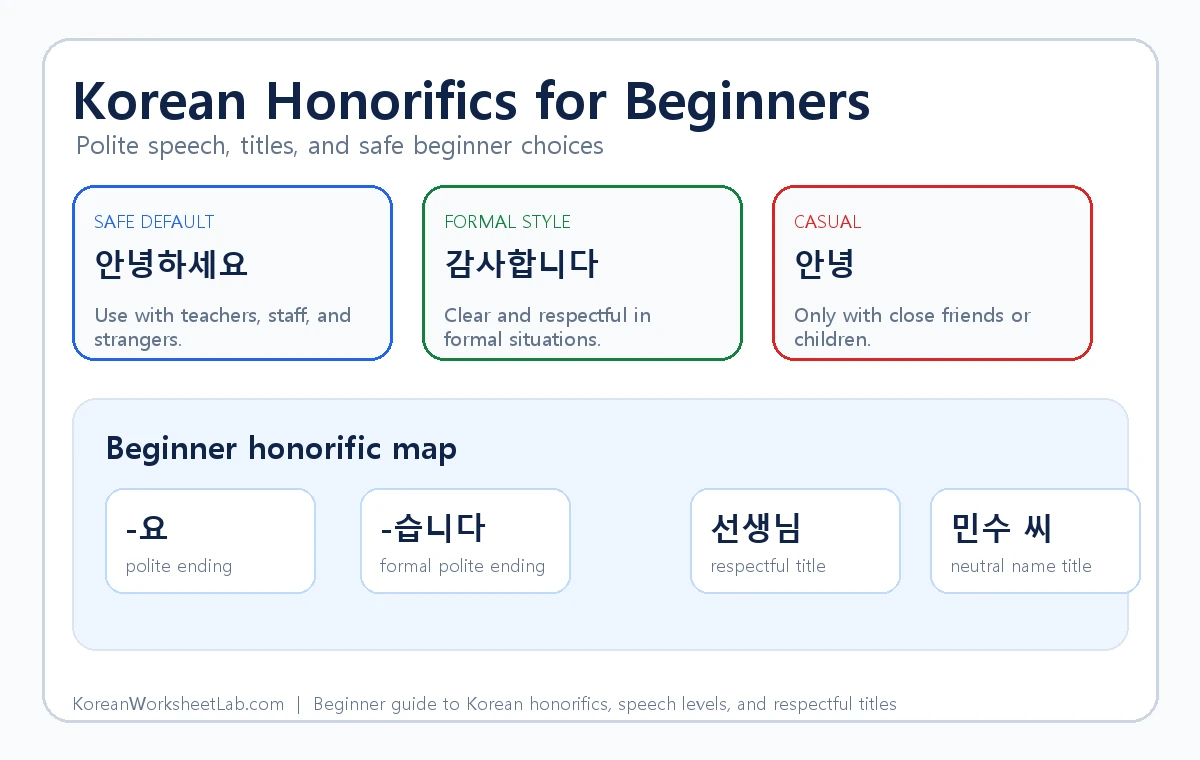
For beginners, the goal is not to master every honorific form immediately. The goal is to avoid the most common mistakes and use a safe polite style in everyday situations. If you can understand when to use 안녕하세요, 감사합니다, 선생님, and 씨, you already have a strong practical start.
Learning Objectives
- Understand what Korean honorifics are and why they matter.
- Use polite endings such as 요 safely in beginner conversations.
- Recognize formal polite endings such as 습니다 and 합니다.
- Choose basic titles such as 님 and 씨 without sounding rude or too casual.
What Are Korean Honorifics?
Korean honorifics are language choices that show respect, politeness, distance, or closeness. English can show politeness with words like please, sir, ma'am, or a formal tone. Korean shows it more directly through sentence endings, titles, and sometimes different vocabulary.
The most important beginner point is this: Korean changes depending on who you are talking to. A sentence that sounds natural with a close friend can sound rude to a teacher, older person, customer, or stranger.
- Speech endings show politeness.
- Titles show respect toward a person.
- Name suffixes show social distance.
- Casual forms are not safe for every situation.
The Safe Beginner Default: Polite -yo
The polite 요 style is the safest everyday starting point for adult beginners. You hear it in phrases such as 안녕하세요, 괜찮아요, 좋아요, and 먹어요. It is polite enough for most normal situations but not overly stiff.
When you do not know whether to be formal or casual, choose a 요 ending. It works well with teachers, store staff, people you just met, classmates you are not close to yet, and most travel situations.
- 안녕하세요 = Hello
- 괜찮아요 = It is okay
- 좋아요 = It is good / I like it
- 먹어요 = eat / eats
Formal Polite Speech: -seumnida and -hamnida
Formal polite endings such as 습니다 and 합니다 sound more official than the regular 요 style. Beginners often meet them in 감사합니다, 죄송합니다, and 처음 뵙겠습니다.
You do not need to use formal polite speech all the time. In daily conversation, it can sound too stiff if every sentence uses it. But for apologies, thanks, speeches, announcements, interviews, and first formal meetings, it is useful.
- 감사합니다 = Thank you
- 죄송합니다 = I am sorry
- 처음 뵙겠습니다 = Nice to meet you
Titles: -nim and -ssi
님 is a respectful title marker. You see it in words such as 선생님 for teacher, 사장님 for business owner or boss, and 고객님 for customer. It raises respect toward the person.
씨 is commonly attached to a full name or given name in a neutral polite way, such as 민수 씨. It is useful among adults, coworkers, classmates, and people who are not close friends yet. Do not attach 씨 to your own name when introducing yourself.
- 선생님 = teacher
- 사장님 = boss / owner
- 고객님 = customer
- 민수 씨 = Mr./Ms. Minsu in a neutral polite style
When Casual Speech Is Okay
Casual Korean, often called banmal, is used with close friends, children, younger siblings, or people who have agreed to speak casually. It is common in dramas and music, but it is not a safe default for learners.
For example, 안녕 can mean hi or bye casually. It sounds friendly in the right relationship, but it can sound too direct with a stranger. Until you understand the relationship clearly, use 안녕하세요 instead.
Vocabulary Box
| Korean | Romanization | Meaning |
|---|---|---|
| 존댓말 | jondaenmal | polite or respectful speech |
| 반말 | banmal | casual speech |
| 안녕하세요 | annyeonghaseyo | hello; polite greeting |
| 안녕 | annyeong | hi or bye; casual |
| 선생님 | seonsaengnim | teacher; respectful title |
| 씨 | ssi | neutral polite name suffix |
| 감사합니다 | gamsahamnida | thank you; formal polite |
Grammar Box
- Verb or adjective stem + 아요/어요 creates a common polite style.
- 습니다 and 합니다 are formal polite endings used in more official contexts.
- 님 attaches to titles or roles to show respect, while 씨 attaches to names in a neutral polite way.
Pronunciation Tips
- 요 is pronounced as one smooth ending, not as a separate English word.
- 습니다 is commonly romanized as seumnida, but the sound is smoother than the spelling may suggest.
- 선생님 has final consonant sounds that should stay short and clear.
Example Sentences
선생님, 안녕하세요.
seonsaengnim, annyeonghaseyo
Hello, teacher.
감사합니다.
gamsahamnida
Thank you.
민수 씨는 한국어를 공부해요.
Minsu ssineun hangugeoreul gongbuhaeyo
Minsu studies Korean.
안녕!
annyeong
Hi! / Bye! casual
Common Mistakes
Avoid
Using casual speech with strangers because it appears in dramas.
Try this
Use polite 요 style until the relationship is clearly casual.
Avoid
Calling yourself by adding 씨 to your own name.
Try this
Use 저는 [name]입니다 or 제 이름은 [name]입니다.
Avoid
Thinking 습니다 must be used in every respectful sentence.
Try this
Use 요 style for most everyday polite conversation and formal polite speech for official situations.
Avoid
Using only romanization to learn polite endings.
Try this
Read the Hangul form and use romanization as temporary support.
Study Tips
- Choose one safe greeting and one safe thank-you phrase first.
- Write three sentences in 요 style before studying formal endings.
- Practice titles with real roles: 선생님, 사장님, 고객님.
- Listen for whether a sentence ends in 요, 습니다, or a casual ending.
Summary
Korean honorifics show respect through endings, titles, and name suffixes.
Beginners should use polite 요 style as the safest everyday default.
Formal polite speech and respectful titles are useful, but they should be learned with real situations, not isolated memorization.
Frequently Asked Questions
What are Korean honorifics?
Korean honorifics are respectful language choices, including polite endings, formal endings, titles, and name suffixes.
What is the safest Korean speech level for beginners?
The polite 요 style is usually the safest everyday default for adult beginners.
What is the difference between 님 and 씨?
님 shows respect toward a role or title, while 씨 is a neutral polite suffix attached to a person's name.
Can I use banmal with Koreans I just met?
No. Banmal is casual speech. Use polite speech unless the relationship is close or both people agree to speak casually.
Related Learning Resources
This article follows the Korean Worksheet Lab editorial standards and is reviewed for beginner clarity and natural Korean usage.