Writing Practice
Hangul Writing Practice: Trace, Copy, and Write Korean
Practice writing Hangul with trace, copy, and independent writing steps plus a printable Korean writing worksheet.
Created by a native Korean speaker in South Korea. · Last reviewed July 2, 2026
Lesson Introduction
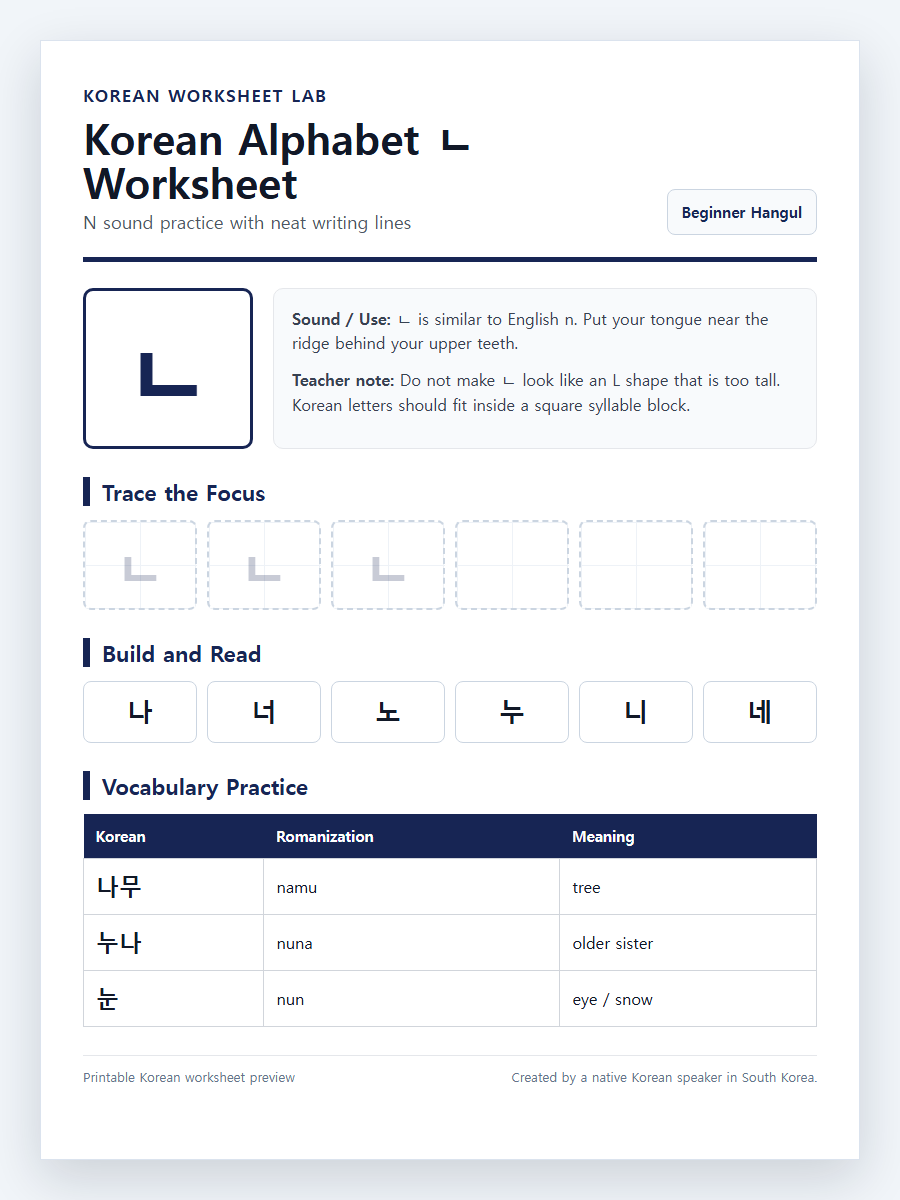
Hangul writing practice works best when it moves in three stages: trace, copy, and write independently. Tracing helps learners notice the shape, copying builds control, and independent writing shows whether the letter can be recalled without support.
This page is for beginners who want clean handwriting and better memory. It explains how to use printable writing PDFs without turning the lesson into mechanical copying. Each line should connect to sound and reading.
Write slowly and say the sound. The goal is not decorative handwriting. The goal is readable Korean that matches the correct letter, vowel, and syllable shape.
Learning Objectives
- Use trace-copy-write practice effectively.
- Write Hangul letters inside balanced syllable blocks.
- Connect handwriting with sound and reading.
- Print a writing worksheet for A4 practice.
Key Vocabulary and Patterns
| Korean | Romanization | Meaning |
|---|---|---|
| ㄱ | g/k | basic consonant |
| ㅏ | a | basic vowel |
| 가 | ga | ㄱ + ㅏ syllable block |
| 나 | na | ㄴ + ㅏ syllable block |
| 다 | da | ㄷ + ㅏ syllable block |
Examples
- Trace 가 three times.
- Copy 가 three times while saying ga.
- Write 가 from memory.
- Repeat with 나 and 다.
Practice Exercises
- Trace the model line.
- Copy without looking after each letter.
- Write one independent row.
- Circle the neatest syllable and explain why it is clear.
Worksheet Preview
Download Free PDF
Use the printable PDF after reading the lesson introduction and examples. The page is designed as a study worksheet, not as a standalone download without context.
Download Free PDFPrint This Worksheet
Answer Key
Answer support is provided on the lesson page so learners can check the target letters, sounds, and syllable-building logic before reviewing the printable worksheet. For classroom use, keep this section hidden until learners complete the practice.
- ㄱ = g/k, basic consonant
- ㅏ = a, basic vowel
- 가 = ga, ㄱ + ㅏ syllable block
- 나 = na, ㄴ + ㅏ syllable block
Tips for Self-learners
- Use slow strokes instead of rushing through rows.
- Check spacing inside the block.
- Say the sound each time you write.
- Stop before your hand gets tired.
Tips for Teachers
- Demonstrate stroke order before distributing the sheet.
- Ask learners to compare two sample blocks.
- Use independent writing as a quick check.
- Keep correction focused on readability.
FAQ
Is stroke order important in Hangul?
Yes. Stroke order helps handwriting feel natural and makes letter shapes easier to control.
Should beginners write full words?
They can, but syllable blocks are usually better at the beginning.
How much should I write each day?
A short, focused page is better than many rushed lines.