Introduction
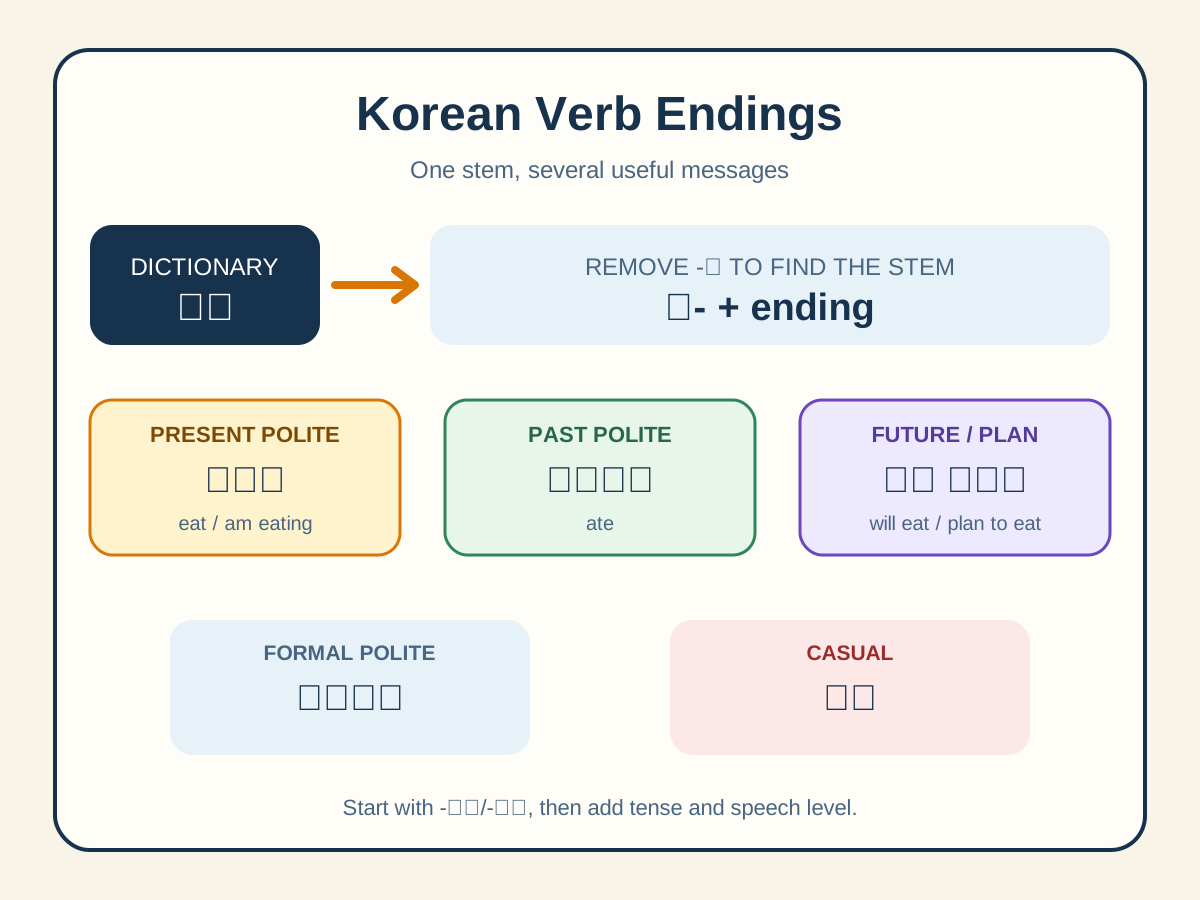
Korean verb endings turn a dictionary word into a complete message. 먹다 means “to eat,” but 먹어요 can mean “I eat,” “you eat,” or “they eat,” depending on context. 먹었어요 places the action in the past, while 먹을 거예요 presents a future plan or prediction. The ending carries information that English often expresses with pronouns, auxiliary verbs, or word order.
The number of possible endings can look intimidating, but beginners do not need a giant conjugation chart. Start with one dependable speech level—everyday polite -아요/-어요—and learn a small family of forms around it. This guide explains how stems and endings fit together, which forms deserve priority, and where a simple rule needs a caution label.
Learning Objectives
- Separate the dictionary ending -다 from the verb or adjective stem.
- Make everyday polite present, past, and future forms.
- Recognize how polite, formal, and casual endings change the listener relationship.
- Use common question, request, suggestion, and connection endings.
- Avoid frequent contraction, spacing, and irregular-conjugation errors.
What Is a Korean Verb Ending?
A Korean dictionary form consists of a stem plus -다: 먹다 → 먹-, 가다 → 가-, 공부하다 → 공부하-. The stem holds the central meaning. One or more endings attach to it to express tense, politeness, sentence type, mood, or a connection to the next clause.
Korean descriptive verbs, often called adjectives in learner materials, conjugate in much the same way. 좋다 becomes 좋아요, 좋았어요, and 좋을 거예요. 예쁘다 becomes 예뻐요, 예뻤어요, and 예쁠 거예요. This is why a guide to verb endings also helps you make sentences such as 날씨가 좋아요, “The weather is good.”
- 먹- + -어요 → 먹어요 (eat; am eating)
- 먹- + -었어요 → 먹었어요 (ate)
- 먹- + -을 거예요 → 먹을 거예요 (will eat; plan to eat)
Start with Everyday Polite -아요/-어요
For ordinary conversation with an adult you do not know closely, the 해요체 style is the safest starting point. After removing -다, use -아요 when the stem’s final vowel is ㅏ or ㅗ; use -어요 after most other vowels. 하다 verbs use -해요. The forms often contract, so 보 + 아요 becomes 봐요 and 마시 + 어요 becomes 마셔요.
Present-tense Korean is broader than an English present-tense label suggests. 저는 매일 운동해요 can mean “I exercise every day,” while 지금 운동해요 can mean “I am exercising now.” Time words and context usually resolve the difference; you do not need to force an English-style -ing form into every ongoing action.
- 가다 → 가요 (go)
- 오다 → 와요 (come)
- 먹다 → 먹어요 (eat)
- 마시다 → 마셔요 (drink)
- 공부하다 → 공부해요 (study)
Build Past and Future from the Same Base
The everyday polite past uses -았어요 after ㅏ or ㅗ and -었어요 after most other vowels; 하다 becomes 했어요. The same contractions reappear: 가다 → 갔어요, 보다 → 봤어요, 먹다 → 먹었어요, 마시다 → 마셨어요. Learn the whole spoken form rather than trying to pronounce every written piece separately.
A practical beginner future is -(으)ㄹ 거예요. Attach -ㄹ 거예요 to a vowel-ending stem and -을 거예요 to a consonant-ending stem: 가다 → 갈 거예요 and 먹다 → 먹을 거예요. With plans, it often corresponds to “will” or “am going to”; with observations, it can express a prediction. 거예요 is spaced from the preceding modifier: 먹을 거예요, not 먹을거예요.
Choose an Ending for the Listener
Tense is only one layer. Korean sentence endings also position the speaker toward the listener. Everyday polite 먹어요 suits most routine interactions. Formal polite 먹습니다 is useful in presentations, announcements, interviews, and institutional speech. Casual 먹어 is natural with close friends, many family members, children, or people who have agreed to use 반말.
Do not treat -습니다 as the only respectful form or 반말 as automatically rude. Both interpretation and choice depend on relationship and setting. When unsure, use -요. Also keep listener politeness separate from the subject honorific -(으)시-: 선생님이 오세요 uses polite speech toward the listener and honors the teacher who is coming.
- Formal polite: 갑니다 / 먹습니다
- Everyday polite: 가요 / 먹어요
- Casual: 가 / 먹어
Useful Beginner Endings beyond Tense
An ending can change the sentence type or connect ideas. -고 싶어요 expresses a desire, -(으)세요 makes a polite request or instruction, -(으)ㄹ까요? proposes or asks for an opinion, and -지만 connects a contrast. Learn each as a function attached to several familiar verbs, not as an isolated translation.
Questions in everyday 해요체 frequently keep the same written ending as statements; intonation and a question mark distinguish them. 민수 씨가 와요. means “Minsu is coming.” 민수 씨가 와요? means “Is Minsu coming?” Formal questions use a visibly different ending: 옵니까?
- 한국에 가고 싶어요. — I want to go to Korea.
- 여기 앉으세요. — Please sit here.
- 같이 먹을까요? — Shall we eat together?
- 비싸지만 좋아요. — It is expensive, but it is good.
Contractions and Irregular Verbs
Regular rules explain the pattern, but the surface form may shrink. 가 + 아요 becomes 가요, 보 + 아요 becomes 봐요, and 배우 + 어요 becomes 배워요. These are standard forms, not careless pronunciation. Writing uncontracted forms such as 보아요 is possible in limited stylistic contexts, but 봐요 is the normal everyday form.
Some stems change before a vowel-initial ending. 듣다 becomes 들어요, 돕다 becomes 도와요, and 모르다 becomes 몰라요. Not every verb with ㄷ, ㅂ, or 르 behaves irregularly, so avoid guessing from the final consonant alone. Memorize a new high-frequency verb with one useful conjugated form: 듣다—들어요, 입다—입어요.
A Reliable Order for Learning Endings
First, make -아요/-어요 automatic with ten common verbs. Second, reuse the same vowel pattern for -았어요/-었어요. Third, add -(으)ㄹ 거예요 and the formal -습니다 form. Only then expand into wishes, requests, suggestions, reasons, and contrasts. This order gives you communicative sentences early without pretending that every Korean ending fits one English tense.
Practice with a four-column card: dictionary form, present polite, past polite, and future polite. Say a short sentence for each form and change the time word: 오늘 공부해요, 어제 공부했어요, 내일 공부할 거예요. The repeated context makes the ending’s job visible.
Mini Practice
Conjugate or choose the best ending. 1) Change 먹다 to everyday polite present. 2) Change 가다 to everyday polite past. 3) Complete 내일 친구를 ___ using 만나다 and a future plan. 4) You are giving a presentation: choose 공부해요 or 공부합니다. 5) Make 보다 everyday polite present. 6) Correct 저는 어제 학교에 가요. 7) Translate “Shall we drink coffee together?” using -(으)ㄹ까요? 8) Explain why 들어요 cannot be formed by simply attaching -어요 to 듣-.
Answer Key
1) 먹어요. 2) 갔어요. 3) 내일 친구를 만날 거예요. 4) 공부합니다 is the better match for a formal presentation, although a conversational presentation may sometimes use -요 style. 5) 봐요. 6) 저는 어제 학교에 갔어요. The time word 어제 calls for the past form here. 7) 같이 커피를 마실까요? 8) 듣다 is ㄷ-irregular before this vowel-initial ending: 듣- changes to 들-, producing 들어요.
Vocabulary Box
| Korean | Romanization | Meaning |
|---|---|---|
| 동사 | dongsa | verb |
| 어간 | eogan | verb or adjective stem |
| 어미 | eomi | grammatical ending |
| 현재 | hyeonjae | present |
| 과거 | gwageo | past |
| 미래 | mirae | future |
| 활용 | hwaryong | conjugation; inflection |
| 불규칙 | bulgyuchik | irregular |
Grammar Box
- Remove dictionary-form -다 before attaching most beginner endings: 먹다 → 먹-.
- Use -아요 after a stem whose final vowel is ㅏ or ㅗ, and -어요 after most other vowels; 하다 becomes 해요.
- Past polite forms use -았어요/-었어요, while a common future or plan form is -(으)ㄹ 거예요.
- -습니다/-ㅂ니다 is formal polite; -아요/-어요 is everyday polite; -아/-어 is casual.
- Korean predicates do not conjugate for grammatical person: 먹어요 can have I, you, or they as its understood subject.
Pronunciation Tips
- Romanization shows 가요 as gayo, but read the Hangul rather than inserting an extra vowel from the underlying 가 + 아요.
- 먹어요 is romanized meogeoyo; the syllable break is 먹-어-요, not meo-geo-yo by meaning.
- 했습니다 is romanized haetseumnida and is commonly heard with a [씀] sound in natural pronunciation.
- 거예요 is geoyeyo. The standard spelling is 거예요, not 거에요, when it is the contracted form of 것이에요.
Example Sentences
저는 아침을 먹어요.
Jeoneun achimeul meogeoyo.
I eat breakfast.
어제 영화를 봤어요.
Eoje yeonghwareul bwasseoyo.
I watched a movie yesterday.
주말에 쉴 거예요.
Jumare swil geoyeyo.
I will rest on the weekend.
지금 뭐 해요?
Jigeum mwo haeyo?
What are you doing now?
회의를 시작하겠습니다.
Hoeuireul sijakhagetseumnida.
I will begin the meeting. (formal)
한국어를 배우고 싶어요.
Hangugeoreul baeugo sipeoyo.
I want to learn Korean.
천천히 말씀하세요.
Cheoncheonhi malsseumhaseyo.
Please speak slowly.
내일 다시 만날까요?
Naeil dasi mannalkkayo?
Shall we meet again tomorrow?
Common Mistakes
Avoid
Using the dictionary form in a polite conversation: 저는 커피를 마시다.
Try this
Conjugate the final predicate: 저는 커피를 마셔요.
Avoid
Assuming -아요 always follows a stem written with ㅏ somewhere.
Try this
Check the stem’s final vowel, not every vowel in the word: 만나다 → 만나요.
Avoid
Writing every form without standard contraction, such as 보아요.
Try this
Use the normal everyday contraction 봐요; learn common contracted forms as complete chunks.
Avoid
Writing future forms without a space: 먹을거예요.
Try this
Space the bound noun construction: 먹을 거예요.
Avoid
Using -습니다 with friends because it is ‘more correct.’
Try this
Match the listener and setting; everyday polite -요 is correct and natural in ordinary conversation.
Avoid
Applying an irregular change to every similar-looking stem.
Try this
Learn irregular verbs individually: 듣다 → 들어요, but 닫다 → 닫아요.
Study Tips
- Learn each verb with its dictionary and present-polite forms: 쓰다—써요.
- Use time words such as 어제, 지금, and 내일 when drilling tense endings.
- Master regular contractions before studying long lists of irregular classes.
- Underline the final predicate in short Korean sentences and label what its ending contributes.
- Practice one speech level consistently before transforming the same sentence into formal or casual speech.
Summary
Korean verb endings attach to a stem and complete the predicate. They can express tense, politeness, sentence type, mood, and connections between clauses. Everyday polite -아요/-어요 is the most useful base for a beginner.
Build outward in a controlled order: present polite, past polite, future plans, formal and casual equivalents, then high-frequency functional endings. Notice contractions, spacing, and irregular stems, but prioritize complete sentences you can use.
Frequently Asked Questions
Which Korean verb ending should a beginner learn first?
Learn everyday polite -아요/-어요 first. It is widely useful in ordinary conversation and provides the base pattern for the polite past -았어요/-었어요.
Do Korean verbs change for I, you, or they?
No. Korean predicates do not conjugate for grammatical person. The subject is understood from a noun, pronoun, or context, so 먹어요 can describe different people.
What is the difference between -아요 and -어요?
After removing -다, use -아요 when the stem’s final vowel is ㅏ or ㅗ and -어요 after most other vowels. Contractions and irregular stems can change the visible result.
Is -요 formal or informal?
-요 marks everyday polite speech. It is respectful but conversational. -습니다/-ㅂ니다 is the more formal polite style, while forms without -요 may be casual.
How do I make Korean verbs past tense?
In everyday polite speech, use -았어요 after ㅏ or ㅗ and -었어요 after most other vowels; 하다 becomes 했어요. Apply standard contractions and check irregular verbs.
How do I say will in Korean?
A common beginner form is -(으)ㄹ 거예요: 갈 거예요, 먹을 거예요. Depending on context, it can express a plan, intention, or prediction rather than mapping to every English use of will.
Are Korean adjectives conjugated like verbs?
Many Korean descriptive verbs, called adjectives in learner materials, take endings directly: 좋다 → 좋아요 and 예쁘다 → 예뻐요. Some behave irregularly.
Related Learning Resources
This article follows the Korean Worksheet Lab editorial standards and is reviewed for beginner clarity and natural Korean usage.