Introduction
Korean polite speech and casual speech express the speaker's relationship with the listener. The same idea can end as 먹습니다, 먹어요, or 먹어. All three can mean eat or am eating, but they do not fit the same conversation. Choosing an ending is part of the message, not optional decoration.
For a beginner, the safest default is everyday polite speech ending in -요. Use it with adults you have just met, service workers, classmates you are not close to, and anyone whose preferred speech level is unclear. Casual speech, 반말 (banmal), is natural with close friends, many family members, children, and people who have mutually agreed to use it. This guide shows how to choose without reducing every interaction to age alone.
Learning Objectives
- Distinguish everyday polite 해요체, formal polite 합쇼체, and casual 해체.
- Choose a speech level by relationship, setting, and mutual expectations.
- Change common statements and questions between -요, -습니다, and casual forms.
- Ask permission before switching to 반말.
- Separate listener-directed speech level from subject honorifics such as -(으)시-.
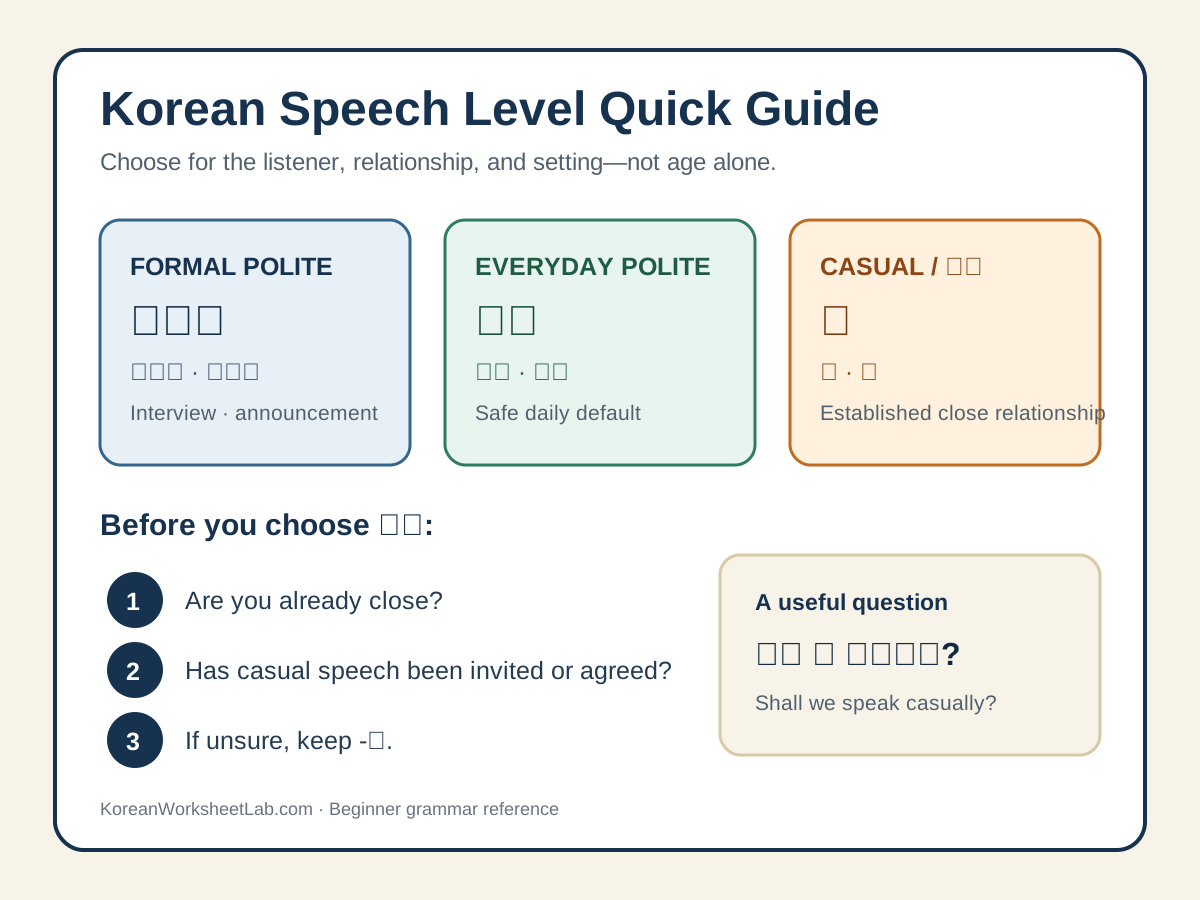
The Three Speech Styles Beginners Need First
Everyday polite speech is called 해요체 (haeyoche). Its sentences commonly end in -아요/-어요 or -이에요/-예요: 가요, 먹어요, 학생이에요. It is respectful without sounding ceremonial, so it covers most ordinary conversations with people who are not intimate.
Formal polite speech is 합쇼체 (hapsyoche), recognized by endings such as -습니다/-ㅂ니다 and -습니까/-ㅂ니까: 갑니다, 먹습니다, 학생입니까? It suits presentations, announcements, interviews, military or institutional settings, and especially formal customer-facing language. Casual 해체 (haeche) removes the polite -요 and uses forms such as 가, 먹어, and 학생이야.
- 해요체: 가요 — polite and conversational
- 합쇼체: 갑니다 — polite and formal
- 해체/반말: 가 — non-polite and intimate
Polite Does Not Mean Formal
English explanations often pair formal with polite and informal with casual, but Korean has two separate questions: Is the speaker honoring the listener, and how formal is the setting? 해요체 is polite even though it is conversational. 합쇼체 is both polite and more formal. This is why 안녕하세요 is normally polite speech, not casual speech, despite being an everyday greeting.
존댓말 (jondaetmal) is the broad everyday label for speech that respects the listener; it includes both 해요체 and 합쇼체. 반말 is the broad label for non-polite speech. A beginner does not need to produce all traditional Korean speech levels, but should recognize that a neat two-column formal/informal translation hides useful distinctions.
When to Start with Polite Speech
Use 존댓말 when meeting an adult for the first time, speaking to a teacher or supervisor, addressing a customer, or talking with an adult whose relationship to you is uncertain. Similar age does not automatically authorize 반말. Two university students may begin with -요 and switch later after becoming comfortable.
Age matters, but it is only one factor. Professional role, familiarity, setting, and the other person's preference also matter. A younger employee may use polite speech to an older manager, while the manager may still choose polite speech to create a respectful workplace. In a shop, both customer and employee can appropriately use -요 or formal polite language.
- First meeting with an adult: start with -요
- Teacher, supervisor, or customer: use polite speech
- Public presentation or formal interview: consider -습니다
- Close peer after mutual agreement: 반말 may be natural
When Casual Speech Is Natural
반말 is normal between close friends who use it with each other, among many siblings and family members, when an adult speaks to a young child, and in private self-talk. It can signal warmth and closeness; it is not inherently bad Korean. The problem is using it where the listener expects respect or distance.
Do not copy a drama character's casual line into a new real-life relationship without checking the scene. Characters may be childhood friends, relatives, enemies, or speaking downward to show power. 반말 can sound affectionate, playful, blunt, commanding, or hostile depending on voice and context.
How to Switch to 반말 Naturally
A switch is often discussed rather than silently assumed. You can ask 우리 말 놓을까요? (Uri mal noeulkkayo?), Shall we speak casually? Another common question is 반말해도 돼요? (Banmalhaedo dwaeyo?), May I use casual speech? If the other person says 네, 편하게 말하세요, they are inviting you to speak comfortably.
Permission may be one-way. An older person saying 말 편하게 하세요 can invite a younger person to relax, but the exact response depends on relationship and context. When unsure, keep -요. There is no penalty for waiting, and polite speech can remain warm rather than distant.
- 우리 말 놓을까요? — Shall we speak casually?
- 반말해도 돼요? — May I use casual speech?
- 네, 편하게 말하세요. — Yes, please speak comfortably.
- 저는 존댓말이 더 편해요. — I am more comfortable with polite speech.
Change the Ending, Then Check the Whole Sentence
For many verbs, the everyday polite and casual forms differ mainly by -요: 가요 becomes 가, 먹어요 becomes 먹어, and 좋아해요 becomes 좋아해. The copula changes as a set: 학생이에요 becomes 학생이야 after a consonant, while 친구예요 becomes 친구야 after a vowel. Formal polite forms require their own endings: 갑니다, 먹습니다, 학생입니다.
Questions can look identical to statements in 해요체 and 해체, with intonation doing work: 가요? and 가? Formal polite questions use -습니까/-ㅂ니까, as in 갑니까? Commands require more care. 앉아 can be too direct outside a close relationship; 앉으세요 is a common polite request, while 앉아 주세요 explicitly asks someone to sit.
- 먹습니다 → 먹어요 → 먹어
- 좋습니다 → 좋아요 → 좋아
- 학생입니다 → 학생이에요 → 학생이야
- 갑니까? → 가요? → 가?
Speech Level and Subject Honorifics Are Different
Sentence endings show the speaker's stance toward the listener. The honorific marker -(으)시- shows respect toward the sentence's subject. These systems can appear together but are not the same. 선생님이 오세요 is polite to the listener and honors the teacher who is coming.
You can honor the subject while speaking casually to a close friend: 선생님 오셨어? means Did the teacher come? The ending is casual toward the friend, while -시- honors the teacher. Conversely, 동생이 와요 is polite toward the listener but does not honor the younger sibling as the subject. This distinction prevents the common mistake of treating every -요 sentence as a subject honorific.
A Practical Decision Check
Before speaking, ask three questions. First, what is my relationship with the listener? Second, is the setting ordinary or institutionally formal? Third, have we clearly established casual speech? If the last answer is no, choose -요. Move to -습니다 when the role or occasion calls for a formal public tone.
Keep one level reasonably consistent within a short interaction. Native speakers sometimes mix -요 and -습니다 naturally, especially in service or workplace speech, but an unexplained jump from -요 to 반말 can feel abrupt. Beginners sound more reliable by holding the listener relationship steady.
Mini Practice
Choose or produce the best form. 1) You meet an adult classmate for the first time: 가 or 가요? 2) Change 먹어요 to casual speech. 3) Change 학생이에요 to formal polite speech. 4) Ask a friend politely, Shall we speak casually? 5) Your close friend asks whether your respected teacher arrived; complete 선생님 __? using casual listener speech and a subject honorific. 6) Explain why a person your age is not automatically a 반말 partner.
Answer Key
1) 가요 is the safe choice because the relationship is new. 2) 먹어. 3) 학생입니다. 4) 우리 말 놓을까요? (Uri mal noeulkkayo?) 5) 선생님 오셨어? (Seonsaengnim osyeosseo?) The casual ending addresses a close friend, while -시- honors the teacher. 6) Speech level also depends on familiarity, setting, role, preference, and mutual agreement; begin with 존댓말 until the relationship is clear.
Vocabulary Box
| Korean | Romanization | Meaning |
|---|---|---|
| 존댓말 | jondaetmal | speech that respects the listener; polite speech |
| 반말 | banmal | non-polite or casual speech |
| 해요체 | haeyoche | everyday conversational polite style |
| 합쇼체 | hapsyoche | formal polite style, including -습니다 |
| 해체 | haeche | intimate non-polite style commonly associated with 반말 |
| 말을 놓다 | mareul nota | to drop polite speech; to begin speaking casually |
| 편하게 | pyeonhage | comfortably; informally, depending on context |
Grammar Box
- Everyday polite statements commonly end in -아요/-어요: 만나요, 읽어요, 공부해요.
- Formal polite statements use -습니다 after a consonant and -ㅂ니다 after a vowel: 먹습니다, 갑니다.
- Casual 해체 often removes -요 from the 해요체 form: 만나요 → 만나, 읽어요 → 읽어.
- The copula set is 입니다 (formal polite), 이에요/예요 (everyday polite), and 이야/야 (casual).
- The subject honorific -(으)시- can combine with different listener speech levels: 오십니다, 오세요, 오셔.
Pronunciation Tips
- 존댓말 is romanized jondaetmal; the final ㅅ in 댓 is pronounced like [n] before ㅁ through nasal assimilation.
- 합쇼체 is romanized hapsyoche. In connected pronunciation, 합쇼 is commonly heard close to [합쑈].
- In 놓을까요, the ㅎ affects the following sound; focus first on the natural phrase rather than pronouncing each romanized letter separately.
- Romanization cannot show relationship or tone. Listen for the Korean ending itself: -요, -습니다, or the casual vowel ending.
Example Sentences
처음 뵙겠습니다.
Cheoeum boepgetseumnida.
It is a pleasure to meet you. (formal polite)
지금 뭐 해요?
Jigeum mwo haeyo?
What are you doing now? (everyday polite)
지금 뭐 해?
Jigeum mwo hae?
What are you doing now? (casual)
저는 학생이에요.
Jeoneun haksaeng-ieyo.
I am a student. (everyday polite)
나는 학생이야.
Naneun haksaeng-iya.
I am a student. (casual)
우리 말 놓을까요?
Uri mal noeulkkayo?
Shall we speak casually?
저는 존댓말이 더 편해요.
Jeoneun jondaetmari deo pyeonhaeyo.
I am more comfortable with polite speech.
선생님이 오세요.
Seonsaengnimi oseyo.
The teacher is coming. (polite to listener; teacher honored)
선생님 오셨어?
Seonsaengnim osyeosseo?
Did the teacher come? (casual to listener; teacher honored)
Common Mistakes
Avoid
Assuming anyone the same age should receive 반말.
Try this
Start with -요 until familiarity and mutual expectations support casual speech.
Avoid
Calling every -요 sentence formal Korean.
Try this
Describe 해요체 as everyday polite; reserve formal for settings and forms such as -습니다.
Avoid
Dropping only -요 without checking irregular or copula forms.
Try this
Learn useful sets such as 학생입니다 → 학생이에요 → 학생이야.
Avoid
Copying 반말 from K-drama dialogue into first meetings.
Try this
Check the characters' relationship and ask before switching in real life.
Avoid
Thinking -요 honors the subject of the sentence.
Try this
Use the ending for the listener relationship and -(으)시- when the subject should be honored.
Avoid
Switching back and forth between -요 and 반말 accidentally.
Try this
Choose one listener level for the interaction and practice the whole sentence pattern consistently.
Study Tips
- Learn new verbs as a three-form set: 합니다, 해요, 해.
- Label dialogue speakers by relationship before deciding whether a drama line is reusable.
- Practice first meetings only in 해요체 until polite endings become automatic.
- Role-play asking 우리 말 놓을까요? and accepting or declining comfortably.
- Underline sentence endings and circle -(으)시- separately when analyzing honorific sentences.
Summary
Korean polite speech versus casual speech is a relationship choice expressed through sentence endings. 해요체 is the best everyday default, 합쇼체 adds a formal public or institutional tone, and 해체 or 반말 belongs in established close relationships and other appropriate contexts.
Age alone does not decide the level. Consider familiarity, role, setting, and mutual preference. Ask before switching to 반말, and remember that listener speech level and subject honorifics are two distinct parts of Korean grammar.
Frequently Asked Questions
Should Korean beginners always use -요?
Use -요 as your everyday default with adults when the relationship is unclear. You will also need -습니다 for some formal settings and 반말 for established close relationships, but -요 is the safest starting point.
Is 존댓말 the same as formal Korean?
Not exactly. 존댓말 includes conversational polite 해요체 as well as formal polite 합쇼체. Politeness toward the listener and formality of the setting are related but separate ideas.
Can I use 반말 with someone the same age?
Possibly, but not automatically. Adults of the same age often begin with 존댓말 and move to 반말 after the relationship becomes comfortable or they agree to speak casually.
How do I ask to speak casually in Korean?
우리 말 놓을까요? means Shall we speak casually? 반말해도 돼요? means May I use casual speech? Keep using polite speech unless the response clearly supports a switch.
What is the difference between 해요 and 합니다?
Both are polite. 해요 is conversational and common in daily interaction; 합니다 is more formal and common in presentations, announcements, interviews, and institutional contexts.
Does removing -요 always make a sentence casual?
Often, but not as a universal mechanical rule. Copula and irregular forms need attention, and requests or commands can change social force when -요 is removed.
Are speech levels and honorifics the same thing?
No. Sentence endings primarily manage the listener relationship, while forms such as -(으)시- honor the subject. A sentence can use casual speech to a friend while honoring the teacher being discussed.
Related Learning Resources
This article follows the Korean Worksheet Lab editorial standards and is reviewed for beginner clarity and natural Korean usage.