Introduction
Korean classroom phrases let you keep learning even when you do not understand every word. A useful first set is not a list of school objects. It is a small toolkit for asking a teacher to repeat, checking a word's meaning, following an instruction, and showing that you are ready.
The phrases below work in an in-person class, an online lesson, or a tutoring session. Most student questions use polite -요 speech. Teacher instructions often end in -(으)세요, a polite directive that you should learn to recognize before trying to analyze every syllable.
Learning Objectives
- Ask a teacher to repeat or speak more slowly.
- Ask what a Korean word means, how to say something, or how to write it.
- Recognize frequent classroom instructions ending in -(으)세요.
- Respond naturally when you understand, are unsure, or have a question.
- Use classroom phrases politely without translating English word for word.
Start with Four Help-Seeking Phrases
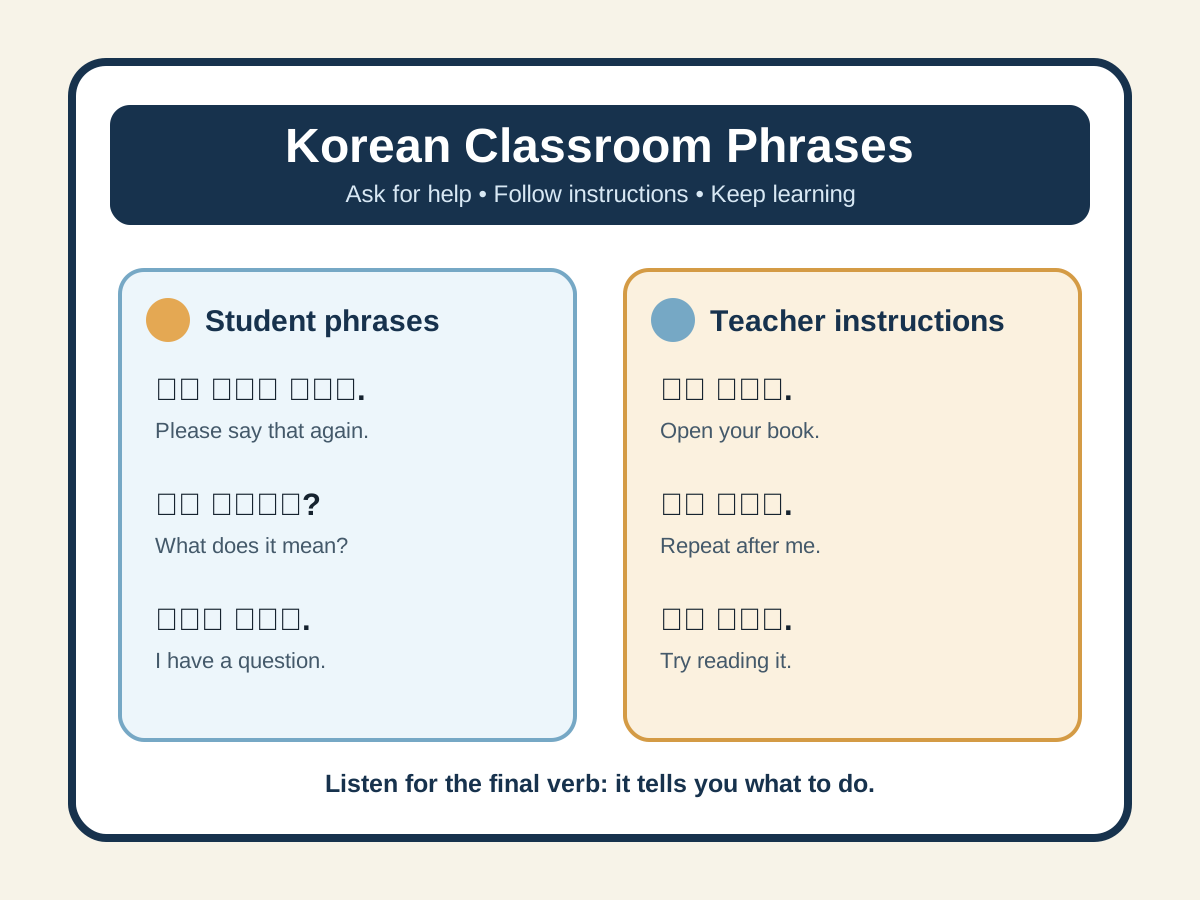
다시 말씀해 주세요 (dasi malsseumhae juseyo) means Please say that again. 말씀하다 is the honorific form of 말하다, to speak, so this is a dependable request to a teacher. 천천히 말씀해 주세요 (cheoncheonhi malsseumhae juseyo) means Please speak slowly. 한 번 더 말해 주세요 (han beon deo malhae juseyo), Please say it one more time, is also natural, but 말씀해 주세요 adds respect toward the person speaking.
잘 모르겠어요 (jal moreugesseoyo) is a tactful way to say I am not sure or I do not really understand. 이해가 안 돼요 (ihaega an dwaeyo) is more direct: I don't understand. These phrases are not admissions of failure. In a language lesson, they tell the teacher what kind of support you need.
- 다시 말씀해 주세요. — Please say that again.
- 천천히 말씀해 주세요. — Please speak slowly.
- 잘 모르겠어요. — I'm not sure / I don't really understand.
- 이해가 안 돼요. — I don't understand.
Ask about Meaning, Korean Words, and Spelling
무슨 뜻이에요? (museun tteusieyo?) means What does it mean? Put the word first when needed: 숙제가 무슨 뜻이에요? asks What does 숙제 mean? To ask for the Korean expression, use ___은/는 한국어로 뭐라고 해요? For example, 'homework'는 한국어로 뭐라고 해요? means How do you say 'homework' in Korean?
어떻게 써요? (eotteoke sseoyo?) means How do you write it? If you need the exact spelling, spell is often expressed through writing: 이 단어를 어떻게 써요? means How do you write this word? 질문이 있어요 (jilmuri isseoyo), I have a question, politely signals that you want to ask something; 선생님, 질문이 있어요 is appropriate in many learner classrooms.
Recognize Common Teacher Instructions
A teacher often uses a verb plus -(으)세요. 책을 펴세요 means Open your book, 보세요 means Look, 들으세요 means Listen, and 읽으세요 means Read. The ending is polite, but the sentence is still an instruction. You do not need to translate the subject you because Korean normally leaves it understood.
Practice instructions often use -아/어 보세요, literally try doing. 써 보세요 means Try writing it, 읽어 보세요 means Try reading it, and 말해 보세요 means Try saying it. 따라 하세요 means Repeat after me or follow along, while 짝과 이야기하세요 means Talk with your partner. Listen for the final verb because it tells you what action to take.
- 책을 펴세요. — Open your book.
- 잘 들으세요. — Listen carefully.
- 따라 하세요. — Repeat after me / Follow along.
- 읽어 보세요. — Try reading it.
- 써 보세요. — Try writing it.
- 짝과 이야기하세요. — Talk with your partner.
Give Short, Natural Classroom Responses
네, 알겠어요 (ne, algesseoyo) means Yes, I understand or Okay, got it. If you have completed a task, 다 했어요 (da haesseoyo) means I finished it. 아직 안 했어요 (ajik an haesseoyo) means I have not done it yet. 잠시만요 (jamsimanyo), One moment, is useful when you need time to find a page or finish writing.
Avoid answering every check with 네 when you are still confused. A useful repair is 네, 그런데 이 부분은 잘 모르겠어요: Yes, but I am not sure about this part. Pointing to 이 부분, this part, gives the teacher a clear place to help.
How Politeness Works in Classroom Phrases
Student requests usually use -아/어 주세요, please do, or a polite -요 question. 주세요 does not translate every English please. It follows an action requested for the speaker: 다시 설명해 주세요 means Please explain it again. For a noun request, use the noun plus 주세요, as in 종이 한 장 주세요, Please give me one sheet of paper.
A teacher may use -(으)세요 because it is a polite directive. In close children's classes, teachers can also use shorter forms such as 읽어 봐 or 앉아. Beginners should recognize those forms but continue using polite speech to the teacher unless the setting clearly establishes another style.
A Short Classroom Dialogue
Teacher: 10쪽을 펴세요. 그리고 첫 번째 문장을 읽어 보세요. (Open to page 10. Then try reading the first sentence.) Student: 선생님, '문장'이 무슨 뜻이에요? (Teacher, what does 문장 mean?) Teacher: Sentence라는 뜻이에요. (It means sentence.) Student: 네, 알겠어요. 그런데 한 번 더 말씀해 주세요. (Okay, I understand. But please say it one more time.)
This exchange combines an instruction, a meaning question, an acknowledgment, and a repetition request. Practice it once with the book instruction, then replace 읽어 보세요 with 써 보세요 or 말해 보세요. Changing one element helps you build a reusable pattern instead of memorizing a script.
Mini Practice
Choose or produce the best classroom phrase. 1) Ask your teacher to speak slowly. 2) Ask what 단어 means. 3) Translate Please try writing it. 4) Your teacher says 책을 펴세요. What should you do? 5) Say I have a question. 6) Correct 다시 말 주세요. 7) Translate I haven't finished yet. 8) Explain the difference between 읽으세요 and 읽어 보세요.
Answer Key
1) 천천히 말씀해 주세요. 2) 단어가 무슨 뜻이에요? 3) 써 보세요. 4) Open your book. 5) 질문이 있어요. 6) 다시 말해 주세요 or, more respectfully to a teacher, 다시 말씀해 주세요. 7) 아직 다 안 했어요. 8) 읽으세요 is a polite instruction to read; 읽어 보세요 invites the student to try reading.
Vocabulary Box
| Korean | Romanization | Meaning |
|---|---|---|
| 수업 | sueop | class; lesson |
| 선생님 | seonsaengnim | teacher (respectful title) |
| 질문 | jilmun | question |
| 뜻 | tteut | meaning |
| 단어 | daneo | word |
| 문장 | munjang | sentence |
| 교과서 | gyogwaseo | textbook |
| 숙제 | sukje | homework |
Grammar Box
- Use verb + -아/어 주세요 to request an action politely: 설명해 주세요 means Please explain it.
- Use verb + -(으)세요 for a polite instruction: 읽으세요 means Please read or Read.
- Use verb + -아/어 보세요 to invite an attempt: 읽어 보세요 means Try reading it.
- Use noun + 이/가 무슨 뜻이에요? to ask what a word means.
- Use noun + 은/는 한국어로 뭐라고 해요? to ask how an expression is said in Korean.
Pronunciation Tips
- 수업 is written sueop in Revised Romanization; pronounce the final ㅂ as an unreleased p sound before a pause.
- 뜻 is romanized tteut. The tense ㄸ begins firmly, and the final ㅅ is pronounced like a closed t at the end of the word.
- 읽으세요 is pronounced [일그세요] because the consonants resyllabify before the following vowel.
- 말씀해 주세요 is spoken as connected chunks; do not add a pause inside 말씀해.
Example Sentences
다시 말씀해 주세요.
Dasi malsseumhae juseyo.
Please say that again.
천천히 설명해 주세요.
Cheoncheonhi seolmyeonghae juseyo.
Please explain it slowly.
이 단어가 무슨 뜻이에요?
I daneoga museun tteusieyo?
What does this word mean?
영어로 뭐라고 해요?
Yeongeoro mworago haeyo?
How do you say it in English?
선생님, 질문이 있어요.
Seonsaengnim, jilmuri isseoyo.
Teacher, I have a question.
책을 펴고 10쪽을 보세요.
Chaegeul pyeogo sip jjogeul boseyo.
Open the book and look at page 10.
짝과 같이 읽어 보세요.
Jjakkwa gachi ilgeo boseyo.
Try reading it with your partner.
아직 다 안 했어요.
Ajik da an haesseoyo.
I haven't finished yet.
Common Mistakes
Avoid
Saying 다시 말 주세요 by translating Please give speech word for word.
Try this
Request the action with 말해 주세요, or use the respectful 말씀해 주세요 with a teacher.
Avoid
Using 주세요 after every English please.
Try this
Use -아/어 주세요 for requested actions and noun + 주세요 when requesting an item.
Avoid
Using 안 알아요 for I don't understand.
Try this
Use 잘 모르겠어요 for uncertainty or 이해가 안 돼요 when the explanation is not understood.
Avoid
Treating -(으)세요 as a question because it sounds polite.
Try this
In classroom context, 책을 펴세요 and 읽으세요 are polite instructions.
Avoid
Relying on romanization while the teacher points to Hangul.
Try this
Use romanization briefly, then connect the spoken phrase directly to its Hangul form.
Avoid
Staying silent after missing an instruction.
Try this
Use 이 부분을 다시 설명해 주세요 and point to the specific part that needs clarification.
Study Tips
- Memorize four repair phrases before your next lesson and use at least one aloud.
- Sort phrase cards into student questions, teacher instructions, and student responses.
- Listen for the final verb in a teacher's instruction before translating every noun.
- Replace one word in a model question: 단어, 문장, 숙제, or 발음.
- Practice the dialogue once slowly and once at a natural classroom pace.
Summary
The most useful Korean classroom phrases help you manage a real learning problem: ask for repetition, check meaning or spelling, follow an instruction, and respond honestly. Polite -요 speech and -아/어 주세요 requests are reliable choices for students.
Teacher instructions commonly end in -(으)세요, while -아/어 보세요 invites you to try an action. Learn these endings inside complete phrases, then use the classroom worksheet only after you understand what each phrase does.
Frequently Asked Questions
How do I ask a Korean teacher to repeat?
Say 다시 말씀해 주세요, meaning Please say that again. 한 번 더 말씀해 주세요, Please say it one more time, is also natural and polite.
How do I say I don't understand in Korean class?
잘 모르겠어요 means I am not sure or I do not really understand. 이해가 안 돼요 directly means I don't understand.
How do I ask what a Korean word means?
Put the word before 이/가 무슨 뜻이에요? For example, 문장이 무슨 뜻이에요? means What does 문장 mean?
What does -세요 mean in classroom instructions?
-(으)세요 makes a polite directive, as in 읽으세요, Please read, and 책을 펴세요, Please open your book.
What is the difference between 말해 주세요 and 말씀해 주세요?
Both request speech, but 말씀하다 is the honorific form of 말하다. 말씀해 주세요 is a respectful choice when asking a teacher to speak or repeat.
Can I use these phrases in an online Korean lesson?
Yes. Repetition, meaning, spelling, and clarification phrases work online and in person. For a connection problem, add 소리가 잘 안 들려요, I can't hear the sound well.
Should beginners memorize romanization?
Use romanization only as temporary pronunciation support. Classroom phrases become more useful when you recognize their Hangul quickly while listening.
Related Learning Resources
This article follows the Korean Worksheet Lab editorial standards and is reviewed for beginner clarity and natural Korean usage.