Introduction
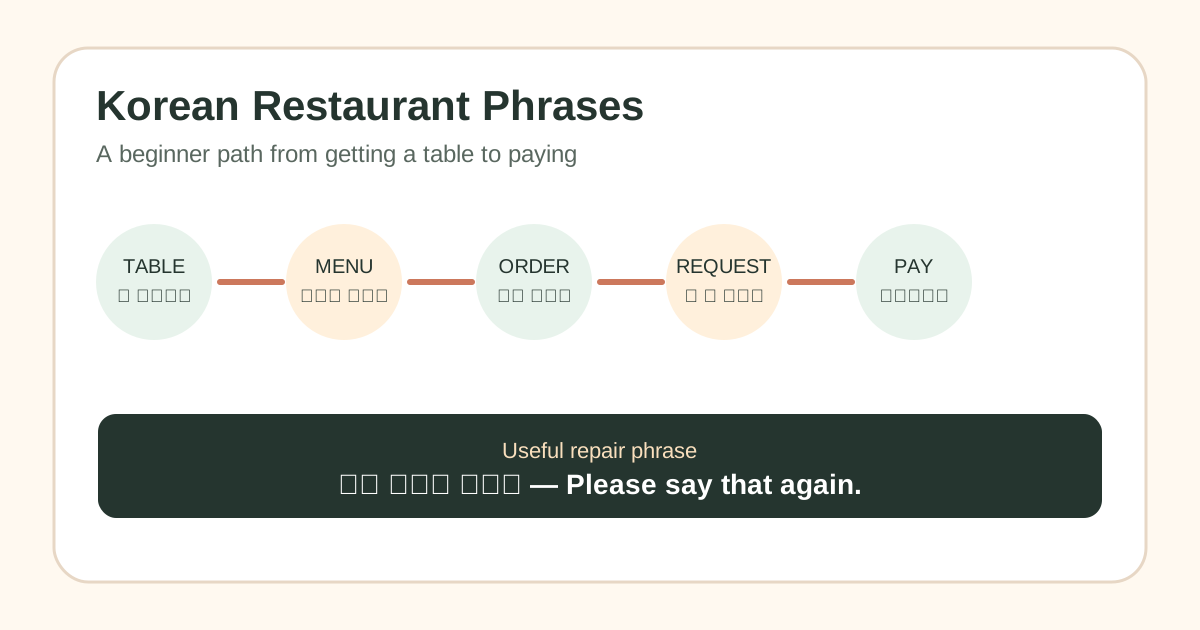
Korean restaurant phrases are most useful when you learn them as a sequence, not as a disconnected list. A real meal may begin with asking whether a table is available, continue with a menu question and an order, and end at a counter rather than with a bill brought to the table.
You do not need advanced grammar to handle that sequence. The polite request pattern 주세요, a few counters, and repair phrases such as 다시 말씀해 주세요 can carry much of the interaction. This guide also prepares you for what staff may ask back, so a successful first sentence does not leave you unable to respond.
Learning Objectives
- Ask for a table and understand basic seating questions.
- Order dishes and portions with polite, natural requests.
- Ask about recommendations, spice, ingredients, and dietary needs.
- Request water or side dishes and pay in common restaurant settings.
The Five Phrases to Learn First
If you remember only five lines, choose 이거 주세요 (This one, please), 추천해 주세요 (Please recommend something), 안 매운 게 있어요? (Is there something that is not spicy?), 물 좀 주세요 (Some water, please), and 계산할게요 (I'd like to pay). Each phrase solves a different stage of the meal.
주세요 literally combines 주다, to give, with a polite request form. With a noun, it asks for an item: 메뉴 주세요. After an action in the -아/어 form, it asks someone to do something: 추천해 주세요. The small word 좀 softens many requests, but a calm tone and the polite ending matter more than inserting 좀 everywhere.
- 이거 주세요 — This one, please.
- 추천해 주세요 — Please recommend something.
- 안 매운 게 있어요? — Is there something not spicy?
- 물 좀 주세요 — Some water, please.
- 계산할게요 — I'd like to pay.
Entering and Getting a Table
At the entrance, staff may ask 몇 분이세요? meaning How many people are in your party? Answer 두 명이에요 for two people or 세 명이에요 for three. 명 is the counter for people in ordinary counting; use the native Korean forms 한, 두, 세, and 네 before a counter.
To ask whether seating is available, say 두 명 자리 있어요? (Is there a table for two?). If you see a kiosk, waiting list, or sign, follow it first. Some restaurants seat guests, while others expect guests to choose a table. 실제 운영 방식은 식당마다 다르므로 직원의 안내와 표지판을 따르는 것이 가장 안전합니다.
Reading the Menu and Asking Questions
메뉴 좀 볼 수 있을까요? politely asks, Could I see the menu? To ask for a recommendation, use 뭐가 맛있어요? (What is good?) or 어떤 메뉴를 추천하세요? (Which menu item do you recommend?). The second question may produce a longer answer, so listen for the dish name and then confirm with 이거요? (This one?).
For spice, 맵지 않아요? can be ambiguous in fast conversation because you are asking for confirmation. A clearer beginner question is 안 매운 게 있어요? If you want to ask whether a dish is spicy, point and say 이거 매워요? To request less spice when the kitchen can adjust it, say 덜 맵게 해 주세요. Not every prepared dish can be changed.
Ordering Dishes and Portions
Build an order as [dish] + [quantity] + 주세요. 비빔밥 하나 주세요 means One bibimbap, please. 불고기 이 인분 주세요 means Two portions of bulgogi, please. 하나 is common for one item, while 인분 counts servings intended for people.
When pointing, 이거 하나 주세요 is natural and useful. For multiple items, connect them and finish the request once: 비빔밥 하나하고 냉면 하나 주세요. 하고 works like and in this ordering context. Confirm the order if necessary with 비빔밥 하나 맞아요? (One bibimbap, right?).
- 김치찌개 하나 주세요. — One kimchi stew, please.
- 삼겹살 이 인분 주세요. — Two portions of pork belly, please.
- 이거 두 개 주세요. — Two of these, please.
- 포장해 주세요. — Please pack it to go.
What the Server May Ask You
A restaurant exchange is two-way. Staff may ask 주문하시겠어요? (Are you ready to order?), 더 필요한 거 있으세요? (Do you need anything else?), or 음료는요? (And drinks?). You can answer 네, 주문할게요; 아니요, 괜찮아요; or 물 주세요.
For dine-in or takeout, you may hear 드시고 가세요, 포장이세요? meaning Are you eating here or is it takeout? Answer 먹고 갈게요 (I'll eat here) or 포장해 주세요 (Please make it to go). If speech is too fast, say 죄송하지만 다시 말씀해 주세요—Sorry, but please say that again.
Ingredients, Allergies, and Dietary Needs
A preference and an allergy are not the same message. 고기 안 먹어요 means I do not eat meat. 땅콩 알레르기가 있어요 means I have a peanut allergy. For a serious allergy, show the ingredient in writing and ask 이 음식에 땅콩이 들어가요? (Does this food contain peanuts?). Do not rely on a memorized phrase alone when cross-contact matters.
To ask whether an ingredient can be removed, say 고기 빼 주실 수 있어요? (Could you leave out the meat?). This is a request, not a guarantee. Broth, sauces, kimchi, and pre-made dishes may contain ingredients that are not visible, so confirm the specific restriction with staff.
- 계란 알레르기가 있어요. — I have an egg allergy.
- 이 음식에 견과류가 들어가요? — Does this dish contain nuts?
- 고기 안 들어간 메뉴가 있어요? — Is there a menu item without meat?
- 새우 빼 주실 수 있어요? — Could you leave out the shrimp?
Extra Requests at the Table
Use [item] + 좀 주세요 for a small, polite table request: 앞접시 좀 주세요 (Please bring a small plate) or 물 좀 주세요. To ask whether a side dish can be refilled, say 이 반찬 더 주실 수 있어요? (Could we have more of this side dish?). Refill policies vary, so ask rather than assume.
Excuse me is 저기요 when calling for attention in many casual restaurants. Say it clearly but not aggressively. In restaurants with call buttons or table ordering screens, use the system provided instead of repeatedly calling across the room.
Paying and Leaving
계산할게요 means I'd like to pay and works well when you approach the counter. 계산해 주세요 asks someone to process the payment. Some restaurants place an order slip on the table for you to carry to the register; others use table payment, kiosks, or pay-first ordering.
Ask 카드 돼요? to check whether cards are accepted. 따로 계산할 수 있어요? asks whether separate payment is possible, but splitting by person or item is not available everywhere. After the meal, 잘 먹었습니다 is a warm way to say I ate well and thank the restaurant as you leave.
A Complete Beginner Restaurant Dialogue
직원: 몇 분이세요? 손님: 두 명이에요. 직원: 이쪽으로 오세요. 손님: 감사합니다. 어떤 메뉴를 추천하세요? 직원: 불고기가 인기 있어요. 손님: 그럼 불고기 이 인분하고 비빔밥 하나 주세요. 직원: 음료는요? 손님: 물 주세요. 그리고 이거 매워요? 직원: 조금 매워요. 손님: 네, 괜찮아요.
Server: How many people? Customer: Two. Server: This way, please. Customer: Thank you. Which menu item do you recommend? Server: Bulgogi is popular. Customer: Then two portions of bulgogi and one bibimbap, please. Server: And drinks? Customer: Water, please. Also, is this spicy? Server: It is a little spicy. Customer: Yes, that's okay.
Mini Practice
Complete the restaurant interaction before checking the answer key. 1) Answer 몇 분이세요? for three people. 2) Order one bibimbap. 3) Ask whether this dish is spicy. 4) Ask for two of the item you are pointing to. 5) Say you have a peanut allergy. 6) Ask the server to repeat. 7) Say you will eat here. 8) Ask whether separate payment is possible.
Answer Key
1) 세 명이에요. 2) 비빔밥 하나 주세요. 3) 이거 매워요? 4) 이거 두 개 주세요. 5) 땅콩 알레르기가 있어요. 6) 다시 말씀해 주세요. 7) 먹고 갈게요. 8) 따로 계산할 수 있어요? Other polite answers with the same meaning may also be correct.
Vocabulary Box
| Korean | Romanization | Meaning |
|---|---|---|
| 식당 | sikdang | restaurant |
| 메뉴 | menyu | menu; menu item |
| 주문 | jumun | order |
| 추천 | chucheon | recommendation |
| 인분 | inbun | serving; portion for a person |
| 반찬 | banchan | side dish |
| 포장 | pojang | takeout; packing |
| 계산 | gyesan | payment; calculation |
Grammar Box
- Use noun + 주세요 to request an item: 물 주세요 means Water, please.
- Use verb stem + -아/어 주세요 to request an action: 추천해 주세요 means Please recommend something.
- Native Korean numbers change before counters: 하나 becomes 한, 둘 becomes 두, 셋 becomes 세, and 넷 becomes 네.
- Use -ㄹ/을게요 for an immediate intention shaped by the situation: 주문할게요 means I'll order or I'm ready to order.
- Use -ㄹ/을 수 있어요? to ask whether something is possible: 따로 계산할 수 있어요?
Pronunciation Tips
- 식당 is romanized sikdang; the final ㄱ before ㄷ is pronounced with tense-sound influence, close to [식땅].
- 몇 명 is commonly pronounced [면 명] in connected speech, even though the spelling remains 몇 명.
- 인분 is pronounced [인분], with a clear n sound before b; keep both syllables audible.
- Romanization is a temporary cue. Read 주세요 and 계산 directly in Hangul as soon as possible.
Example Sentences
두 명 자리 있어요?
Du myeong jari isseoyo?
Is there a table for two?
비빔밥 하나 주세요.
Bibimbap hana juseyo.
One bibimbap, please.
어떤 메뉴를 추천하세요?
Eotteon menyureul chucheonhaseyo?
Which menu item do you recommend?
안 매운 게 있어요?
An maeun ge isseoyo?
Is there something that is not spicy?
이 음식에 땅콩이 들어가요?
I eumsige ttangkongi deureogayo?
Does this food contain peanuts?
앞접시 좀 주세요.
Apjeopsi jom juseyo.
Please bring a small plate.
다시 말씀해 주세요.
Dasi malsseumhae juseyo.
Please say that again.
따로 계산할 수 있어요?
Ttaro gyesanhal su isseoyo?
Can we pay separately?
Common Mistakes
Avoid
Using 주세요 as a translation for every English please.
Try this
Use noun + 주세요 for an item and -아/어 주세요 for a requested action.
Avoid
Ordering two servings as 둘 인분.
Try this
Counters use the shortened native number form: 두 인분.
Avoid
Saying 안 매워요? when you need an unambiguous non-spicy option.
Try this
Ask 안 매운 게 있어요? or point and ask 이거 매워요?
Avoid
Treating an allergy like a casual preference.
Try this
Say [ingredient] 알레르기가 있어요, show it in writing, and verify hidden ingredients or cross-contact.
Avoid
Assuming every side dish is freely refillable.
Try this
Ask 이 반찬 더 주실 수 있어요? because restaurant policies differ.
Avoid
Waiting for a paper bill in every restaurant.
Try this
Look for a counter, kiosk, order slip, or table-payment instructions and say 계산할게요 when ready.
Study Tips
- Practice the meal as five stages: enter, ask, order, request, pay.
- Learn likely staff questions as well as your own lines.
- Replace the dish and quantity in one pattern instead of memorizing dozens of orders.
- Keep allergy wording in Hangul on your phone for accurate confirmation.
- Use the worksheet only after you can explain what each phrase accomplishes.
Summary
A small set of Korean restaurant phrases can cover an entire meal when you understand their patterns. Use 주세요 for items and requested actions, counters for quantities, and direct questions for spice or ingredients.
Prepare for the server's questions, clarify serious dietary needs, and observe how each restaurant handles seating and payment. That combination is more useful than memorizing a long phrase list without context.
Frequently Asked Questions
How do I order food in Korean?
Say the dish, quantity, and 주세요: 비빔밥 하나 주세요 means One bibimbap, please. When pointing, 이거 하나 주세요 means One of this, please.
How do I call a server in a Korean restaurant?
저기요 is common in casual restaurants. Use a table call button or ordering screen when one is provided, and speak clearly without shouting.
How do I ask for a non-spicy dish in Korean?
Ask 안 매운 게 있어요? meaning Is there something not spicy? To ask about one dish, say 이거 매워요?
What is the difference between 개 and 인분?
개 counts general items, while 인분 counts food portions intended for a number of people. 이거 두 개 is two of these; 불고기 이 인분 is two portions of bulgogi.
How do I explain a food allergy in Korean?
Say [ingredient] 알레르기가 있어요 and ask whether the dish contains it. For a serious allergy, also show the written ingredient and verify cross-contact with staff.
How do I ask for the bill in Korean?
계산할게요 means I'd like to pay, especially at the counter. 계산해 주세요 asks someone to process the payment. Follow the restaurant's counter, kiosk, or table-payment system.
Do Korean restaurants split the bill?
Some do, but policies and payment systems vary. Ask 따로 계산할 수 있어요? meaning Can we pay separately?
Related Learning Resources
This article follows the Korean Worksheet Lab editorial standards and is reviewed for beginner clarity and natural Korean usage.