Beginner Conversation
Korean Greetings for Beginners: Hello, Thank You, and Goodbye
Learn essential Korean greetings with polite phrases, pronunciation support, beginner examples, practice tasks, and a printable PDF worksheet.
Created by a native Korean speaker in South Korea. · Last reviewed July 2, 2026
Lesson Introduction
Korean greetings are usually the first real phrases a beginner learns. They are also a useful way to understand Korean politeness. A phrase like 안녕하세요 is not just a direct translation of hello. It is a polite everyday greeting that works in many first meetings, classrooms, shops, and travel situations.
This lesson focuses on practical greetings adult beginners can actually use: saying hello, thanking someone, apologizing, and saying goodbye. You will see the Korean phrase, romanization, meaning, and short usage notes before downloading the printable worksheet.
Do not try to memorize too many phrases at once. Start with three or four phrases, say them aloud, and practice choosing the right expression for the situation.
Learning Objectives
- Read and say common polite Korean greetings.
- Understand when to use hello, thank you, sorry, and goodbye.
- Practice short beginner dialogues.
- Use the printable PDF for review and speaking practice.
Key Vocabulary and Patterns
| Korean | Romanization | Meaning |
|---|---|---|
| 안녕하세요 | annyeonghaseyo | hello |
| 감사합니다 | gamsahamnida | thank you |
| 죄송합니다 | joesonghamnida | I am sorry |
| 안녕히 가세요 | annyeonghi gaseyo | goodbye to someone leaving |
Examples
- 안녕하세요. 저는 민수예요. Hello. I am Minsu.
- 감사합니다. Thank you.
- 죄송합니다. I am sorry.
- 안녕히 가세요. Goodbye, when the other person is leaving.
Practice Exercises
- Read each greeting aloud three times.
- Match each Korean phrase with the English meaning.
- Choose the right greeting for a classroom, shop, or first meeting.
- Write a two-line dialogue using 안녕하세요 and 감사합니다.
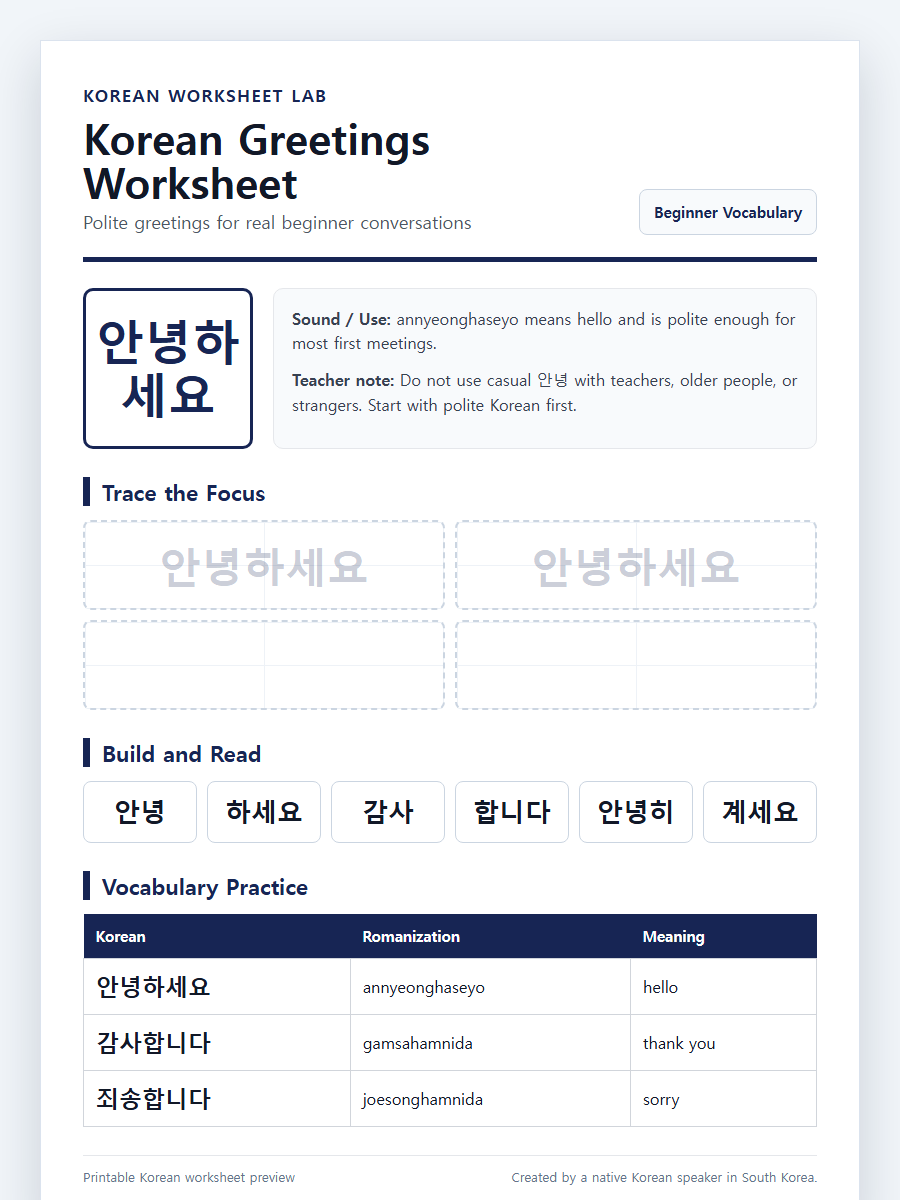
Worksheet Preview
Download Free PDF
Use the printable PDF after reading the lesson introduction and examples. The page is designed as a study worksheet, not as a standalone download without context.
Download Free PDFPrint This Worksheet
Answer Key
Answer support is provided on the lesson page so learners can check the target letters, sounds, and syllable-building logic before reviewing the printable worksheet. For classroom use, keep this section hidden until learners complete the practice.
- 안녕하세요 = annyeonghaseyo, hello
- 감사합니다 = gamsahamnida, thank you
- 죄송합니다 = joesonghamnida, I am sorry
- 안녕히 가세요 = annyeonghi gaseyo, goodbye to someone leaving
Tips for Self-learners
- Practice with voice, not only silent reading.
- Use polite greetings first; casual greetings can wait.
- Notice that goodbye changes depending on who is leaving.
- Review greetings before moving into longer conversation.
Tips for Teachers
- Use greetings as a role-play warmup.
- Model polite voice and body language.
- Let learners practice in pairs before writing.
- Keep correction focused on phrase choice and clarity.
FAQ
Is 안녕하세요 formal or casual?
안녕하세요 is polite and safe for most beginner situations.
Can I say 안녕 to everyone?
안녕 is casual. Beginners should learn polite greetings first.
Why are there different goodbyes in Korean?
Korean goodbye expressions can change depending on whether you are staying or leaving.