Everyday Korean
Everyday Korean for Beginners: Useful Words for Daily Life
Learn everyday Korean words for home, study, food, routines, and simple self-study practice with a printable vocabulary PDF.
Created by a native Korean speaker in South Korea. · Last reviewed July 2, 2026
Lesson Introduction
Everyday Korean gives beginners the words they can reuse immediately. Instead of memorizing random vocabulary, it is better to start with words connected to daily routines: home, study, morning, food, going out, and simple actions.
This page is designed for adult learners who want practical Korean beyond alphabet practice. You will learn a small set of useful words, see how they appear in simple contexts, and then use a printable PDF to review them.
Keep the first word set small. A short list that you can read, say, and write is more useful than a long list you forget after one day.
Learning Objectives
- Learn useful beginner words for daily life.
- Connect vocabulary with simple routines.
- Practice reading and writing everyday Korean words.
- Use the PDF as a weekly review sheet.
Key Vocabulary and Patterns
| Korean | Romanization | Meaning |
|---|---|---|
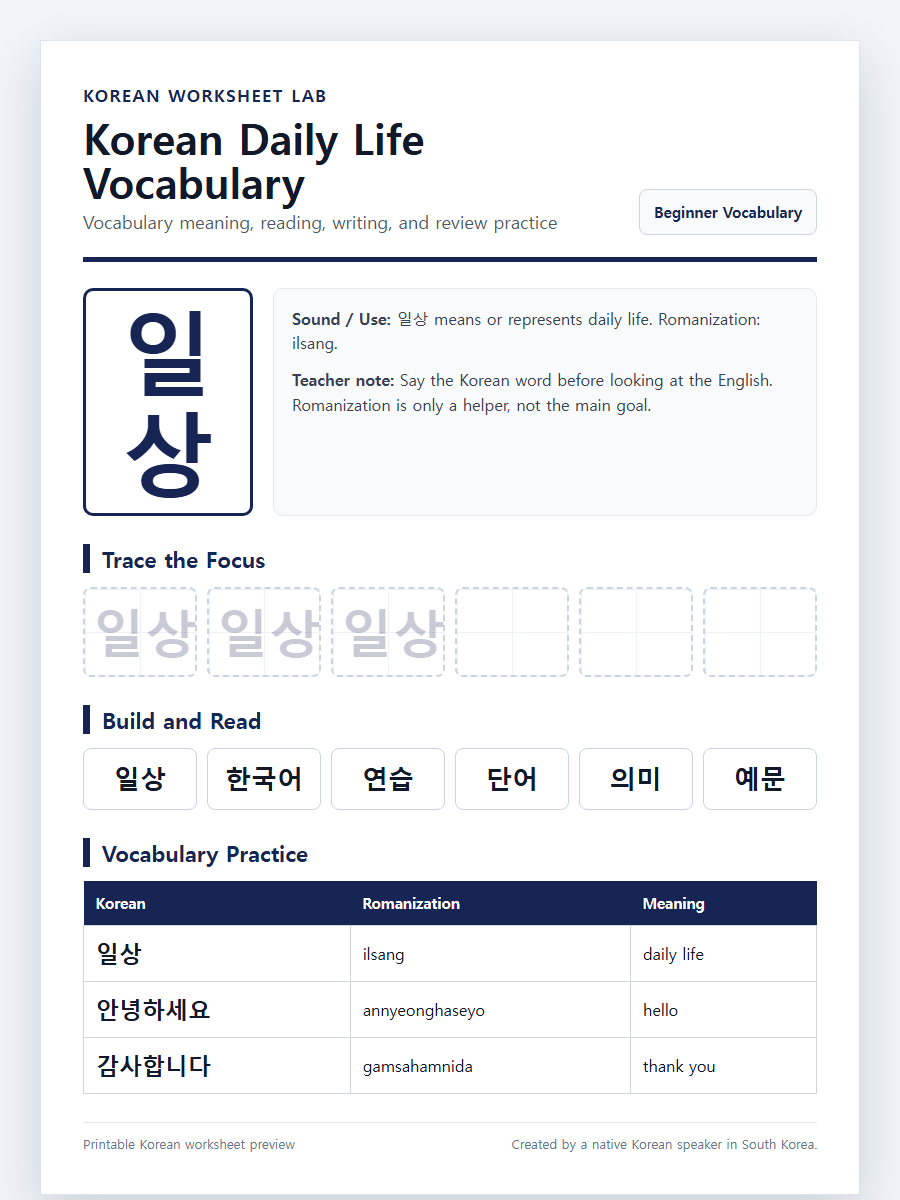
| 일상 | ilsang | daily life |
| 아침 | achim | morning; breakfast |
| 공부 | gongbu | study |
| 집 | jip | home; house |
Examples
- 저는 공부해요. I study.
- 집에 가요. I go home.
- 아침을 먹어요. I eat breakfast.
- 일상 vocabulary is useful for beginner diaries.
Practice Exercises
- Read each word and cover the romanization.
- Match each Korean word with a daily routine.
- Write one simple sentence with 집 or 공부.
- Circle the words you can use today.
Worksheet Preview
Download Free PDF
Use the printable PDF after reading the lesson introduction and examples. The page is designed as a study worksheet, not as a standalone download without context.
Download Free PDFPrint This Worksheet
Answer Key
Answer support is provided on the lesson page so learners can check the target letters, sounds, and syllable-building logic before reviewing the printable worksheet. For classroom use, keep this section hidden until learners complete the practice.
- 일상 = ilsang, daily life
- 아침 = achim, morning; breakfast
- 공부 = gongbu, study
- 집 = jip, home; house
Tips for Self-learners
- Choose vocabulary connected to your actual life.
- Review words in small groups.
- Say a word when you do the activity in real life.
- Use the worksheet as a weekly check, not a one-time task.
Tips for Teachers
- Ask learners to personalize vocabulary.
- Use routines as speaking prompts.
- Pair reading practice with short sentence frames.
- Let learners build a daily-life word bank.
FAQ
What everyday Korean words should beginners learn?
Start with words for home, study, food, time, family, and simple routines.
Should I memorize long vocabulary lists?
Short useful lists are better for beginners than long random lists.
Can I use this for self-study?
Yes. This page is designed for self-study learners and classroom review.