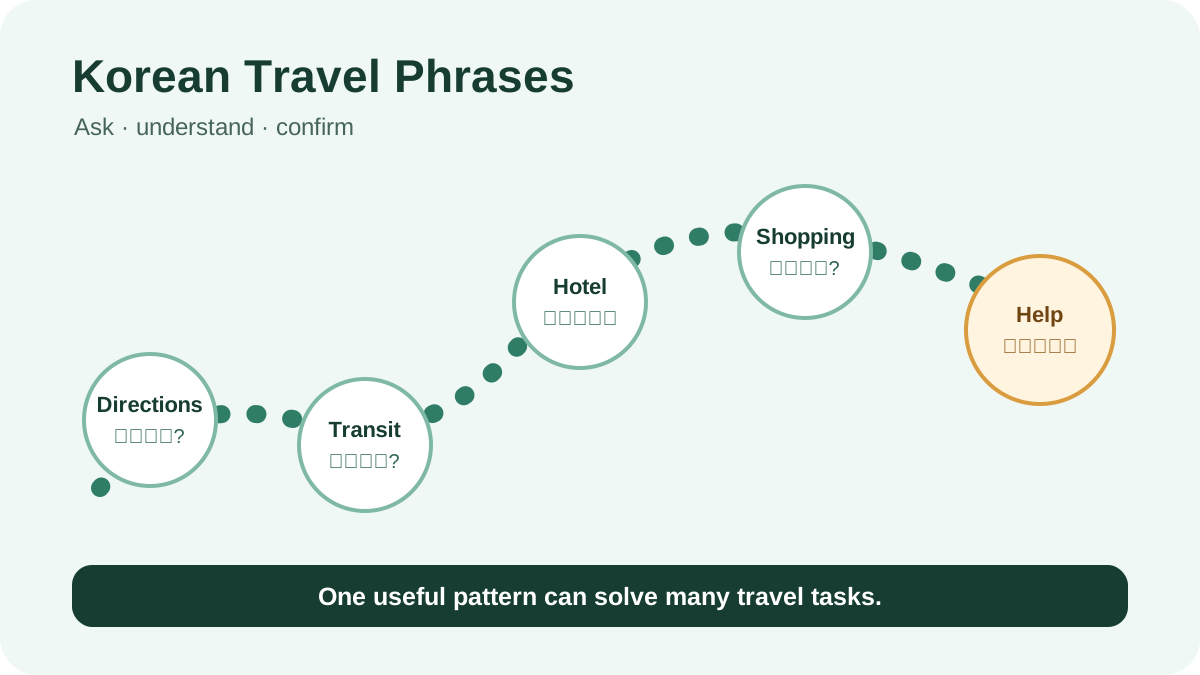
Introduction
Korean travel phrases are easier to use when you learn a few flexible patterns instead of a huge phrasebook. 어디예요? asks where something is, 주세요 requests an item or action, and 갈 수 있어요? asks whether you can get somewhere. With those patterns, you can solve many small problems without building a long sentence from scratch.
A useful travel guide must also prepare you for the answer. If you ask 지하철역이 어디예요? but cannot recognize 왼쪽, 오른쪽, 직진, or 건너편, the question only completes half the task. This guide pairs each request with the words and follow-up questions you are likely to hear.
Learning Objectives
- Use a compact set of polite phrases across several travel situations.
- Ask for directions and recognize basic location words in the answer.
- Handle transit, accommodation, shopping, and communication problems.
- State an urgent need clearly and know when to seek professional help.
Start with Six Flexible Travel Patterns
Learn these as reusable frames: [place]이/가 어디예요? (Where is [place]?), [place]에 어떻게 가요? (How do I get to [place]?), [item] 주세요 (Please give me [item]), [action]해 주세요 (Please do [action]), [action]할 수 있어요? (Can I [action]?), and [noun]이/가 있어요? (Is there [noun]?). Replace only the bracketed part.
Polite -요 speech is a reliable default with staff and strangers. You do not need to add 당신, the dictionary translation of you. Korean normally omits an obvious subject, so 화장실이 어디예요? sounds more natural than a literal word-for-word English question.
- 화장실이 어디예요? — Where is the restroom?
- 서울역에 어떻게 가요? — How do I get to Seoul Station?
- 표 한 장 주세요. — One ticket, please.
- 여기에 세워 주세요. — Please stop here.
- 카드로 결제할 수 있어요? — Can I pay by card?
- 빈방이 있어요? — Is there a vacant room?
Asking for Directions and Understanding the Answer
Get attention with 실례합니다 (Excuse me), then name the destination: 실례합니다. 경복궁이 어디예요? A more route-focused question is 경복궁에 어떻게 가요? If the answer is too fast, say 천천히 말씀해 주세요 (Please speak slowly) or 지도에서 보여 주세요 (Please show me on the map).
Listen for 왼쪽 (left), 오른쪽 (right), 직진 (straight), 앞 (front), 뒤 (behind), 옆 (beside), and 건너편 (across from). 여기서 가까워요? asks Is it close from here? 걸어서 갈 수 있어요? asks Can I walk there? Confirm a route with 이 길로 가면 돼요? (Should I go this way?).
Subway, Bus, Train, and Taxi Phrases
For public transit, ask 이 버스가 서울역에 가요? (Does this bus go to Seoul Station?) or 어디에서 갈아타요? (Where do I transfer?). 갈아타다 means to transfer. 몇 번 출구예요? asks which exit number to use, an important detail in large subway stations.
At a ticket counter, 부산 가는 표 한 장 주세요 means One ticket to Busan, please. Staff may ask 편도예요, 왕복이에요? (One way or round trip?) and 몇 시로 드릴까요? (What time would you like?). In a taxi, show the destination in Hangul and say 여기로 가 주세요 (Please go here). 여기에 세워 주세요 means Please stop here.
Hotel and Accommodation Phrases
At reception, 예약했어요 (I have a reservation) is usually enough to begin. Add [name]으로 예약했어요 to say the booking is under a name. Staff may ask 여권 보여 주세요 (Please show your passport) or 몇 박이세요? (How many nights?). Answer 이 박이에요 for two nights or 삼 박이에요 for three.
Describe a room problem specifically: 와이파이가 안 돼요 (The Wi-Fi does not work), 온수가 안 나와요 (There is no hot water), or 에어컨이 작동하지 않아요 (The air conditioner is not working). 짐을 맡길 수 있어요? asks whether you can leave luggage. 체크아웃이 몇 시예요? asks the checkout time.
Shopping and Everyday Payment
얼마예요? means How much is it? When several items are visible, point and say 이거 얼마예요? (How much is this?). To ask about another size or color, use 더 큰 사이즈가 있어요? (Do you have a larger size?) or 다른 색도 있어요? (Do you have another color too?).
At checkout you may hear 봉투 필요하세요? (Do you need a bag?), 영수증 필요하세요? (Do you need a receipt?), and 일시불로 하시겠어요? (Would you like to pay in one installment?). Answer 네, 주세요 or 아니요, 괜찮아요. 카드로 결제할게요 means I will pay by card.
Repair Phrases When Communication Breaks Down
A successful traveler needs repair phrases more than perfect grammar. 한국어를 잘 못해요 means I do not speak Korean well. 다시 말씀해 주세요 asks someone to say it again, and 적어 주세요 asks them to write it down. 이게 무슨 뜻이에요? asks what something means.
Do not pretend to understand an important answer. Repeat the key detail to confirm it: 삼 번 출구요? (Exit 3?), 두 시요? (Two o'clock?), or 여기서 내려요? (Do I get off here?). Keep your destination, accommodation address, allergies, and emergency contacts written in Korean on your phone.
Emergency and Safety Phrases
도와주세요 means Please help me. For a specific need, say 경찰을 불러 주세요 (Please call the police), 구급차를 불러 주세요 (Please call an ambulance), or 병원에 가야 해요 (I need to go to a hospital). 여권을 잃어버렸어요 means I lost my passport; 휴대폰을 잃어버렸어요 means I lost my phone.
Clear information is more important than politeness in an emergency. State what happened, show identification or written details if possible, and contact local emergency services or your embassy when appropriate. A memorized phrase supports professional help; it does not replace it.
A Complete Travel Dialogue
여행자: 실례합니다. 경복궁에 어떻게 가요? 직원: 지하철 3호선을 타고 경복궁역에서 내리세요. 여행자: 몇 번 출구예요? 직원: 5번 출구예요. 여행자: 죄송하지만 다시 말씀해 주세요. 직원: 5번 출구요. 여행자: 5번 출구요? 감사합니다.
Traveler: Excuse me. How do I get to Gyeongbokgung Palace? Staff: Take subway Line 3 and get off at Gyeongbokgung Station. Traveler: Which exit is it? Staff: Exit 5. Traveler: Sorry, but please say that again. Staff: Exit 5. Traveler: Exit 5? Thank you.
Mini Practice
Complete each task before checking the answer key. 1) Ask where the restroom is. 2) Ask whether this bus goes to Seoul Station. 3) Request one ticket to Busan. 4) Say you have a reservation under the name Smith. 5) Ask whether you can leave your luggage. 6) Ask the speaker to talk slowly. 7) Say your phone is lost. 8) You hear 왼쪽에 있어요. Which direction is it?
Answer Key
1) 화장실이 어디예요? 2) 이 버스가 서울역에 가요? 3) 부산 가는 표 한 장 주세요. 4) 스미스 이름으로 예약했어요. 5) 짐을 맡길 수 있어요? 6) 천천히 말씀해 주세요. 7) 휴대폰을 잃어버렸어요. 8) It is on the left. Other polite answers with the same meaning may also be correct.
Vocabulary Box
| Korean | Romanization | Meaning |
|---|---|---|
| 여행 | yeohaeng | travel; trip |
| 길 | gil | road; way; directions |
| 지하철 | jihacheol | subway |
| 갈아타다 | garatada | to transfer |
| 출구 | chulgu | exit |
| 예약 | yeyak | reservation |
| 짐 | jim | luggage |
| 여권 | yeogwon | passport |
Grammar Box
- Use place + 에 어떻게 가요? to ask how to reach a destination.
- Use noun + 이/가 어디예요? to ask where something is; choose 이 after a consonant and 가 after a vowel.
- Use noun + 주세요 for an item and verb + -아/어 주세요 for a requested action.
- Use verb + -(으)ㄹ 수 있어요? to ask whether an action is possible.
- Use -아/어야 해요 to state a need or obligation: 병원에 가야 해요.
Pronunciation Tips
- 여행 is romanized yeohaeng; the final ㅇ has an ng sound.
- 몇 번 is commonly pronounced [멷뻔]: the final sound links to a tense ㅃ in natural speech.
- 갈아타요 is pronounced in connected syllables, [가라타요], because the final ㄹ links before the following vowel.
- Use romanization only as a temporary cue. Save important destinations in Hangul so a listener can read them even if pronunciation is unclear.
Example Sentences
지하철역이 어디예요?
Jihacheolyeogi eodiyeyo?
Where is the subway station?
명동에 어떻게 가요?
Myeongdonge eotteoke gayo?
How do I get to Myeongdong?
어디에서 갈아타요?
Eodieseo garatayo?
Where do I transfer?
여기로 가 주세요.
Yeogiro ga juseyo.
Please go here.
예약했어요.
Yeyakhaesseoyo.
I have a reservation.
짐을 맡길 수 있어요?
Jimeul matgil su isseoyo?
Can I leave my luggage?
천천히 말씀해 주세요.
Cheoncheonhi malsseumhae juseyo.
Please speak slowly.
여권을 잃어버렸어요.
Yeogwoneul ireobeoryeosseoyo.
I lost my passport.
Common Mistakes
Avoid
Memorizing dozens of isolated nouns without a sentence pattern.
Try this
Attach destinations and items to reusable frames such as 어디예요?, 어떻게 가요?, and 주세요.
Avoid
Adding 당신 whenever English uses you.
Try this
Omit the obvious subject and ask the question directly; 당신 can sound unnatural or confrontational in ordinary service interactions.
Avoid
Using 주세요 after a dictionary-form verb.
Try this
Use the -아/어 form before 주세요: 가 주세요, 보여 주세요, 적어 주세요.
Avoid
Asking for directions without learning direction words.
Try this
Practice 왼쪽, 오른쪽, 직진, 앞, 뒤, 옆, and 건너편 so you can act on the answer.
Avoid
Relying on romanization for a place name.
Try this
Show the destination in Hangul because English spellings may not produce a recognizable Korean pronunciation.
Avoid
Nodding when a safety, time, or route detail is unclear.
Try this
Ask for repetition and confirm the key word or number aloud before acting.
Study Tips
- Choose ten phrases that match your actual itinerary instead of memorizing a giant list.
- Practice both your question and three likely words in the answer.
- Save destinations and accommodation details in Hangul before leaving Wi-Fi.
- Role-play one complete sequence: ask, listen, repair, and confirm.
- Use the related worksheet only after you understand each phrase's job.
Summary
Useful Korean travel phrases are small patterns that can be reused. 어디예요?, 어떻게 가요?, 주세요, and -(으)ㄹ 수 있어요? cover directions, transportation, accommodation, shopping, and many unexpected needs.
Prepare for the reply as carefully as the question. Learn direction words, common staff questions, and repair phrases; keep critical details written in Hangul and seek professional help in an emergency.
Frequently Asked Questions
What are the most useful Korean travel phrases?
Start with 실례합니다, 어디예요?, 어떻게 가요?, 주세요, 천천히 말씀해 주세요, and 도와주세요. These cover attention, location, routes, requests, communication repair, and urgent help.
Is polite -요 speech enough for travelers?
Yes. Polite -요 speech is a practical default with staff and strangers. Formal -습니다 forms are also polite, but beginners do not need to convert every travel phrase into the formal style.
How do I ask for directions in Korean?
Use [place]이/가 어디예요? to ask where a place is or [place]에 어떻게 가요? to ask how to get there. Begin with 실례합니다 when approaching a stranger.
How do I ask someone to speak slowly in Korean?
Say 천천히 말씀해 주세요. 다시 말씀해 주세요 means Please say that again, and 적어 주세요 means Please write it down.
How do I say I do not speak Korean well?
한국어를 잘 못해요 means I do not speak Korean well. Follow it with 천천히 말씀해 주세요 or 적어 주세요 to request a helpful action.
Should I use romanization while traveling in Korea?
Romanization can help with first practice, but Hangul is safer for place names and written details. Keep your destination and hotel address in Korean on your phone.
What Korean phrase should I use in an emergency?
도와주세요 means Please help me. State the specific need when possible, such as 경찰을 불러 주세요 or 구급차를 불러 주세요, and contact professional emergency services.
Related Learning Resources
This article follows the Korean Worksheet Lab editorial standards and is reviewed for beginner clarity and natural Korean usage.